Aeneas transforms how historians connect the past
Introducing the first model for contextualizing ancient inscriptions, designed to help historians better interpret, attribute and restore fragmentary texts.
More from the blog
Training and Finetuning Multi-Vector Embedding Models with Sentence Transformers

Multi-Vector (Late Interaction) Embedding Models with Sentence Transformers
We’re on a journey to advance and democratize artificial intelligence through open source and open science.
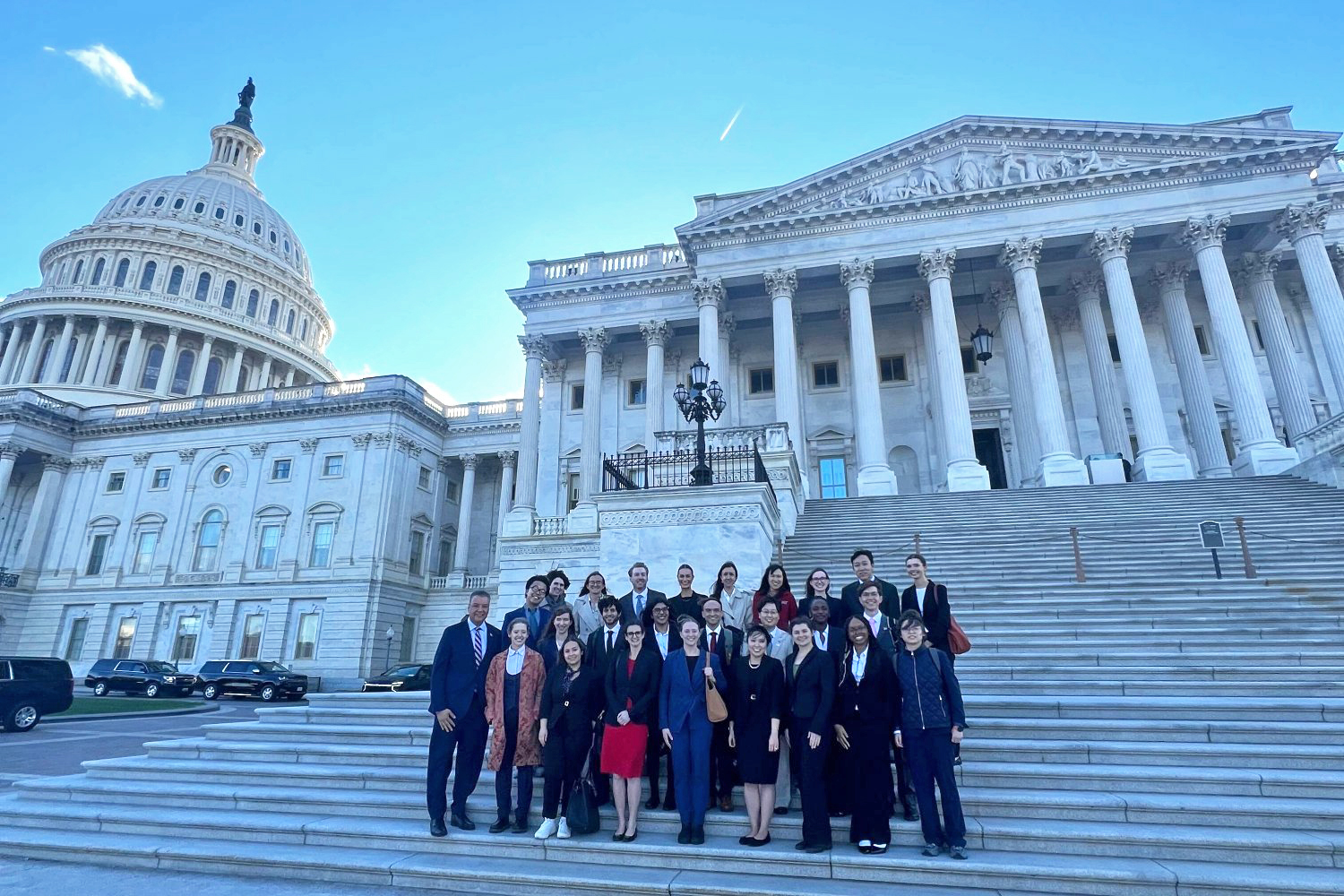
Connecting research to policy on Capitol Hill
MIT students and postdocs discussed science funding and research with policymakers in Washington during the MIT Science Policy Initiative’s annual Congressional Visit Days.
Related papers
Constitutional Midtraining: Content Presence Drives Alignment Gains
Post-training alignment is often shallow, eroding under fine-tuning. It remains untested as to whether constitutional midtraining interventions can produce durable alignment when cleanly isolated from post-training. We build a 394M-token constitutional corpus from Anthropic's Constitution and apply constitutional midtraining at 120B scale, where principled, values-based content is inserted into midtraining. A 2x2 design (curriculum ordering x deliberative reasoning) was used to produce four constitutionally midtrained conditions, plus a control, which were evaluated on self-generated and established benchmarks including alignment under pressure, value conflict resolution, blackmail, and emergent misalignment. All models were evaluated across three stages: post-midtraining, post-SFT, and post-benign fine-tuning. Constitutionally midtrained models outperformed the control on alignment generalization and durability, notably on blackmail: SFT instilled a blackmail propensity in all models, but constitutional midtraining blunted it, with the advantage surviving benign fine-tuning (-17.5pp). This durability did not extend to settings that required active resistance to in-context pressure or conflict, where the advantage attenuates after SFT. The presence of constitutional content at midtraining also mattered more than its structure, and constitutional midtraining incurred no capability cost, on average, at any stage (MMLU, ARC-Easy, piqa, GSM8K). A modest amount of constitutional content at midtraining could therefore yield broad, persistent alignment gains, offering a cheap, complementary addition to SFT-centered pipelines. Code, data, and models are available.
A comparative review of modern large language model paradigms: GPT-4, BERT, Gemini, and DeepSeek
Comparison of GPT-4, BERT (bidirectional encoder representations from transformers), Gemini, and DeepSeek large language models (LLM), focusing on architectures, training methodologies, and real-world applications reveals GPT-4 excels in natural language generation and complex reasoning, supporting up to 128K tokens with moderate latency and higher costs making it effective for conversational artificial intelligence (AI).
LLMs Leak Training Data Beyond Verbatim Memorization: Extraction via Membership Decoding
The Membership Decoding method is a plug-and-play replacement for standard decoding that requires only black-box token probabilities, and a new token-level membership inference method is proposed by leveraging likelihood from reference models, shifting the generation from the original token distribution to the member token distribution.
A Multiagent Large Language Model–Based System for Early-Stage Building Layout Planning
A multiagent large language model (LLM)–based system for early-stage building layout planning, which enables flexible design requirement inputs and robust spatial reasoning and demonstrated significant improvements in both geometric quality and semantic alignment over a baseline LLM-only system.