
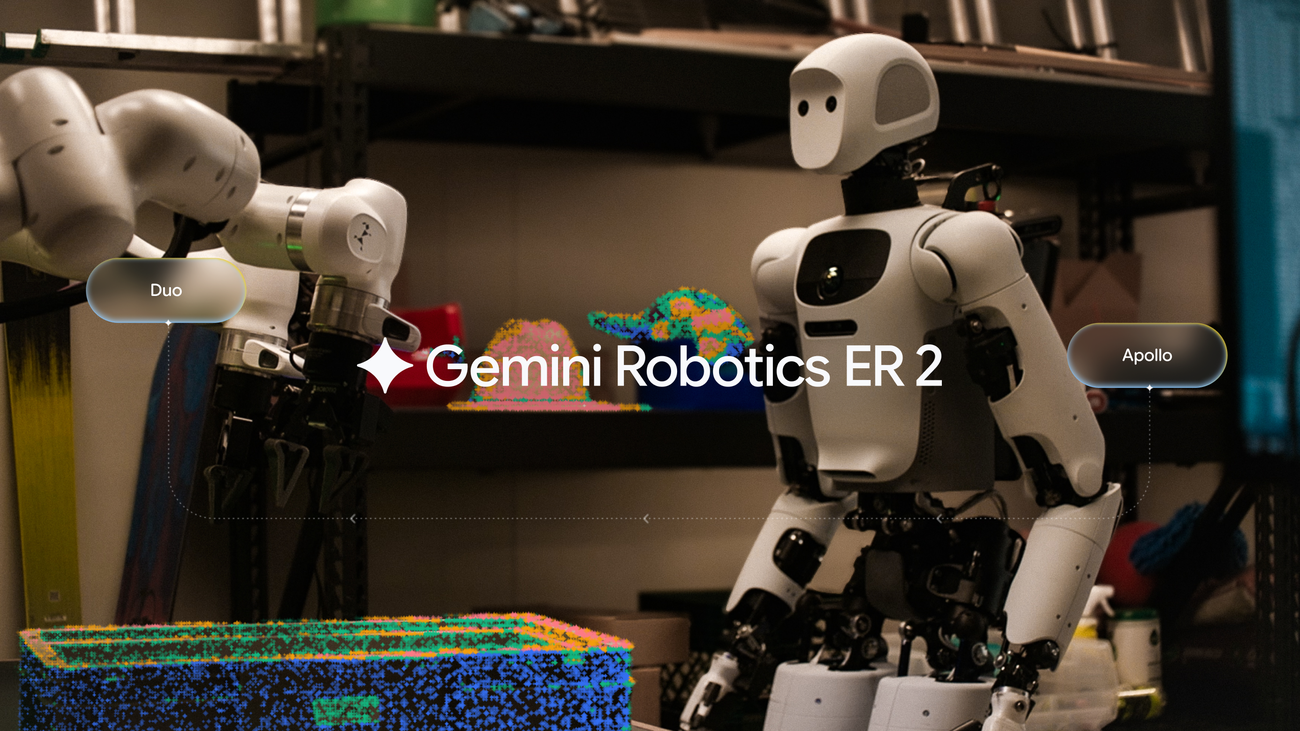
Gemini Robotics ER 2: powering robotics with video understanding, task orchestration, and multi-robot collaboration
Gemini Robotics ER 2 helps robots reason, collaborate, and solve real-world tasks. It represents a step change in video understanding, tool orchestration, and multi-robot collaboration for robotic applications.
More from the blog

ToyBlocks: A controlled world for robot learning and evaluation
A Blog post by Ai2 on Hugging Face
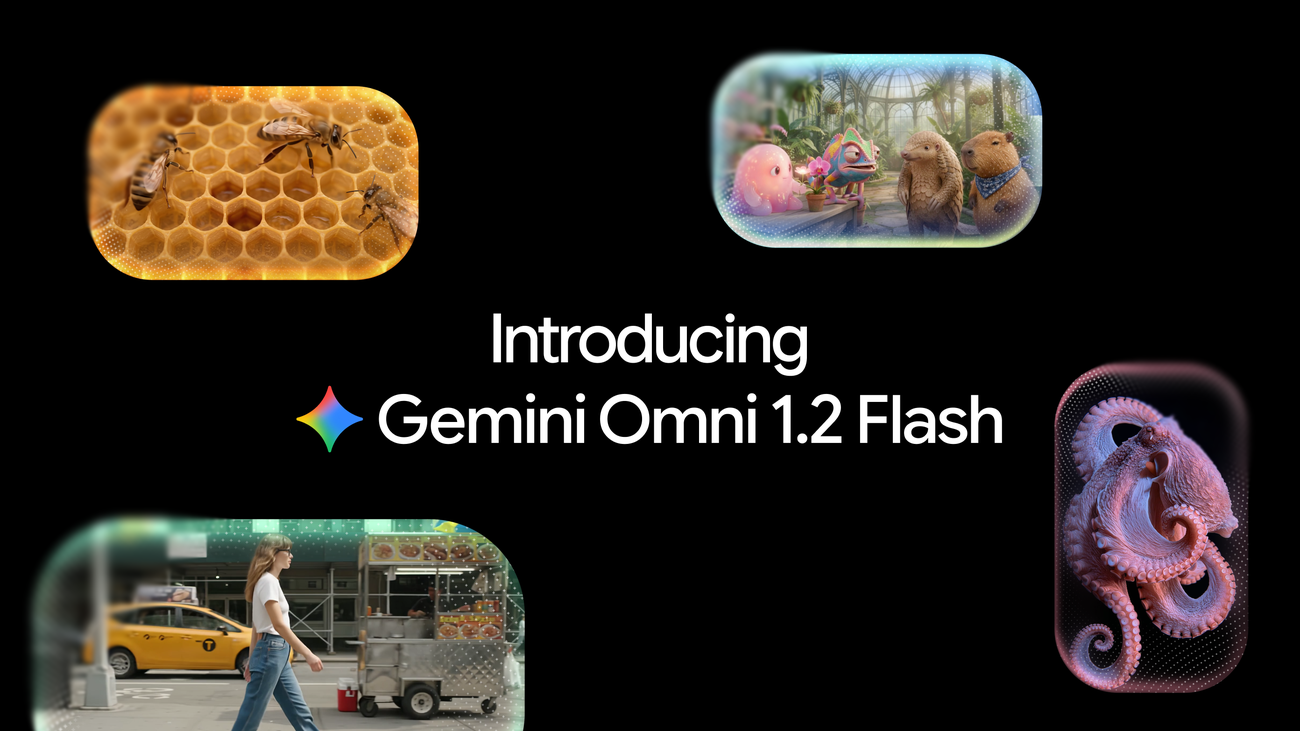
Gemini Omni 1.2 Flash: Fast and cost-effective with longer clips
Gemini Omni 1.2 Flash brings native 15-second video generation and editing, stronger consistency, and 30% lower pricing.

Clearing up a robot’s fuzzy memory
A new system identifies and corrects unreliable object descriptions stored in a robot’s memory, improving the robot’s ability to interact with its environment.

Learn the rules: The hacker mindset
Research Manager Mike Walker reflects on a career spanning hacker culture, cybersecurity, and AI, sharing lessons about trust, teamwork, leadership, and why solving difficult problems requires curiosity, judgment, agility—and an understanding of the rules. The post Learn the rules: The hacker mindset appeared first on Microsoft Research.
Related papers
Gibson Env: Real-World Perception for Embodied Agents
This paper investigates developing real-world perception for active agents, proposes Gibson Environment for this purpose, and showcases a set of perceptual tasks learned therein.
RMBench: Memory-Dependent Robotic Manipulation Benchmark with Insights into Policy Design
RMBench is introduced, a simulation benchmark comprising 9 manipulation tasks that span multiple levels of memory complexity, enabling systematic evaluation of policy memory capabilities and Mem-0, a modular manipulation policy with explicit memory components designed to support controlled ablation studies.
What Drives Success in Physical Planning with Joint-Embedding Predictive World Models?
This work characterize models from this family of methods as JEPA-WMs and investigates the technical choices that make algorithms from this class work, and proposes a model that outperforms two established baselines, DINO-WM and V-JEPA-2-AC, in both navigation and manipulation tasks.
StarVLA-α: Reducing Complexity in Vision-Language-Action Systems
This work introduces StarVLA-$\alpha, a simple yet strong baseline designed to study VLA design choices under controlled conditions that deliberately minimizes architectural and pipeline complexity to reduce experimental confounders and enable systematic analysis.