Learn the Hugging Face Kernel Hub in 5 Minutes
More from the blog
Looking beyond natural sequences
A new machine-learning framework aims to improve the success rate of computational protein design while moving away from results that reproduce sequences found in nature.
Generating scenarios for extreme events, without extreme data
A new algorithm learns to anticipate the unprecedented scenarios that critical infrastructure and global supply chains are least prepared for.
How Hugging Face Inference Endpoints, Jobs, and Buckets Power Search on Papers with Code
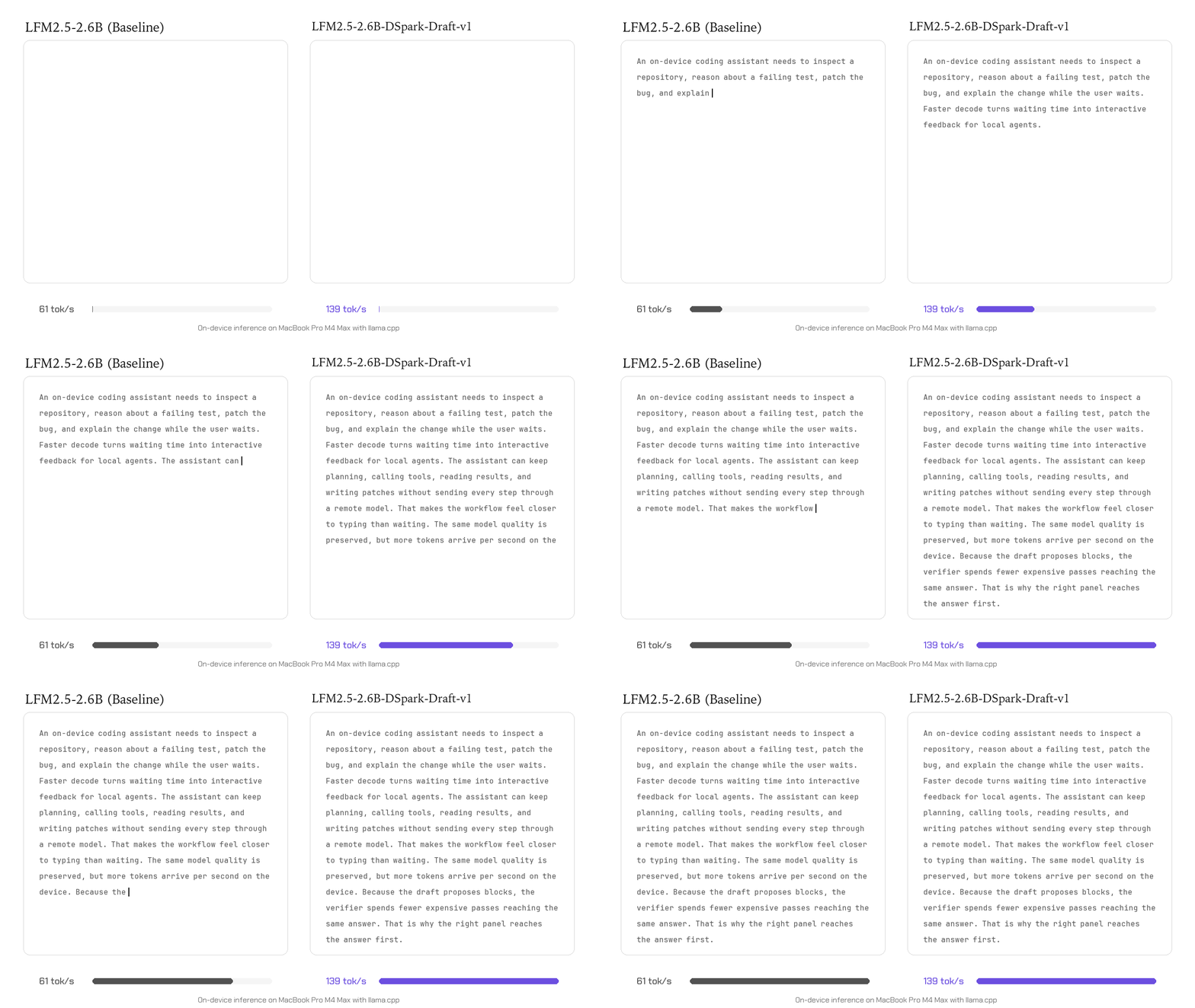
Up to 3.2x Faster Inference with LFM2.5-DSpark
A Blog post by Liquid AI on Hugging Face
Related papers
Intelligent agents: architectures, learning paradigms, deployment models, and applications
Anomaly detection method for satellite networks based on adaptive federated learning driven by deep reinforcement learning
Asynchronous Federated Reinforcement Learning for Adaptive Resource Slicing and Low-Latency Task Offloading in Heterogeneous 6G Edge Computing Networks
The emerging paradigm of 6G wireless communication networks envisions ultra-reliable low-latency communication (URLLC), massive machine-type communications (mMTC), and pervasive edge computing intelligence. In heterogeneous mobile edge computing (MEC) networks, dynamically offloading compute-intensive tasks (e.g., augmented reality rendering, connected vehicular telemetry, autonomous robotic control) while orchestrating multi-tenant network slicing under time-varying channel conditions is an NP-hard stochastic optimization problem. Centralized reinforcement learning algorithms suffer from extreme communication overhead, severe backhaul congestion, and severe privacy vulnerabilities. Conversely, standard synchronous Federated Learning (FL) methods encounter severe 'straggler effects' caused by heterogeneous edge device processing capabilities. In this paper, we propose AF-EdgeRL, a novel Byzantine-resilient Asynchronous Federated Reinforcement Learning framework tailored for distributed resource allocation and dynamic task offloading. AF-EdgeRL deploys a distributed Proximal Policy Optimization (PPO) agent across edge servers and end-user devices, combined with a Staleness-Aware Adaptive Weight Aggregator (SAWA) that dynamically adjusts model update gradients based on hardware compute latency and channel state information (CSI). Furthermore, we establish theoretical convergence guarantees under non-convex reinforcement learning objectives. Evaluated on a high-fidelity 6G MEC simulator with real-world mobile mobility traces (Telecom Italia Milano dataset), AF-EdgeRL reduces end-to-end task execution latency by 41.2%, achieves 99.999% URLLC deadline compliance, and decreases edge energy consumption by 32.6% compared to state-of-the-art synchronous FedRL and centralized DRL baselines.