Scaling robotics datasets with video encoding
More from the blog
GigaPath-Flash and GigaTIME-Flash: Toward population-scale discovery with efficient pathology foundation models
What if pathology foundation models could do more with less? GigaPath-Flash and GigaTIME-Flash cut computational demands while maintaining strong performance, opening the door to larger studies and broader exploration. The post GigaPath-Flash and GigaTIME-Flash: Toward population-scale discovery with efficient pathology foundation models appeared first on Microsoft Research.

When AI art has no author: Study finds generated images often can’t be traced to training data
A new method for surgically removing training examples from a model reveals that as datasets grow, the link between what a model learns and what it produces dissolves.
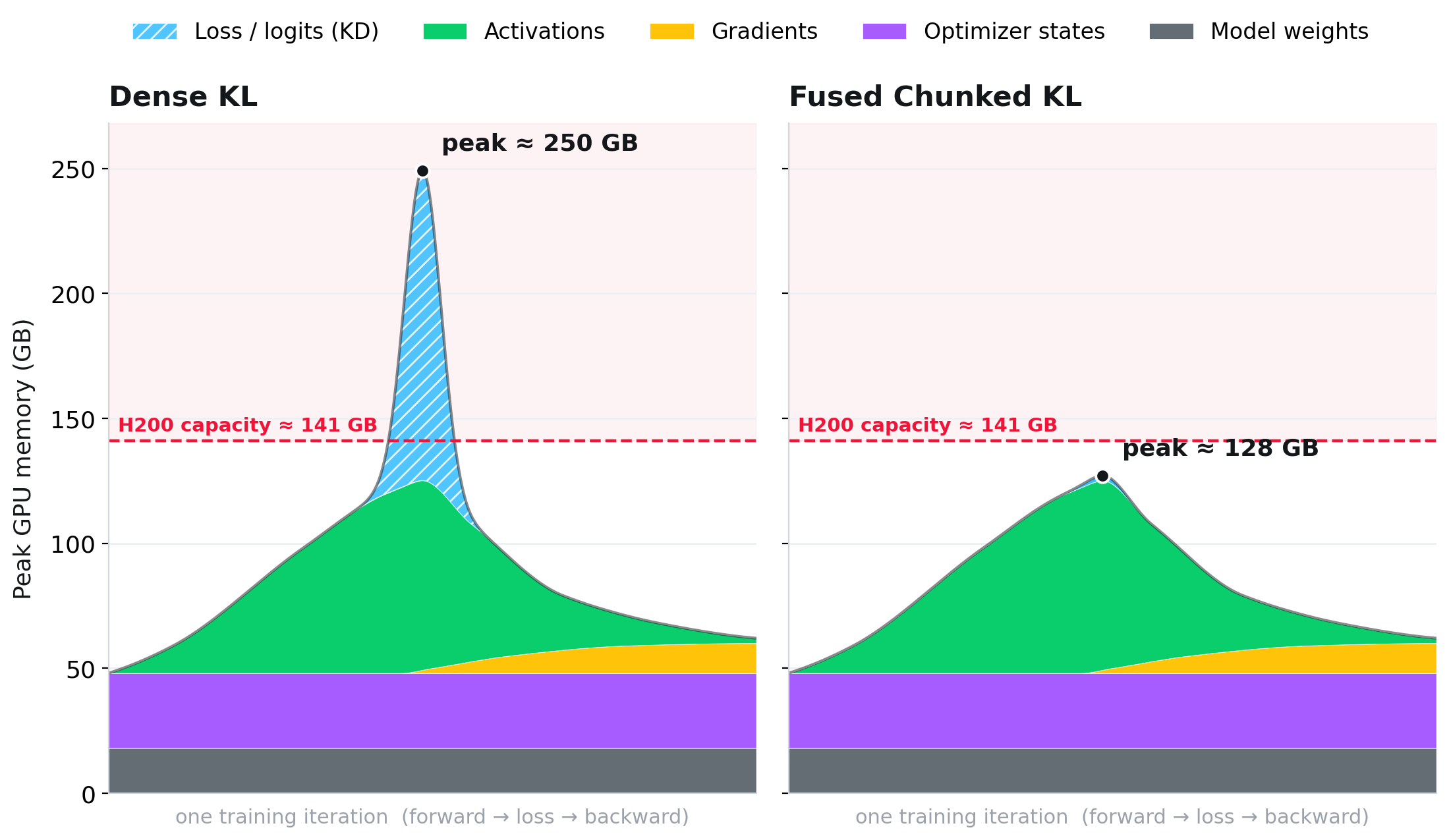
Making Knowledge Distillation Cheap Enough to Run at Scale
A Blog post by Multiverse Computing on Hugging Face

Daniela Rus receives Bavarian Minister-President's High-Tech Prize
Director of CSAIL and MIT professor honored for her contributions to robotics, artificial intelligence, and autonomous systems.
Related papers
Mask2Real-WM: Segmentation Masks as a Sim-to-Real Bridge for Controllable Dexterous World Models
Mask2Real-WM is presented, a two-stage action-conditioned world model for dexterous manipulation that decouples pixel prediction into a dynamics model and a rendering model that shows that mask conditioning and simulation pretraining are both required for per-DoF action controllability across all 23 degrees of freedom.
Planning-aligned Token Compression for Long-Context Autonomous Driving
This work proposes COMPACT-VA, a planning-aligned working memory framework built on conditional VQ-VAE, compressing extended context into bounded representations, and evaluates on high-signal dynamic scenarios where historical context is most critical for behavior correctness, and accordingly design behavioral metrics.
Online Learning-to-Defer with Varying Experts
Learning-to-Defer (L2D) methods route each query either to a predictive model or to external experts. Real-world deployments require handling streaming data, changing expert availability, shifting expert reliability, and feedback observed only for the selected action. We introduce an online multiclass L2D algorithm that combines queried-action bandit feedback with a dynamically varying pool of experts. Let $N=n+n_e$, let $B$ bound the Frobenius norm of the linear score matrix, and let $\rho$ bound the augmented input norm. Assuming linear calibration and zero surrogate minimizability gap for the projected comparator class, our method achieves expected true-deferral regret $O((BN^{3/2}\rho+1)T^{2/3})$, improving to $O(BN^{3/2}\rho\sqrt T+B^2N^3\rho^2)$ under a concentrated-score condition. The analysis combines an online $\mathcal H$-consistency transfer bound with projected online convex optimization. Experiments on synthetic and real-world datasets demonstrate selective routing under varying expert availability and reliability.
GigaBrain-WBC-0.5: A Behavior World Model for Robust Whole-Body Control with Environment Interaction
GigaBrain-WBC-0.5, the first Behavior World Model for humanoid whole-body control, is presented, which trains a causal Transformer to jointly predict its next action, next state, and the distribution over its next latent behavior command, so the network that acts also models how the environment shapes what it can do next.