Multimodal adaptation can weaken temporal reasoning (TR) in video-language models (VLMs) even when the visual evidence needed for an answer is correctly perceived. This weakened competence, however, remains partly recoverable from the model's paired pre-adaptation language checkpoint. We introduce MERIT, a gradient-fre...
Zihang Fu, Haonan Wang, Jian Kang et al.· 0 citations
Earth observation (EO) models are still built by hand. For each new task, experts design a training recipe and tune it against a benchmark. We show that this loop can be handed to an agent. Any verifiable task can be cast as a harness and a verifier, where the harness defines what the agent may use and the verifier def...
Sijie Zhao, Zeqi Zhou, Heli Qi et al.· 0 citations
With the rapid development of multimodal large language models (MLLMs), evaluating their video understanding capabilities has become increasingly important. Existing video understanding benchmarks cover only part of the evaluation dimensions, limiting systematic diagnosis of omni-modal video understanding. We introduce...
Xuyang Liu, Shihao Wang, Xinyu Wei et al.· 0 citations
Converting natural-language instructions into executable action plans conditioned on a scene image is a core capability for embodied human-robot interaction, but existing benchmarks target English, simulated or video-grounded environments, and largely assume instructions are clear and executable. We introduce the first...
Abdollah Pourasghari, Saeedeh Sadat Sadidpour, Mohammad Roustaei· 0 citations
Reach audiences
Advertise in front of researchers, engineers, and readers.
We introduce OpenMobile-2, a near-frontier mobile agent with fully open training environments and recipes. We make three key advances: (1) Diverse environments with simulated commercial apps: We build MobileGym++, featuring 35 realistic, functionally rich commercial-style apps with cross-app workflows, while preserving...
Chen-Yang Yan, Ying-Ying Zhang, Kanzhi Cheng et al.· 0 citations
In manga translation, visual context outside speech-bubble text, including speaker identities, referents, and scene tone, is depicted in page images, making it natural to refer to images during translation evaluation. However, most conventional manga translation evaluations rely solely on text-only automatic metrics, l...
Visual contrastive decoding corrects answers using the prediction difference between the original image and a reference condition, yet the same contrast also turns supported abstentions into incorrect answers. We find that abstentions are lost at two stages: contrastive decoding with candidate filtering can exclude the...
Haonan Zhang, Ting Jin, Wenzhong Tang et al.· 0 citations
Large Vision-Language Models (LVLMs) have achieved remarkable progress across a wide range of multimodal tasks. However, object hallucination remains a persistent challenge, undermining model reliability in applications such as visual question answering, embodied agents, and human-AI decision support systems. In this p...
Xinhao Wang, Junbo Cui, Zhenghao Liu et al.· 0 citations
Recent years have witnessed an explosive trend of scaling ego-centric human videos for robot manipulation, yet it remains unclear which data actually benefits dexterous manipulation. We present SiMDex, a similarity-based data mining framework that casts human data selection for VLA post-training in dexterous manipulati...
Nie Lin, Takehiko Ohkawa, Sijin Chen et al.· 0 citations
Deep neural networks (DNNs) frequently fail to generalize to out-of-distribution (OOD) medical images because of variations in scanners and acquisition protocols. Retraining DNN models to address these distribution shifts is often impractical due to the high cost of acquiring and annotating new medical datasets. To add...
Vision-Language Models (VLMs) such as CLIP have become a standard backbone for open-vocabulary recognition, yet their zero-shot predictions remain vulnerable to distribution shifts encountered at deployment. Test-Time Adaptation (TTA) has recently been extended to CLIP as a lightweight solution, leading to a rapidly gr...
Jiazhen Huang, Xiao Chen, Zhiming Liu et al.· 0 citations
This work proposes Retention-aware Policy Optimization (RaPO), a simple yet effective RFT method that mitigates forgetting through trajectory-level reward shaping, and comprehensively evaluates RaPO across five visual continual learning settings.
Exploring how generative AI could make machine vision more accessible to businesses. The post GenEye in a Box: Making Machine Vision Something You Can Just Ask For appeared first on GPT-Lab.
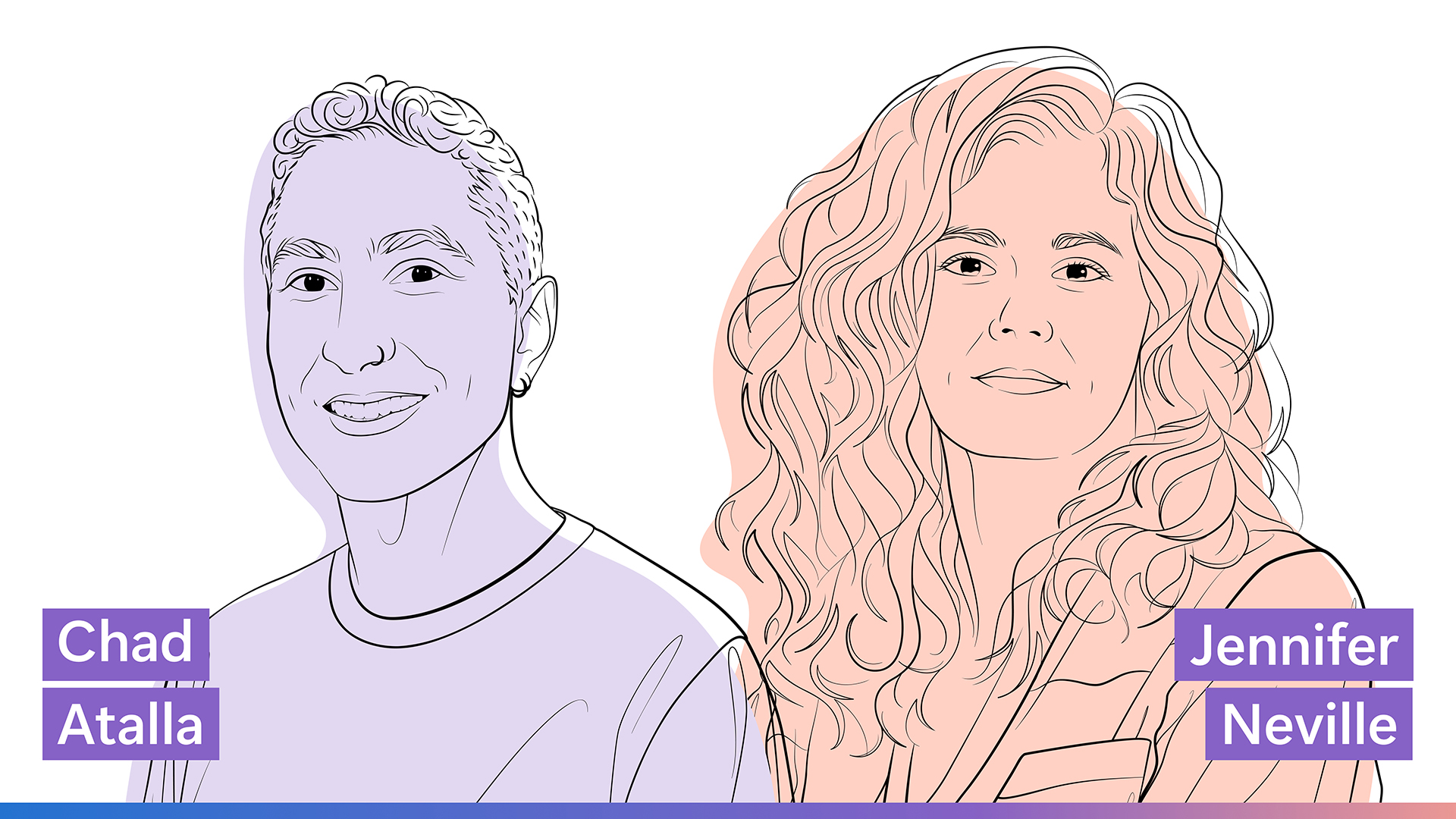
Jennifer Neville did not want to go into computer science—but that’s exactly where she landed. Neville discusses the starts and stops that led to her professional sweet spot and her work identifying “surprising failures” making it hard for AI to handle complexity. The post What AI gets wrong and what failure teaches us appeared first on Microsoft Research.
Computer scientist, entrepreneur, and philanthropist will collaborate with the MIT Schwarzman College of Computing to advance AI and scientific discovery.