Autism spectrum disorder (ASD) is diagnosed through specialist observation of a child's social behavior, and access to that expertise is the bottleneck for early identification. Vision-language models (VLMs) describe a child's behavior from video well; the verdict drawn from the description is unstable: at temperature~...
Wenqi Li, Mindi Ruan, Chuanbo Hu et al.· 0 citations
Modern image editing models can satisfy a text instruction while breaking the physics of the edited scene. A new object may cast no shadow, a mirror may fail to reflect visible geometry, or an object may float above a surface that should support it. We study physical plausibility diagnosis, detecting whether an edited...
M. Esfahani, S. Salem, Mohammed Alser et al.· 0 citations
Modern language model systems operate autonomously over increasingly long contexts containing untrusted text and images. Can an adversarial input continue to steer a model even after that input is removed from its context? We show that attacks can be trained to persist through the key/value (KV) cache of subsequent tok...
David Dobre, Leo Schwinn, Gauthier Gidel et al.· 0 citations
This formulation reduces per-user adaptation to optimizing a low-dimensional weight vector, simplifying optimization and enabling data-efficient personalization from sparse feedback and improves the alignment of generated images with individual user preferences.
Jiamu Bai, Jia-Ming Hu, Yan-Hong Wu et al.· 0 citations
Reach audiences
Advertise in front of researchers, engineers, and readers.
Video large language models (Vid-LLMs) excel at diverse video-language tasks by reasoning over selected frames. However, frame selection for long videos remains challenging, as it requires retrieving relevant frames distributed across segments from a large candidate pool given complex queries. This paper investigates d...
Yiyang Huang, Yi-Tian Zhang, Yi-Zhou Wang et al.· 0 citations
SlideRuler is introduced, which uses regions within a slide as internal controls to estimate and correct acquisition-induced shifts in other regions to offer a path toward more consistent use of frozen pathology models across imaging systems.
Glioblastoma (GBM), an aggressive primary brain tumor, is routinely monitored with longitudinal MRI after treatment. Distinguishing stable disease (SD), pseudoprogression (PsP), and true progression (TP) remains challenging because these states can show overlapping MRI appearances despite different temporal trajectorie...
Wen-Hao Guo, Chang-Chang Yin, P. Giglio et al.· 0 citations
The findings highlight that deep learning-based longitudinal imaging analysis remains a promising field, though newer temporal architectures and larger datasets may improve success and clinical adoption of these tools.
Autonomous driving has made remarkable progress, with recent AI advances enabling commercial deployments that are reshaping urban mobility. Yet the field remains far from its universal social promise: autonomous systems that can operate robustly anywhere, anytime, for anyone. We posit that this gap is not merely a mode...
Jinsu Yoo, Zanming Huang, Katie Z Luo et al.· 0 citations
X-ray image-based Radiology Report Generation (RRG) constitutes a critical research direction within medical artificial intelligence, with great potential to alleviate clinicians'diagnostic workload and shorten patient waiting periods. Despite substantial advances over recent years, the field faces evident bottlenecks...
Xiao Wang, Yu-Xiang Zhang, Dan Xu et al.· 0 citations
Joint spatial-geometric and analytic function reasoning requires translating a perceived spatial configuration into a symbolic function whose executed curve satisfies geometric constraints. We present GAGR-Lab, a framework for measuring this capability through Cartesian game scenes, explicit function semantics, and aut...
Dataset distillation (DD) aims to compress large-scale datasets into compact synthetic sets while preserving training efficacy. However, existing studies mainly focus on image classification, leaving dense prediction tasks such as semantic segmentation largely underexplored. In this work, we identify three key challeng...
Wenjie Zheng, Haoji Hu, Jiali Lu et al.· 0 citations
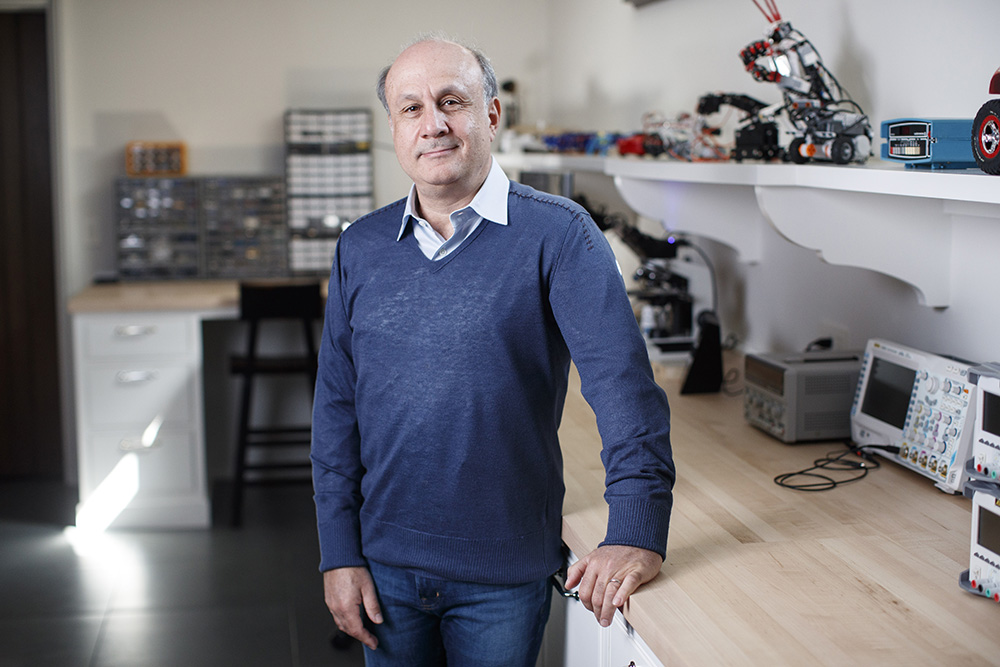
Professor Paris Smaragdis develops computers with superhuman hearing for applications like speech recognition, music understanding, and environmental monitoring.
Exploring how generative AI could make machine vision more accessible to businesses. The post GenEye in a Box: Making Machine Vision Something You Can Just Ask For appeared first on GPT-Lab.
Jennifer Neville did not want to go into computer science—but that’s exactly where she landed. Neville discusses the starts and stops that led to her professional sweet spot and her work identifying “surprising failures” making it hard for AI to handle complexity. The post What AI gets wrong and what failure teaches us appeared first on Microsoft Research.
Computer scientist, entrepreneur, and philanthropist will collaborate with the MIT Schwarzman College of Computing to advance AI and scientific discovery.
We use cookies to run the site and, with your consent, for analytics and to show ads.
See our Cookie Policy.