Temporally aware image representations are crucial for capturing disease progression in 3D volumes of longitudinal medical datasets. However, recent state-of-the-art self-supervised learning approaches like Masked Autoencoding (MAE), despite their strong representation learning capabilities, lack temporal awareness. In...
Taha Emre, Arunava Chakravarty, Thomas Pinetz et al.· 0 citations
Fine-tuning has become the dominant paradigm for adapting Vision-Language Models (VLMs), yet most approaches rely on explicit weight updates that introduce a fundamental trade-off. Full Fine-Tuning (FFT) may perturb pretrained representations due to cross-modal gradient interference, whereas Parameter-Efficient Fine-Tu...
Mingyuan Zhang, Yue Bai, Yifan Wang et al.· 0 citations
We study path-flow alignment as a unified training objective for flow matching. Instead of fixing the interpolation path and learning only the velocity field, we jointly train an endpoint-preserving path network and a flow network using the same alignment loss: the flow learns to match the path velocity, and the path l...
Zeyu Michael Li, William Xingxu Chen, Xiang Cheng· 0 citations
Skin cancer is a major global health concern, and early detection and accurate lesion delineation are important for effective diagnosis and treatment planning. Automated skin lesion analysis can assist dermatologists, with lesion segmentation serving as a fundamental step in computer-aided diagnostic systems. Conventio...
A. Pal, Ganesh Patidar, Bikash Santra· 0 citations
Reach audiences
Advertise in front of researchers, engineers, and readers.
Streaming video-language models must decide not only what to answer, but whether the evidence needed for the current question has arrived. Existing systems learn that decision as a separate trigger; we ask whether an unmodified model already computes it. We show that frozen VideoLLMs carry a linearly readable evidence-...
Geometric alignment scores based on Gram determinants provide a compact way to model higher-order consistency among modalities, yet how such scores respond to modality degradation is poorly understood. This paper asks whether the response of a multimodal geometric score is determined primarily by the magnitude of the p...
Yongsheng Luo, Wengan He, Yu Li et al.· 0 citations
Recent training-free pruning approaches for Multimodal Large Language Models (MLLMs) effectively cut computational overhead by exploiting visual redundancy or text-vision attention. However, they frequently suffer from semantic degradation due to their task-agnostic design or unreliable attention estimates. Based on ou...
Shuo Yang, Chang-Bai Li, Lin-Lin Yang et al.· 0 citations
Machine learning classifiers for remote sensing imagery are typically evaluated as though every pixel were an independent sample. Spatial autocorrelation violates this assumption, since neighboring pixels carry redundant information which inflates sample sizes. How many independent samples does a satellite image actual...
In digital pathology, compact evidence is often used to explain or audit predictions made by whole-slide image multiple instance learning models. In hierarchical compact-evidence pipelines, candidate filtering introduces a strategy-specific candidate-conditioned prediction alongside the original full-bag prediction. If...
Hyun Do Jung, Jungwon Choi, Soojung Choi et al.· 0 citations
Multi-reference image generation requires preserving the appearance of multiple subjects while composing them into a coherent scene. However, existing diffusion transformers commonly encode references as dense visual token grids and jointly process them with global attention, making conditioning increasingly expensive...
We propose a scalable roto-reflection-group-equivariant vision transformer based on windowed group-convolutional self-attention and a hierarchical feature architecture. We demonstrate that our approach can be scaled to group-equivariant vision transformers (ViTs) with millions of parameters and large datasets with prac...
Sheir A. Zaheer, Jihwan Moon, Chan Y. Park· 0 citations
Cassini synthetic aperture radar (SAR) images reveal the dunes, plains, and lake basins of Titan, providing an instance of representations learned from Earth imagery for planetary terrain classification. Cross-domain Evaluation of Earth-to-Titan Transfer Using SAR (CETUS) compares features from DINOv2, DOFA and CROMA w...
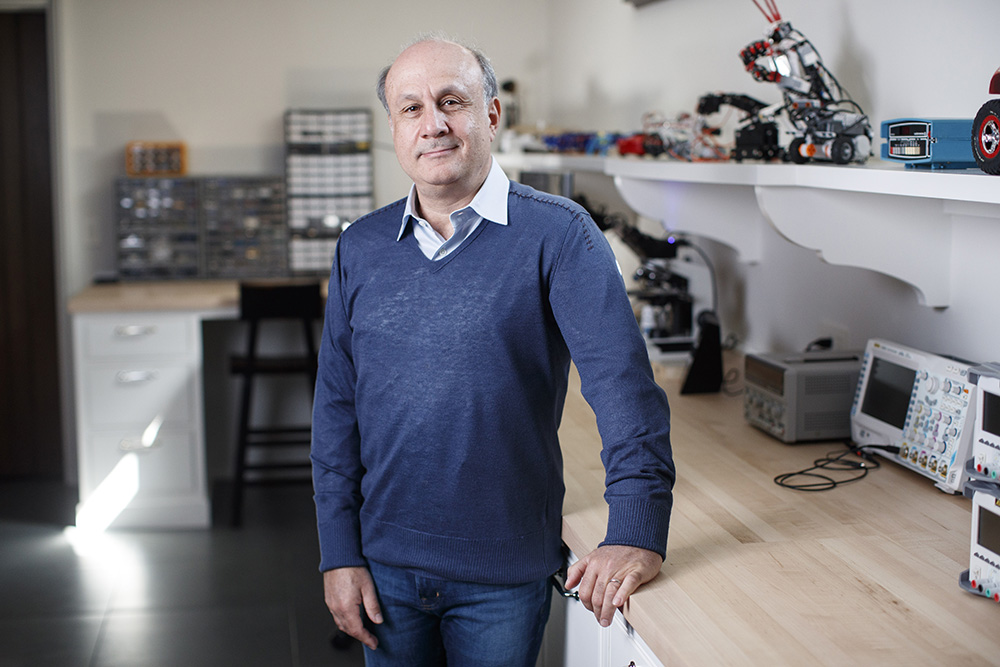
Professor Paris Smaragdis develops computers with superhuman hearing for applications like speech recognition, music understanding, and environmental monitoring.
Exploring how generative AI could make machine vision more accessible to businesses. The post GenEye in a Box: Making Machine Vision Something You Can Just Ask For appeared first on GPT-Lab.
Jennifer Neville did not want to go into computer science—but that’s exactly where she landed. Neville discusses the starts and stops that led to her professional sweet spot and her work identifying “surprising failures” making it hard for AI to handle complexity. The post What AI gets wrong and what failure teaches us appeared first on Microsoft Research.
Computer scientist, entrepreneur, and philanthropist will collaborate with the MIT Schwarzman College of Computing to advance AI and scientific discovery.
We use cookies to run the site and, with your consent, for analytics and to show ads.
See our Cookie Policy.