Peer stories have been shown to boost self-efficacy in older adults'health behavior change. Despite their effectiveness, peer stories are difficult to deploy in health promotion at scale given the difficulty of matching the diverse health concerns and coping styles of heterogeneous older populations. Large language mod...
Kexin Quan, Precious Olalere, Smit Desai et al.· 0 citations
PAIR, a theory-based emotion-regulation companion, was deployed with 19 participants for 14 days and linked memory updates and retained corrections to cross-session personalization, informing future emotional support tools that adapt to evolving needs, learn from prior outcomes, and preserve user control over memory.
Kexin Quan, Zi-Jian Ding, Jia-Ye Yong et al.· 0 citations
This paper argues for making the IxTs themselves more intelligent, so users can freely mix modalities, even within the same interaction, and also into the infrastructure that will enable these intelligent IxTs (IIxTs) to be built.
The results demonstrate the feasibility of a stateful contactless sensing-to-action architecture for long-term home health monitoring and integrates sensing, temporal state, reasoning, and action into a unified and auditable loop.
Xu-Wen Zhang, Zi-Jian Lu, Yi-Cheng Lei et al.· 0 citations
Reach audiences
Advertise in front of researchers, engineers, and readers.
A tension between hallucination avoidance and user satisfaction is revealed and the importance of designing balanced refusal strategies is highlighted, to highlight the importance of designing balanced refusal strategies.
Mahjabin Nahar, Eun-Ju Lee, Yujin Heo et al.· 0 citations
A semi-structured interview study with 15 responsible data scientists and AI practitioners is presented to understand the moral decision-making procedures they use to articulate and actualize their moral missions and to call for subversive data science communities and identifying sociotechnical design implications to b...
Teanna Barrett, B. Biira, Jainaba Jawara et al.· 0 citations
As LLM conversations grow, their histories capture alternative directions, decisions, and evolving lines of thought that can be difficult to navigate through chat alone. We investigate an interaction concept that represents the same conversation through two synchronized views: a familiar linear chat for ongoing dialogu...
Voice cloning is often evaluated in terms of overall quality, but less is known about accent preservation and its perceptual consequences. We compare standard and heavily accented Mandarin speech and their voice clones using a combined computational and perceptual design. Embedding-based analyses showed larger original...
Tianle Yang, Chengzhe Sun, Phil Rose et al.· 0 citations
This work examines how large language models reason about misconceptions when generating distractor answers for multiple-choice questions (MCQs) and introduces a taxonomy over reasoning strategies for distractor generation that is grounded in learning-science literature and empirical observation.
Yanick Zengaffinen, Andreas Opedal, Donya Rooein et al.· arXiv.org· 2 citations
Multi-agent systems (MAS) are emerging as promising socio-collaborative companions for emotional and cognitive support. However, existing systems frequently suffer from persona collapse, where agents revert to generic, homogenized assistant behaviors, and social sycophancy, where agents produce redundant, non-construct...
Yiyang Wang, Yiqiao Jin, Alex Cabral et al.· 0 citations
CareMirror is built, an envisioned caregiver wellbeing ecosystem with interconnected caregiver- and clinician-facing interfaces for longitudinal reflection, personalized support, and caregiver-controlled sharing with clinical care.
J. Shi, Ethan D. Nguyen, Drishti Goel et al.· 0 citations
AI companions can provide meaningful relationships, yet these relationships remain vulnerable to platform-initiated changes. We study AI companion disruptions: platform changes that alter or terminate users' ongoing companionship with an AI. We compile 30 disruption events across major platforms, develop a taxonomy of...
Chau Do, Yunhao Yuan, Koustuv Saha et al.· 0 citations
AI agents can generate code at a scale that’s hard for humans to review line-by-line. PDD Kit helps ensure the code is doing what the developer intended by creating formal specifications and testing against them. It converts developer intent into a Verus specification, proves AI-generated code meets it for every input, and uses tests where proofs aren't practical. Developers review intent, not every line. The post Formally verifying agent-written full-stack web apps with PDD Kit appeared first o…
Professor Paris Smaragdis develops computers with superhuman hearing for applications like speech recognition, music understanding, and environmental monitoring.
MIT News · Artificial Intelligence· news.mit.eduOct 23, 2026
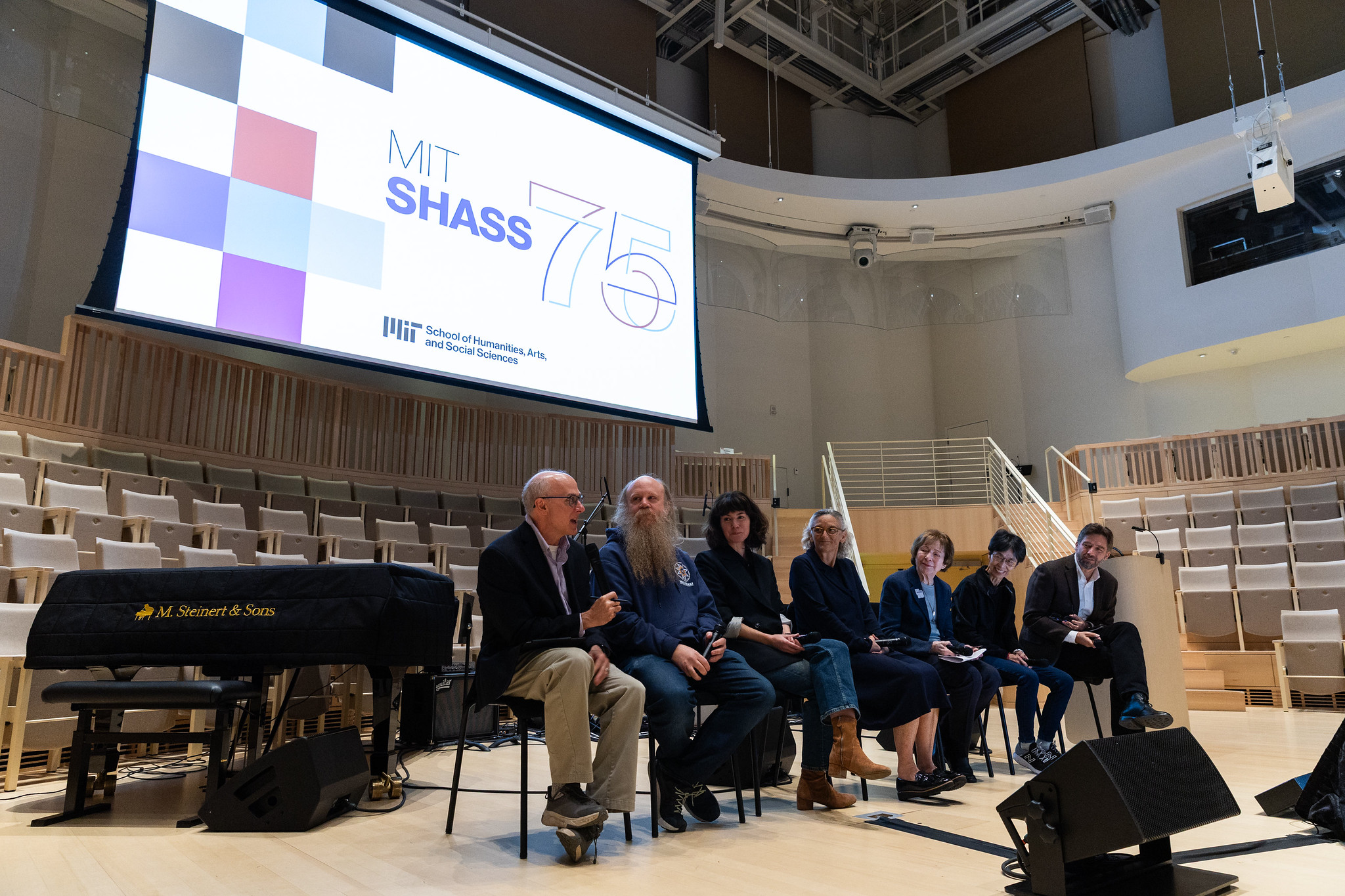
During the School of Humanities, Arts, and Social Sciences’ 75th Anniversary Symposium, President Sally Kornbluth said “MIT has never needed your particular insight and guidance more than we do now.”
MIT News · Artificial Intelligence· news.mit.eduOct 23, 2026
Assistant Professor Benjamin Lindquist studies how engineers deliberately injected randomness into early AI, giving rise to deep-learning models that sometimes hallucinate.
MIT News · Artificial Intelligence· news.mit.eduOct 22, 2026
“X-Hinges” helps design and 3D print items like lamps and gloves with an interactive twist: automatically embedded sensors that perceive and adaptively respond to human contact.
We use cookies to run the site and, with your consent, for analytics and to show ads.
See our Cookie Policy.