A language model can resolve a writer's current organizing problem while the construction needed for her own resolution remains unfinished. I call this early epistemic settlement. The supplied organization meets every demand then governing the passage, yet proceeding from it can displace work through which the writer w...
RushTok is examined as an event-based algorithmic community: a collective assembled around a bounded offline ritual and sustained by recommendation that outlines implications for platform governance, including time-bounded context, graduated visibility, and aftercare.
MonoTM is introduced, an interpretable topic modeling framework that preserves global topic structure while representing topics with semantic units more meaningful than individual words, making them more useful for downstream corpus analysis.
This piece bridges the gap between observing technological transformation and critically assessing the constitutive role of law within it, offering a conceptual resource for researchers, students, policymakers, and practitioners navigating and contesting this evolving landscape.
Mauricio Figueroa· International Handbook of Le...· 0 citations
Reach audiences
Advertise in front of researchers, engineers, and readers.
TimeCues Studio is an open-source workspace where algorithm-development teams annotate a music corpus, compare detection algorithms against those annotations, and prototype new ones.
This work introduces striving co-creation, a process for inferring broader life goals from unstructured observations of computer use and supports an editing interface that gives people agency over how they are understood by the system, feeding their corrections back into subsequent rounds of striving induction.
Shardul Sapkota, Matthew Jörke, Zane Sabbagh et al.· arXiv.org· 0 citations
Artificial intelligence is increasingly embedded in human decision-making, yet distinguishing systems that genuinely amplify human cognition from those promoting excessive dependence remains underdefined. This paper introduces a framework to distinguish cognitive amplification (improving hybrid performance without degr...
Interactive narrative (IN) authors craft spaces of divergent narrative possibilities for players to explore, with the player's input determining which narrative possibilities they actually experience. Generative AI can enable new forms of IN by improvisationally expanding on pre-authored content in response to open-end...
Yi Wang, John Joon Young Chung, Melissa Roemmele et al.· 2 citations
We propose MADS (Multi-Agent Dialogue Simulation), a scalable framework for generating persuasive multi-turn dialogues via agent self-play. MADS employs three coordinated agents: User Agents designed to simulate diverse persona-driven behaviors by leveraging personality signifiers such as Zodiac Signs and MBTI types, a...
A design framework for intent-evidence-action alignment is contributed: intent is articulated into a shared project record, judgments are anchored to grounded evidence, and authorized decisions are converted into clear revision tasks tied directly to reference notes.
Shih-Yu Lai, Wen-Fan Wang, Sai Ling et al.· 0 citations
Pairit is an online platform that facilitates the design, testing, and deployment of experiments that test human-AI organizational designs and interventions, and provides reusable infrastructure for specifying, deploying, and sharing live human-AI organizational experiments.
This work aims to advance the development of socially desirable embodied agents in open-domain environments by extending the concept of proactive assistance to Social Proactive Intelligence (SPI), characterized by diverse scenarios, social understanding, and robot-centric behaviors.
Kuo-Fei Fang, Zheng Lian, Xin-Yi Che et al.· 3 citations
AI agents can generate code at a scale that’s hard for humans to review line-by-line. PDD Kit helps ensure the code is doing what the developer intended by creating formal specifications and testing against them. It converts developer intent into a Verus specification, proves AI-generated code meets it for every input, and uses tests where proofs aren't practical. Developers review intent, not every line. The post Formally verifying agent-written full-stack web apps with PDD Kit appeared first o…
Professor Paris Smaragdis develops computers with superhuman hearing for applications like speech recognition, music understanding, and environmental monitoring.
MIT News · Artificial Intelligence· news.mit.eduOct 23, 2026
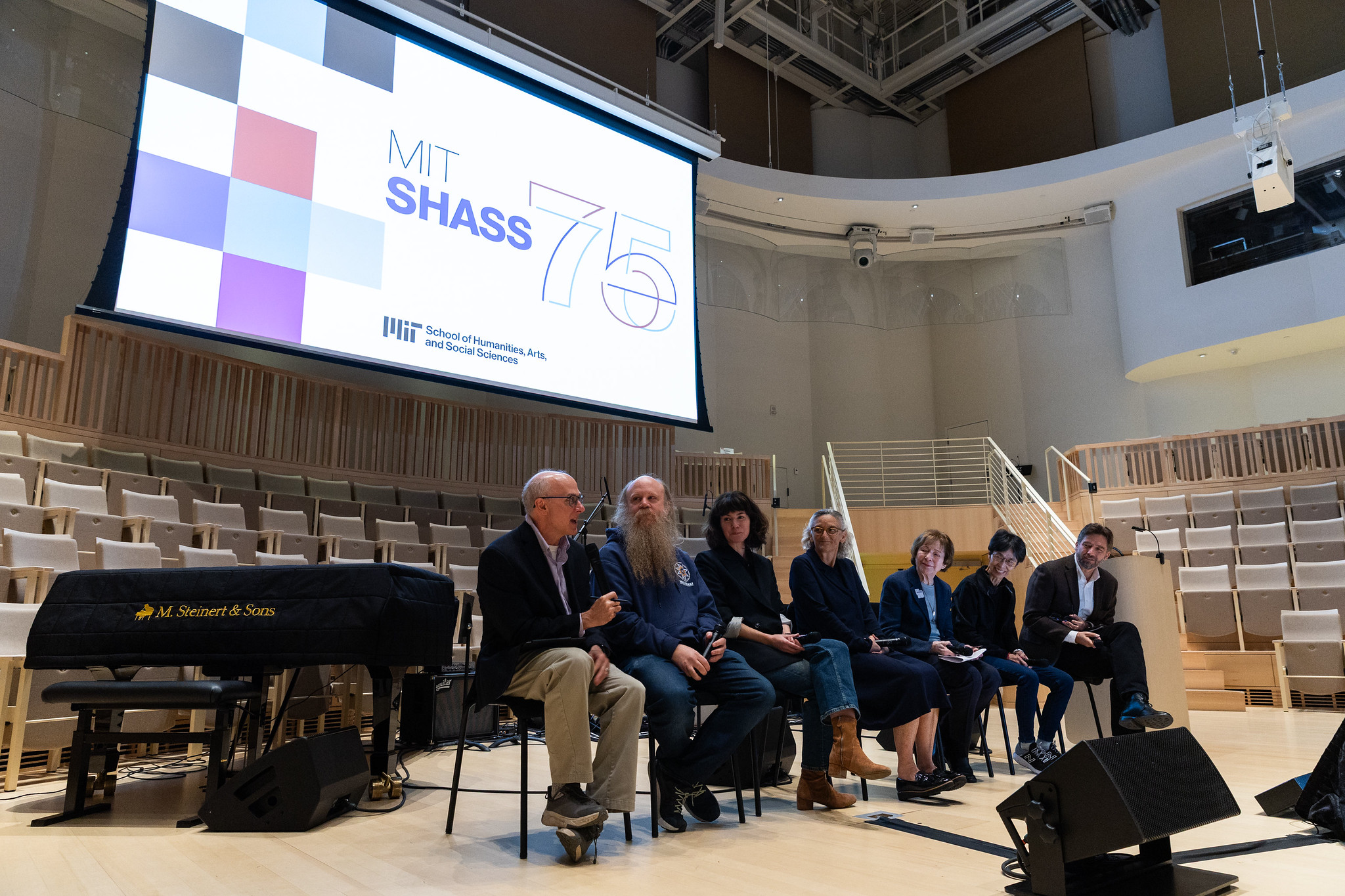
During the School of Humanities, Arts, and Social Sciences’ 75th Anniversary Symposium, President Sally Kornbluth said “MIT has never needed your particular insight and guidance more than we do now.”
MIT News · Artificial Intelligence· news.mit.eduOct 23, 2026
Assistant Professor Benjamin Lindquist studies how engineers deliberately injected randomness into early AI, giving rise to deep-learning models that sometimes hallucinate.
MIT News · Artificial Intelligence· news.mit.eduOct 22, 2026
“X-Hinges” helps design and 3D print items like lamps and gloves with an interactive twist: automatically embedded sensors that perceive and adaptively respond to human contact.
We use cookies to run the site and, with your consent, for analytics and to show ads.
See our Cookie Policy.