As AI and data-driven systems pervade practice, there is an imperative for instructors to embed societal impact and ethics content into computing courses. In response, we present the Human-Centered Education for Learning in Information and eXplainable Computing (HELIX) framework for information science programs, organi...
Victoria Chui, Kelly McConvey, Daniel Chui et al.· 0 citations
As smartphones become integral to daily life, researchers have sought to identify when the use becomes problematic. Previous studies have operationalized problematic smartphone usage (PSU) from either an intention or a behavior perspective. Both risk delivering interventions not welcomed by users. We propose a novel ap...
Preliminary evidence is provided that use of purpose-built AI may be associated with positive symptom-based and utilization outcomes for those managing co-occurring mental and physical concerns.
Kristen M. Van Swearingen, Thomas D. Hull, J. Swigert et al.· 0 citations
This study conducted a study with a professional percussionist, co-developing a gesture mapping toolkit and recording a ten-track album, which supported the development of a continuous gesture recognition method for percussive mapping and surfaced insights into the design process.
Jordie Shier, Teresa Pelinski, C. Saitis et al.· 0 citations
Reach audiences
Advertise in front of researchers, engineers, and readers.
This paper takes a critical approach to visualization of colonial regimes. Drawing on critical hermeneutics and postcolonial theory, we created interactive visu- alizations revealing the constructed nature of colonial categories and exposing the hierarchies between empires and territories. Using the Varieties of Politi...
Nicole Husemann, Steffen Kailitz, C. Meinecke· 0 citations
The adaptation of a rhythm-based interface, originally designed for manual dexterity rehabilitation, for use in speech therapy is found to improve motivation and therapeutic outcomes by facilitating more interactions between verbally challenged patients and the therapist.
Based on findings, authoring environments should consider the context of scientific work aspects such as domain expertise, collaboration culture, and publication traditions, and examine ways of meaningfully integrating AI.
Caroline Berger, Josh Pollock, Dylan Wooton et al.· 0 citations
Smart textiles embed interactivity into everyday garments, supporting use cases like always-available sensing for medical applications or sports. Machine embroidery allows integrating functionalities into existing textiles. However, embroidering onto real-world textile goods remains challenging. Textile goods are rarel...
This work introduces a multidimensional design space of representational fidelity for didactic visualization in science&engineering, inductively derived from a 175-item corpus spanning several disciplines, modalities, and instructional aims.
Shehryar Saharan, Michele Oliver, Karen Gordon et al.· 0 citations
In this self-selected convenience sample, AI-chatbot-associated harms were frequently described in relation to delusional beliefs, perceived chatbot validation, intensive use, and substantial social, occupational, and clinical consequences.
H. Morrin, Vinitha Soundararajan, Thomas Cheliotis-James et al.· 0 citations
As geopolitical tensions, energy crises, and energy-intensive AI infrastructure intensify concerns about demand, affordability, and resilience, communities increasingly encounter these challenges through everyday energy practices, particularly winter heating. Against this background, the doctoral expos\'e,"Designing Hu...
These findings suggest that, in this setting, LLMs function less as human co-authors and more as adaptive narrative amplifiers that reshape how agency is distributed in collaborative writing.
Halfdan Nordahl Fundal, Yuri Bizzoni, Charlotte Gjørup Bilde et al.· 0 citations
AI agents can generate code at a scale that’s hard for humans to review line-by-line. PDD Kit helps ensure the code is doing what the developer intended by creating formal specifications and testing against them. It converts developer intent into a Verus specification, proves AI-generated code meets it for every input, and uses tests where proofs aren't practical. Developers review intent, not every line. The post Formally verifying agent-written full-stack web apps with PDD Kit appeared first o…
Professor Paris Smaragdis develops computers with superhuman hearing for applications like speech recognition, music understanding, and environmental monitoring.
MIT News · Artificial Intelligence· news.mit.eduOct 23, 2026
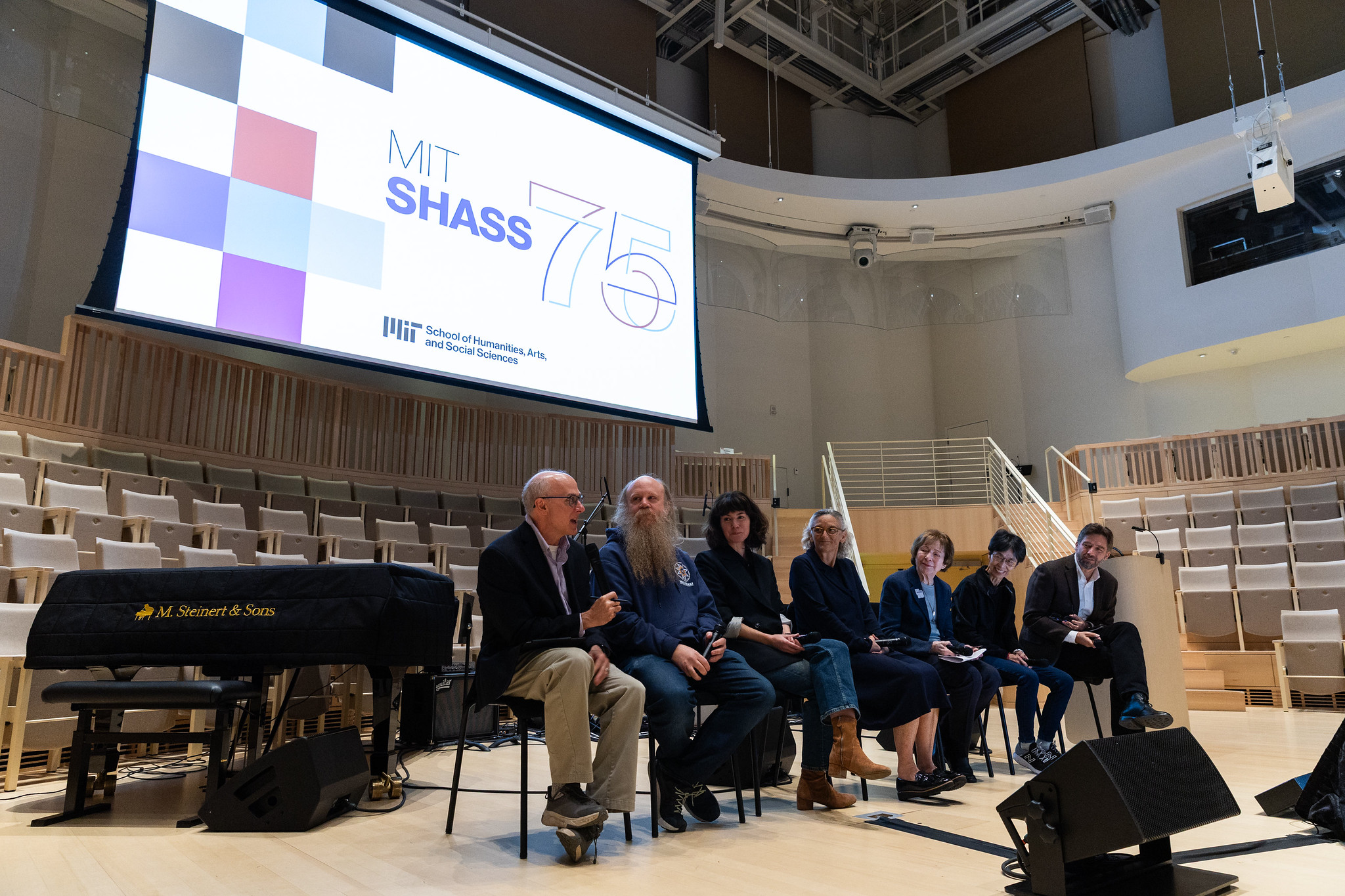
During the School of Humanities, Arts, and Social Sciences’ 75th Anniversary Symposium, President Sally Kornbluth said “MIT has never needed your particular insight and guidance more than we do now.”
MIT News · Artificial Intelligence· news.mit.eduOct 23, 2026
Assistant Professor Benjamin Lindquist studies how engineers deliberately injected randomness into early AI, giving rise to deep-learning models that sometimes hallucinate.
MIT News · Artificial Intelligence· news.mit.eduOct 22, 2026
“X-Hinges” helps design and 3D print items like lamps and gloves with an interactive twist: automatically embedded sensors that perceive and adaptively respond to human contact.
We use cookies to run the site and, with your consent, for analytics and to show ads.
See our Cookie Policy.