Personal digital activity increasingly shapes online experiences, yet few users have been educated regarding the processes transforming raw interactions into personalized suggestions. We developed an education artifact that illustratively simulates how AI leverages users' digital activities to shape online recommendati...
Sushmita Khan, Connor Pennington, Bart P Knijnenburg· 0 citations
When several people share a 3D virtual room with an LLM agent, the agent must decide not only what to say, but whether an utterance was addressed to it and, if accessible, what profile information about the others present it may use. To study both problems, we construct LookAway, a controlled corpus of 40 sessions invo...
Mohammad Al-Ratrout, Shayla Sharmin, Roghayeh Leila Barmaki· 0 citations
We assessed the value of two live human-AI interactions in a precision disease control project in California vineyards. The project tested whether 2021-2024 commercial scouting records and remote-sensing measurements across 140 hectares could support 2025 red-leaf symptom forecasting for prioritized scouting and virus...
Niko Carvajal Janke, Daoyuan Jin, Shivranjani Baruah et al.· 0 citations
This paper presents SENSE, a state-aware framework for generating playable branching visual novels with multi-track emotional navigation. Integrating a state-based narrative architecture called MIND, a structure analyzer, and a path-aware context management module, SENSE produces narratives that are both structurally c...
Yi Xia, Pablo Carrasco Velo, Mudit Paliwal et al.· IEEE Transactions on Games· 0 citations
Reach audiences
Advertise in front of researchers, engineers, and readers.
Large Language Models (LLMs) have disrupted the balance between content production and quality assurance that sustains knowledge commons, leading many to prohibit or restrict their use. But what happens when a community instead appropriates an LLM-powered tool for its own needs? We investigate this question through Wik...
Inhwa Song, Sohyeon Hwang, Teddi Yoo et al.· 0 citations
This study provides a structural explanation for cross-national variation in the relationship between screen time and digital outcomes. While prior research and large-scale assessments such as ICILS have documented inconsistent associations between screen time and digital competence, the mechanisms underlying these dif...
Hyejeong Lee, Daeyoung Ham, Suyoun Kim et al.· 0 citations
This article proposes Selective Affective Layer Fine-Tuning (SALFT), an efficient adaptation framework for Video Vision Transformers in player arousal recognition from gameplay. To bypass computationally expensive full fine-tuning, SALFT introduces a selection criterion based on the L2-norm change in layer parameters a...
Yi Xia, Ibrahim Khan, Mury Fajar Dewantoro et al.· 0 citations
Sustained emotional support requires generative agents to connect momentary emotion inference and regulation with continuity across encounters. We present PAIR (Perceptual Affective Inference and Regulation), a real-time multimodal agent that reconstructs how an event is appraised into an emotional state. Appraisal sca...
Kexin Quan, Zi-Jian Ding, Jia-Ye Yong et al.· 0 citations
Virtual reality (VR) relaxation environments are increasingly proposed as accessible tools for stress management, yet the physiological correlates of self-reported stress during VR exposure remain unclear, particularly for blood pressure (BP). We conducted a within-subjects study (N = 18) in which participants viewed r...
Speech agents are reactive and dyadic: they speak when spoken to, and to one person at a time. We ask what it takes for a speech agent to instead take part in a conversation among several people and speak up only when it can help. We introduce Jarvis, a real-time proactive speech agent that audibly participates in mult...
Seunghyun Oh, Hirotaka Hiraki, Shuyue Stella Li et al.· 0 citations
The widespread availability of LLMs is challenging written learning activities, as students can increasingly generate responses without necessarily engaging with the learning content. Conversational AI creates an opportunity to redesign these activities as dialogue, while multilingual capabilities may make such dialogu...
Large language models (LLMs) let users direct heterogeneous multi-robot systems (MRS) through natural language, but make task interpretation, robot assignment, and coordination difficult to inspect and change. Based on a formative study with 12 non-expert users, we developed MRPilot, a mixed reality system organized ar...
Xiao-Ran Yang, Xun Qian, Yang Zhan et al.· 0 citations
AI agents can generate code at a scale that’s hard for humans to review line-by-line. PDD Kit helps ensure the code is doing what the developer intended by creating formal specifications and testing against them. It converts developer intent into a Verus specification, proves AI-generated code meets it for every input, and uses tests where proofs aren't practical. Developers review intent, not every line. The post Formally verifying agent-written full-stack web apps with PDD Kit appeared first o…
Professor Paris Smaragdis develops computers with superhuman hearing for applications like speech recognition, music understanding, and environmental monitoring.
MIT News · Artificial Intelligence· news.mit.eduOct 23, 2026
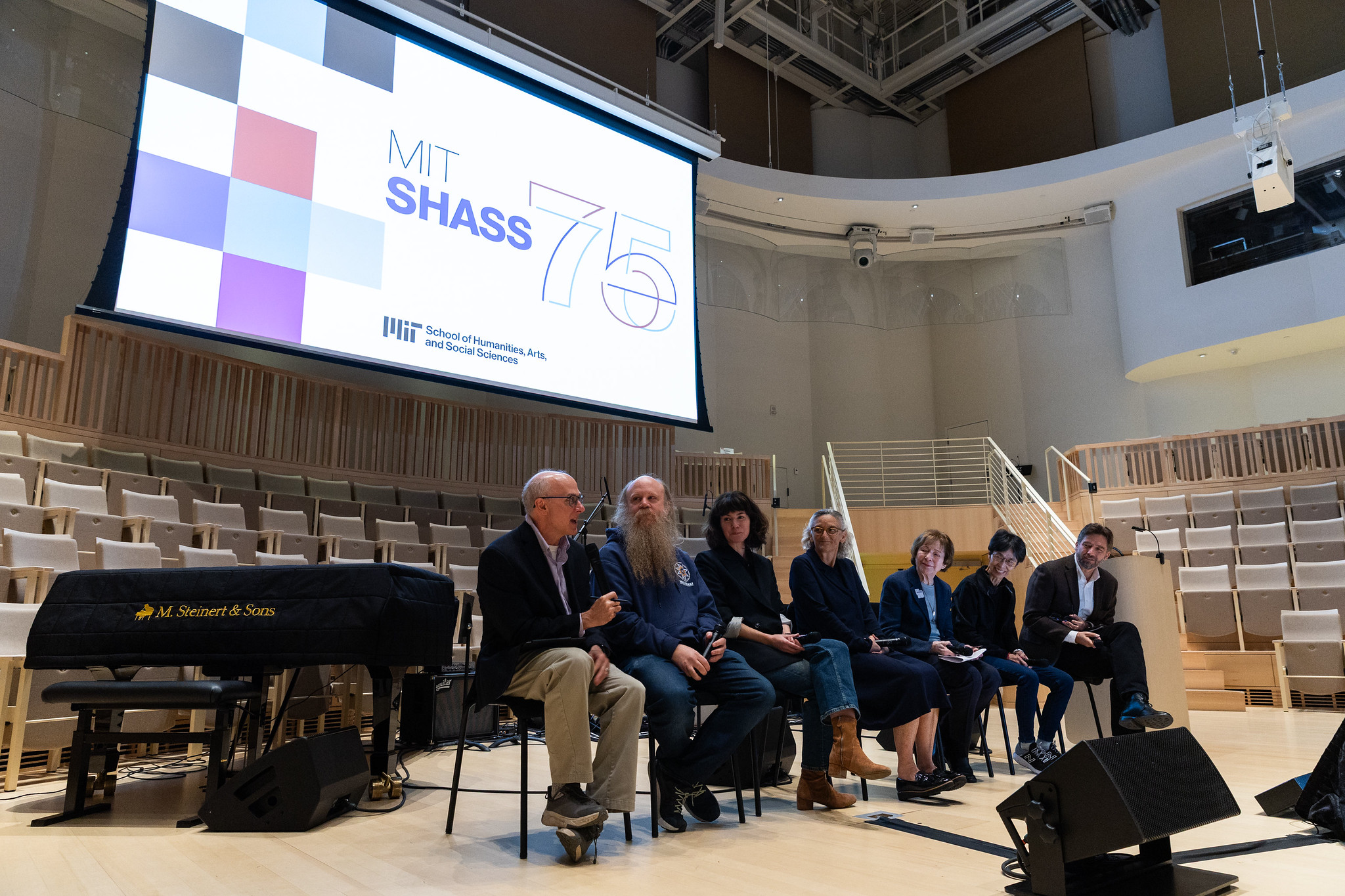
During the School of Humanities, Arts, and Social Sciences’ 75th Anniversary Symposium, President Sally Kornbluth said “MIT has never needed your particular insight and guidance more than we do now.”
MIT News · Artificial Intelligence· news.mit.eduOct 23, 2026
Assistant Professor Benjamin Lindquist studies how engineers deliberately injected randomness into early AI, giving rise to deep-learning models that sometimes hallucinate.
MIT News · Artificial Intelligence· news.mit.eduOct 22, 2026
“X-Hinges” helps design and 3D print items like lamps and gloves with an interactive twist: automatically embedded sensors that perceive and adaptively respond to human contact.
We use cookies to run the site and, with your consent, for analytics and to show ads.
See our Cookie Policy.