Presence research has often proceeded by addition, treating immersion, embodiment, agency, ownership, co-presence, reciprocity, and temporal simultaneity as conditions that stabilise the sense of being there. Yet immersive video suggests that several of these conditions can be weakened without eliminating Presence. Bui...
Online learning offers flexibility but lacks the structure of a classroom, where a teacher's presence guides attention. The platform we study restores that structure by monitoring the learner through the webcam during ordinary coursework, interrupting or restarting a video when the learner appears distracted. What such...
V. Meenakshi, Pavani Ayinampudi, V. AdityaB.M. et al.· 0 citations
A live classroom poll is usually read through its answer key, as a count of participation and correctness. Yet the same record holds more before any key is fixed, namely who answers early and how the class divides across the options. Whether these key-free signals are stable, and what they reveal, has not been examined...
Rohit Sharma, Pavani Ayinampudi, Aditya B. M. V. et al.· 0 citations
Large online programmes receive heavy volumes of queries during onboarding, at a scale that grows faster than the number of staff available to answer them. This paper reports a study of an AI integrated query resolution platform that spreads incoming queries across four routes: an AI based assistant, answers from fello...
Jinal Gupta, Pavani Ayinampudi, Aditya B. M. V. et al.· 0 citations
Reach audiences
Advertise in front of researchers, engineers, and readers.
Real-time classroom polls are widely used and increasingly generated with automated assistance, yet the questions themselves are rarely evaluated as measurements. We audit a large corpus of authentic classroom polls, 604 items across 47 sessions answered 340,668 times by 2,807 learners, as a measurement instrument. For...
Rohit Sharma, Pavani Ayinampudi, Aditya B. M. V. et al.· 0 citations
Mastery-based education increasingly places the reporting of learning progress in students' hands, who record task completion on learning dashboards. The usefulness of such self-reports depends on how closely reported mastery corresponds to demonstrated competence. Most evidence on student self-assessment compares an o...
Sakshi Sharma, Pavani Ayinampudi, Aditya B. M. V. et al.· 0 citations
Pet bereavement often receives little social recognition. Generative AI can give a continuing bond a responsive voice, but a comforting reply may also claim authority to forgive or request attention. We investigate how a memorial can support connection without turning remembrance into obligation. Through Research throu...
Nowadays, Virtual Reality (VR) systems are more helpful for making decisions, training, and rehabilitation. Multimodal settings in these systems impose a significant balance and cognitive difficulties. Additionally, decreased performance, higher cognitive load, user overwhelm, and limited accessibility of VR technology...
Stereoscopy is fundamental to virtual reality (VR), providing depth perception through binocular viewing. Recent advances in 3D Gaussian Splatting (3DGS) enable high-quality novel view synthesis, making it well suited to immersive VR. We render 3DGS reconstructions stereoscopically and evaluate them in a head-mounted d...
Shreyas Shivakumara, Gabriel Eilertsen, Karljohan Lundin Palmerius· 0 citations
Therapeutic exercises can help slow cognitive decline in dementia, but conventional programs are often tedious and difficult to sustain. Virtual reality (VR) offers an alternative through game-based approaches designed to improve engagement and training-based approaches focused on structured functional recovery. Prior...
Digital symptom checkers are widely used for quick guidance on health concerns, yet many systems still face challenges in collecting accurate information, supporting communication, or integrating with clinical workflows. To explore how these tools function in real use, we examine the case of the Simtomi system, which p...
Jinha Lee (Indiana Wesleyan University, Marion, USA) et al.· 0 citations
Generative AI output can contain errors, such as hallucinations, non-responsive results, or otherwise inaccurate or potentially harmful content. To explore the public's emerging understanding, attitudes, and behavior regarding such mistakes, we ran an online survey in the United States with 1,503 respondents, with a re...
Patrick Gage Kelley, Derrick Feldmann, Reena Jana et al.· Proceedings of the AAAI/ACM...· 0 citations
AI agents can generate code at a scale that’s hard for humans to review line-by-line. PDD Kit helps ensure the code is doing what the developer intended by creating formal specifications and testing against them. It converts developer intent into a Verus specification, proves AI-generated code meets it for every input, and uses tests where proofs aren't practical. Developers review intent, not every line. The post Formally verifying agent-written full-stack web apps with PDD Kit appeared first o…
Professor Paris Smaragdis develops computers with superhuman hearing for applications like speech recognition, music understanding, and environmental monitoring.
MIT News · Artificial Intelligence· news.mit.eduOct 23, 2026
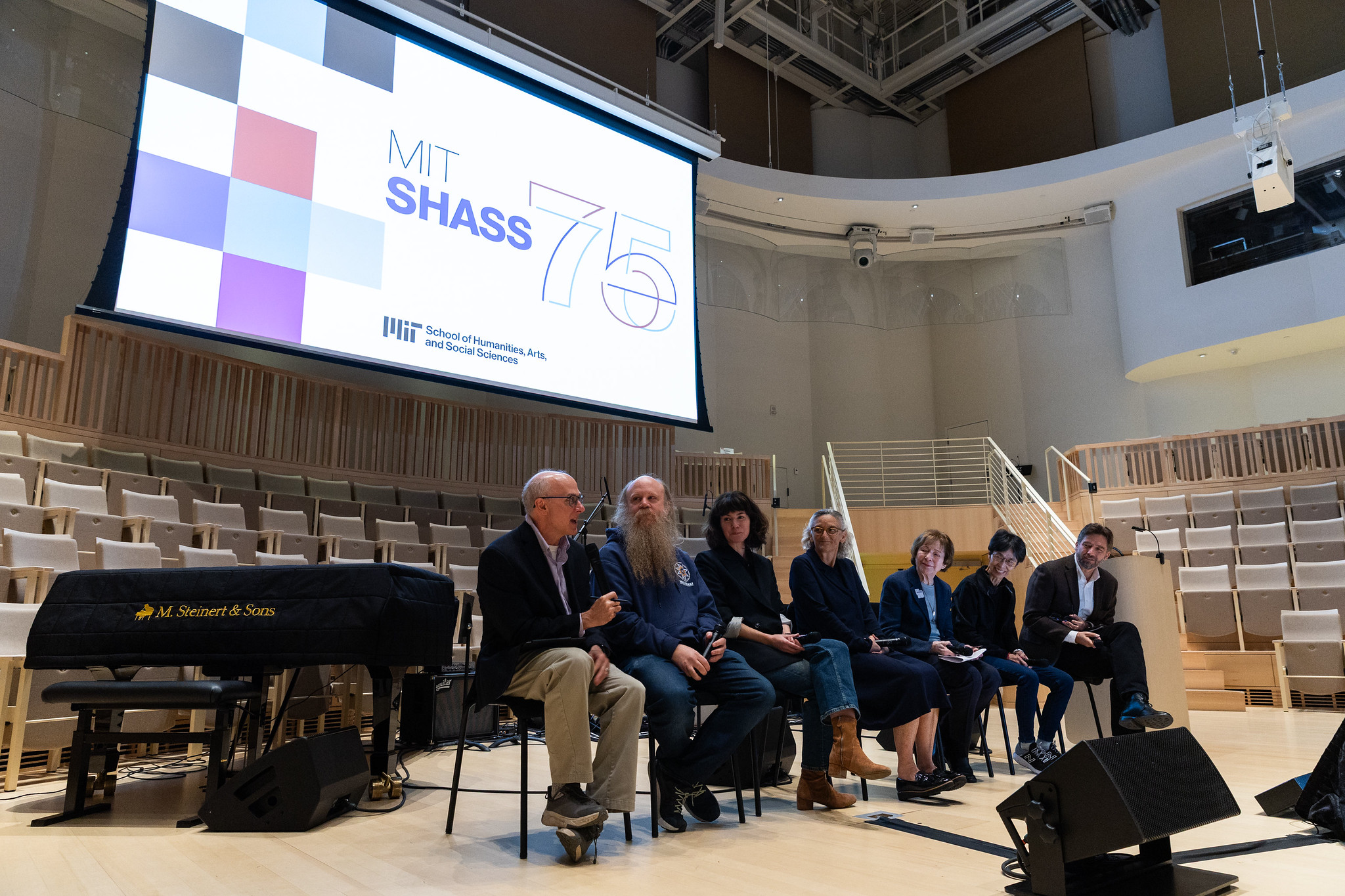
During the School of Humanities, Arts, and Social Sciences’ 75th Anniversary Symposium, President Sally Kornbluth said “MIT has never needed your particular insight and guidance more than we do now.”
MIT News · Artificial Intelligence· news.mit.eduOct 23, 2026
Assistant Professor Benjamin Lindquist studies how engineers deliberately injected randomness into early AI, giving rise to deep-learning models that sometimes hallucinate.
MIT News · Artificial Intelligence· news.mit.eduOct 22, 2026
“X-Hinges” helps design and 3D print items like lamps and gloves with an interactive twist: automatically embedded sensors that perceive and adaptively respond to human contact.
We use cookies to run the site and, with your consent, for analytics and to show ads.
See our Cookie Policy.