The dismantling of the United States Agency for International Development (USAID) in early 2025, representing an 83% reduction in American foreign assistance to Africa, constitutes one of the most significant shifts in global development architecture since the establishment of the post-World War II international order....
Kwan Hong TAN· Zenodo (CERN European Organi...· 0 citations
Artificial intelligence is increasingly becoming a governing medium through which institutions classify persons, allocate opportunities, structure work, produce knowledge and mediate public trust. Current AI governance frameworks emphasise risk classification, technical assurance, transparency, accountability and human...
Kwan Hong TAN· Zenodo (CERN European Organi...· 0 citations
The emergence of digital afterlife technologies and consciousness uploading presents unprecedented ethical challenges that existing philosophical frameworks inadequately address. This paper introduces a novel theoretical framework—Existential Continuity Ethics (ECE)—that transcends traditional binary approaches to cons...
Kwan Hong TAN· Zenodo (CERN European Organi...· 0 citations
Reach audiences
Advertise in front of researchers, engineers, and readers.
The emergence of digital afterlife technologies and consciousness uploading presents unprecedented ethical challenges that existing philosophical frameworks inadequately address. This paper introduces a novel theoretical framework—Existential Continuity Ethics (ECE)—that transcends traditional binary approaches to cons...
Kwan Hong TAN· Zenodo (CERN European Organi...· 0 citations
Generative Artificial Intelligence (GenAI) coding tools are transforming visualization education. They can assist with implementation and design, but they can also let students bypass intended learning trajectories. In this paper, we share our retrospective experience managing and teaching AI use in an upper-level visu...
This position paper challenges the dominant “AI as companion” paradigm by proposing a shift: from AI that simulates relationships with humans to AI that supports relationships between humans.
Yao Xiao, Rafael A. Calvo· CHI Extended Abstracts· 2 citations
Social media platforms, especially Facebook parenting groups, have long been used as informal support networks for mothers seeking advice and reassurance. However, growing concerns about social judgment, privacy exposure, and unreliable information are changing how mothers seek help. This exploratory mixed-method study...
In the age of Large Language Models (LLMs), much work has already been done on how LLMs support medication advice and serve as information providers; however, how mothers use these tools for emotional and informational support to avoid social judgment remains underexplored. This study conducted a 10-day mixed-methods e...
Objective This review systematically investigates the determination of sufficient time budgets in conditionally automated driving, focusing on the interplay between takeover time, allocated time budgets, and outcomes. Background Conditionally automated driving requires human drivers to resume vehicle control within lim...
Ke-Xin Liang, Simeon C. Calvert, J. V. van Lint· Human Factors· 5 citations· ⚡1
Study of how GenAI use and task context relate to professional developers' perceived cognitive load and whether wearable-derived physiological characteristics provide additional information beyond this context suggests developers' perceived cognitive load during GenAI-supported software development should be evaluated...
Charlotte Brandebusemeyer, Daniela Gasser, Tobias Schimmer et al.· 0 citations
The results indicate that LMS interaction data can provide an early signal of AI-assisted cheating risk, and course-module views, assignment submissions, and the number of days on which course videos were accessed were the most consistently selected features across the LOOCV folds.
AI agents can generate code at a scale that’s hard for humans to review line-by-line. PDD Kit helps ensure the code is doing what the developer intended by creating formal specifications and testing against them. It converts developer intent into a Verus specification, proves AI-generated code meets it for every input, and uses tests where proofs aren't practical. Developers review intent, not every line. The post Formally verifying agent-written full-stack web apps with PDD Kit appeared first o…
Professor Paris Smaragdis develops computers with superhuman hearing for applications like speech recognition, music understanding, and environmental monitoring.
MIT News · Artificial Intelligence· news.mit.eduOct 23, 2026
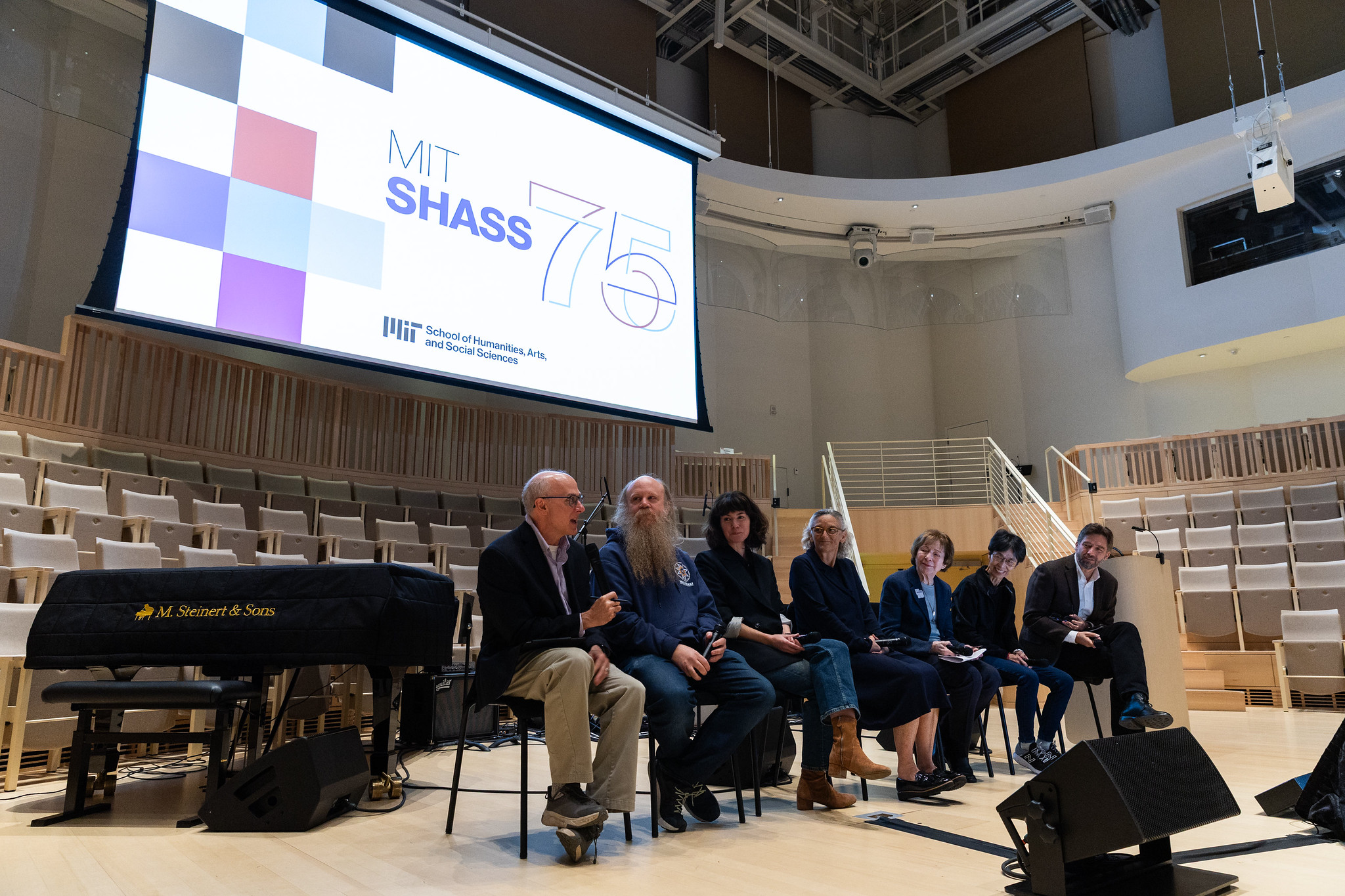
During the School of Humanities, Arts, and Social Sciences’ 75th Anniversary Symposium, President Sally Kornbluth said “MIT has never needed your particular insight and guidance more than we do now.”
MIT News · Artificial Intelligence· news.mit.eduOct 23, 2026
Assistant Professor Benjamin Lindquist studies how engineers deliberately injected randomness into early AI, giving rise to deep-learning models that sometimes hallucinate.
MIT News · Artificial Intelligence· news.mit.eduOct 22, 2026
“X-Hinges” helps design and 3D print items like lamps and gloves with an interactive twist: automatically embedded sensors that perceive and adaptively respond to human contact.
We use cookies to run the site and, with your consent, for analytics and to show ads.
See our Cookie Policy.