The transformer reduces multiplication to addition in discrete-log space, implementing a "Discrete-Log Clock" algorithm analogous to Nanda et al.'s Clock algorithm for addition, which generalizes: matching the analysis basis to the algebraic structure of the task reveals interpretable structure where standard tools see noise.
TokenPilot is presented, a dual-granularity context management framework that reduces costs by 61% and 56% in isolated mode, and 61% and 87% in continuous mode, while maintaining competitive performance compared to prior systems.
Buqiang Xu, Z. Xue, Dian Chen et al.· arXiv.org· 1 citation
Real-world data analysis is inherently iterative, yet existing benchmarks mostly evaluate isolated or short interactive tasks, leaving agents' ability to track evolving analytical context over long horizons untested. We introduce LongDS, a benchmark for long-horizon, multi-turn data analysis where agents must maintain, update, restore, and compose evolving analytical states. LongDS comprises 68 tasks constructed from real-world Kaggle notebooks, spanning 2,225 turns across six domains including Geoscience, Business, and Education. Tasks are designed around state-evolution patterns (e.g., counterfactual perturbation, rollback, multi-state composition), with an average dependency span of 11.3 turns. Evaluating five state-of-the-art models, we find that the best model reaches only 48.45% average accuracy, performance drops nearly 47 points from early to late turns, and long-horizon errors account for 52%--69% of failures. Further analysis shows that additional agent steps do not necessarily improve performance, suggesting that the key bottleneck is maintaining a correct analytical state rather than increasing interaction budget. We release LongDS to support research on reliable long-horizon agentic data analysis. Code and data are released at https://github.com/zjunlp/DataMind.
Kewei Xu, Xiaoben Lu, Shuofei Qiao et al.· 0 citations
This work presents a systematic study of scale vectors in LLMs from the perspectives of expressivity, optimization, and architectural structure, and proposes three lightweight and complementary improvements to scale vectors: branch-specific heterogeneity, improved placement around linear mappings, and magnitude-direction reparameterization.
This work proposes Mixture of Activations (MoA), a token-adaptive FFN design that mixes a dictionary of activation functions using lightweight input-dependent gates while sharing the same linear projections, suggesting that token-adaptive activation mixing is a simple and effective mechanism for improving FFN expressivity in LLMs.
This work presents SkillSafetyBench, a runnable benchmark for evaluating skill-facing safety failures, and suggests that agent safety depends not only on model-level alignment, but also on how agents interpret skills, trust workflow context, and act through executable environments.
This work proposes ABC: Any-Subset Autoregressive Models via Non-Markovian Diffusion Bridges in Continuous Time and Space, and derives SDE dynamics via changes-of-measure on path space, yielding another advantage: path-dependent conditioning on arbitrary subsets of the state history and/or future.
Gabriel Guo, Thanawat Sornwanee, L. Hao et al.· arXiv.org· 0 citations
G-Loss is presented, a graph-guided loss function that incorporates semi-supervised label propagation to use structural relationships within the embedding manifold to build a document-similarity graph that captures global semantic relationships.
This work introduces CodeRQ-Bench, the first benchmark for evaluating LLM reasoning quality across three coding task categories: generation, summarization, and classification, and proposes VERA, a two-stage evaluator that combines evidence-grounded verification with ambiguity-aware score correction.
Yuangang Li, Justin Tian Jin Chen, Ethan Yu et al.· arXiv.org· 1 citation
Extending LLM context windows is hindered by scarce high-quality long-context data. Recent methods synthesize data with genuine long-range dependencies via information-theoretic verification, selecting contexts that reduce a base model's predictive entropy. However, their single-pass offline construction with a fixed model creates a fundamental off-policy gap: the static screening landscape misaligns with the model's evolving capabilities, causing the training distribution to drift. We propose PolicyLong, shifting data construction towards a dynamic on-policy paradigm. By iteratively re-executing data screening (entropy computation, retrieval, and verification) using the current model, PolicyLong ensures the training distribution tracks evolving capabilities, yielding an emergent self-curriculum. Crucially, both positive and hard negative contexts derive from the current model's entropy landscape, co-evolving what the model learns to exploit and resist. Experiments on RULER, HELMET, and LongBench-v2 (Qwen2.5-3B) show PolicyLong consistently outperforms EntropyLong and NExtLong, with gains growing at longer contexts (e.g., +2.54 at 128K on RULER), confirming the value of on-policy data evolution.
Junlong Jia, Jiang Zhou, Ziyang Chen et al.· 0 citations
This paper proposes a camera-agnostic, one-shot, post-training pruning method for 3D Gaussian splats that relies solely on attribute-derived neighbourhood descriptors, and introduces a hybrid descriptor framework that captures structural and appearance consistency directly from the splat representation.
Peter O. Fasogbon, Ugurcan Budak, P. R. Alface et al.· arXiv.org· 0 citations
The Variational JEPA (Var-JEPA), which makes the latent generative structure explicit by optimizing a single Evidence Lower Bound (ELBO) and yields meaningful representations without ad-hoc anti-collapse regularizers and allows principled uncertainty quantification in the latent space.
Moritz Gögl, Christopher Yau· arXiv.org· 3 citations· ⚡1
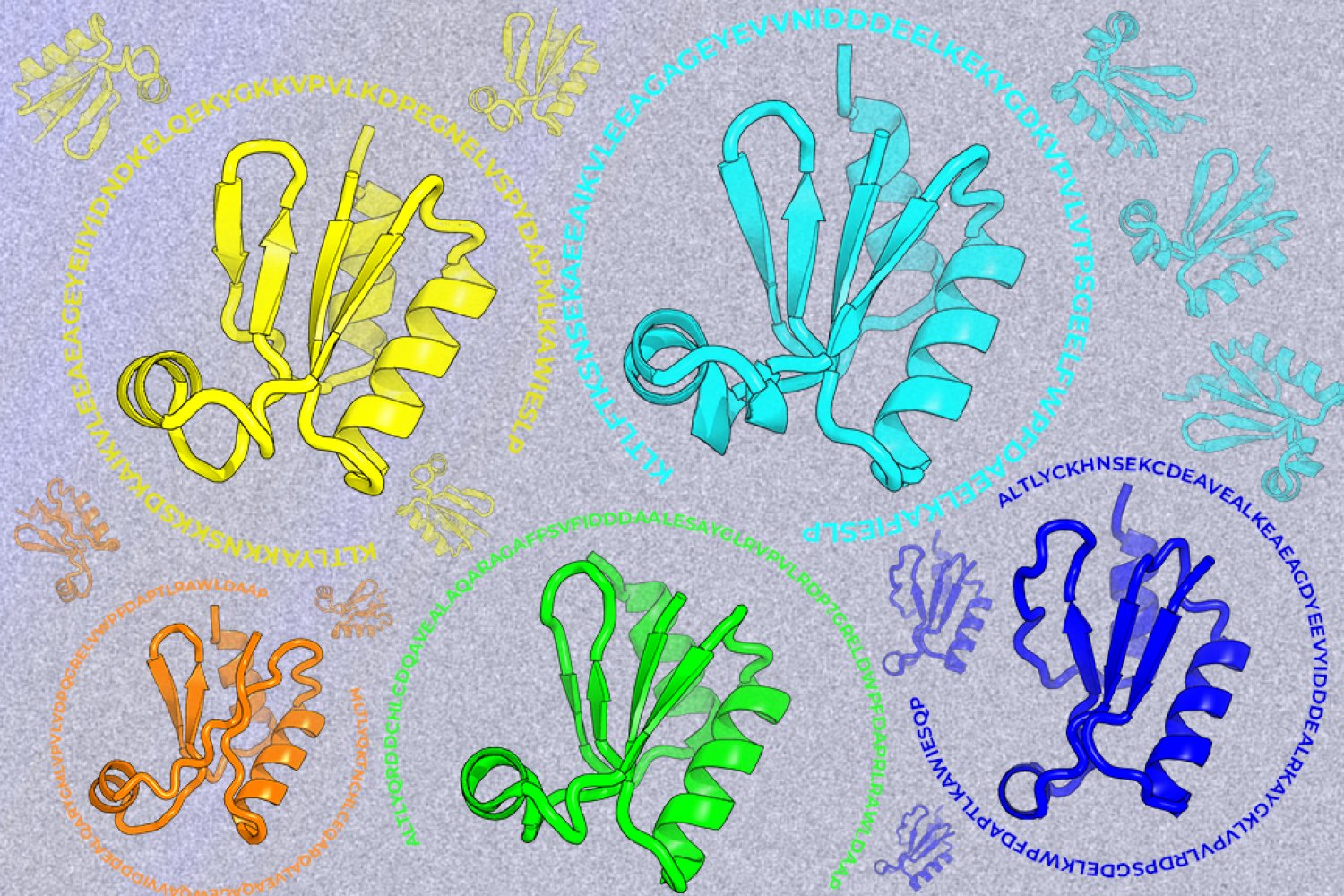
A new machine-learning framework aims to improve the success rate of computational protein design while moving away from results that reproduce sequences found in nature.
MIT News · Artificial Intelligence· news.mit.eduAug 24, 2026
A new method for surgically removing training examples from a model reveals that as datasets grow, the link between what a model learns and what it produces dissolves.