This work presents a constrained two-view learning framework for robust graph learning, which aligns structure-aware GNN embeddings with a structure-free feature prior and designs a channel-split adaptive gated layer within DSAL to effectively integrate this prior.
This review surveys how Large Language Models are adding semantic interfaces, code generation, and tool orchestration to established numerical nanophotonic workflows, and looks ahead to the next generation of multimodal foundation models with physical perception capabilities.
Huanshu Zhang, Kegeng Tang, Lei Kang et al.· 1 citation
This work deconstructs the RL post-training algorithm, investigating each step to clarify what is actually happening beneath the surface, and uses the entropy of the policy's output distribution as a lens to compare the distributions learned through pretraining, SFT, and RL post-training, revealing how each stage shapes model certainty.
D. Clay, Saket Gollapudi, Sankar V Harilal et al.· 0 citations
This work introduces a general steering technique called Semantic Overlays: small learned adapters applied at chosen prefill positions to a frozen model's residual stream that defends against the broad class of prompt injections that add instructions in untrusted context.
Joshua Penman· 0 citations
Reach audiences
Advertise in front of researchers, engineers, and readers.
Text Prompt Boosting (TPB), an AdaBoost-inspired framework that treats each text-prompt-based classifier as a weak learner and sequentially aggregates them into a strong ensemble by explicitly targeting hard, misclassified examples, is proposed.
Seokhee Jin, C. Sung, Sunung Mun et al.· 0 citations
ProphDR is an interpretable deep learning framework that integrates multiomics data and drug structural information using a hierarchical attention mechanism, and generates biologically interpretable attention maps that highlight key pharmacophores and resistance-related genes consistent with established mechanisms in NSCLC and BRCA.
Yundian Zeng, Qing Ye, Jike Wang et al.· Journal of Chemical Informat...· 0 citations
ClosureBench is introduced, a constructive benchmark for compositional graph-relational reasoning with programmatically verified ground truth with programmatically verified ground truth: each task's reference answer is computed by executing a program in the Ein tensor-logic language, ensuring machine-verified correctness.
Uniform stability is a classical tool for controlling the generalization error of a learning algorithm. Bousquet, Klochkov, and Zhivotovskiy (2020) showed that the problem can be reduced to a moment inequality for a sum of weakly interacting functions of independent random variables. Their bound contains an additional factor $\log n$, and they asked whether this factor can be removed. We answer this upper-bound question affirmatively. More specifically, let $Z=(Z_1,\ldots,Z_n)$ have independent coordinates and let $g_i(Z)$ satisfy $$ \mathbb E[g_i(Z)\mid Z_{-i}]=0, \qquad \left| \mathbb E[g_i(Z)\mid Z_i]\right|\le M, \qquad \forall i = \overline{1, n} $$ while changing any coordinate $Z_j$, $j\neq i$, changes $g_i$ by at most $\beta$ and $Z_{-i}$ denotes all coordinates except $Z_i$. We prove that, for every $p\ge2$, $$ \left\| \sum_{i=1}^n g_i(Z)\right\|_p \le 16pn\beta+M\sqrt{2pn}. $$ This removes the $\log n$ factor from the previous bound and matches the lower bound of Bousquet, Klochkov, and Zhivotovskiy up to universal constants in the range covered by their construction. Our proof first establishes the required estimate on the Rademacher cube, then transfers it to arbitrary product distributions by a two-copy randomization argument.
The first comprehensive benchmarking framework specifically designed to accommodate inter-dataset heterogeneity is presented, finding that well-designed small datasets can match or even surpass the performance of larger benchmarks, suggesting that different metrics are applicable to different datasets/testing scenarios.
Yingjuan Cheng, Qing Ye, Linlong Jiang et al.· Journal of Cheminformatics· 0 citations
A novel committor learning framework grounded in the AlphaFold 3 paradigm is proposed that elucidates how ligand substituents regulate the ratio between distinct binding pathways, offering new perspectives for structure-based drug design.
Jintu Zhang, Zichang Jin, Huifeng Zhao et al.· 0 citations
The Comprehensive VS Platform with AI Engine (CVSP-AIE) for drug discovery from compound libraries integrates three AI models: KarmaDock, a fast docking model that directly updates atomic coordinates; CarsiDock, an accurate docking model that predicts protein-ligand distances and reconstructs binding poses; and RTMScore, an accurate scoring model that learns residue-atom distance distributions for affinity prediction.
Current structure-based drug design generative models often struggle to faithfully recapitulate genuine ligand-protein binding interactions. Instead, under the coupling of implicit learning architectures and biased training data, they tend to learn spurious statistical correlations. To address this, we propose EIP-Diff (Explicit Interaction-Prompted Diffusion), an architecture featuring a novel explicit interaction-prompt embedding mechanism that is better suited for real-world target-specific drug design. This architecture replaces biased implicit learning with explicit, residue-level biological guidance, thereby promoting more fine-grained geometric fidelity and more precise interaction-aware conditioning. To fully realize the capabilities of EIP-Diff and provide a reliable basis for performance evaluation, we further constructed CrystalData set, which provides higher-fidelity and less-biased structural supervision than existing data sets. This explicit architecture markedly improves distribution consistency: even when trained on the crossdocked data set, EIP-Diff achieves the highest alignment with authentic pharmacological distributions among evaluated models. Training on CrystalData set further enhances this alignment and improves 3D geometric accuracy, while retaining strong controllability, high chemical space coverage, and near-perfect uniqueness. In addition, target-based validation on KAT6A and YTHDC1 confirmed that EIP-Diff accurately recapitulates native-like binding modes. Furthermore, in a real-world drug design task against IDO1, we successfully designed a novel lead compound with nanomolar potency (IC50 = 0.31 nM). These results demonstrate that the EIP-Diff architecture can explicitly leverage experimentally derived structural data and biologically meaningful interaction information for target-specific molecular generation, thereby enabling its effective application to real-world structure-based drug design.
Huabin Du, Mingyang Wang, M. Luo et al.· Journal of the American Chem...· 0 citations
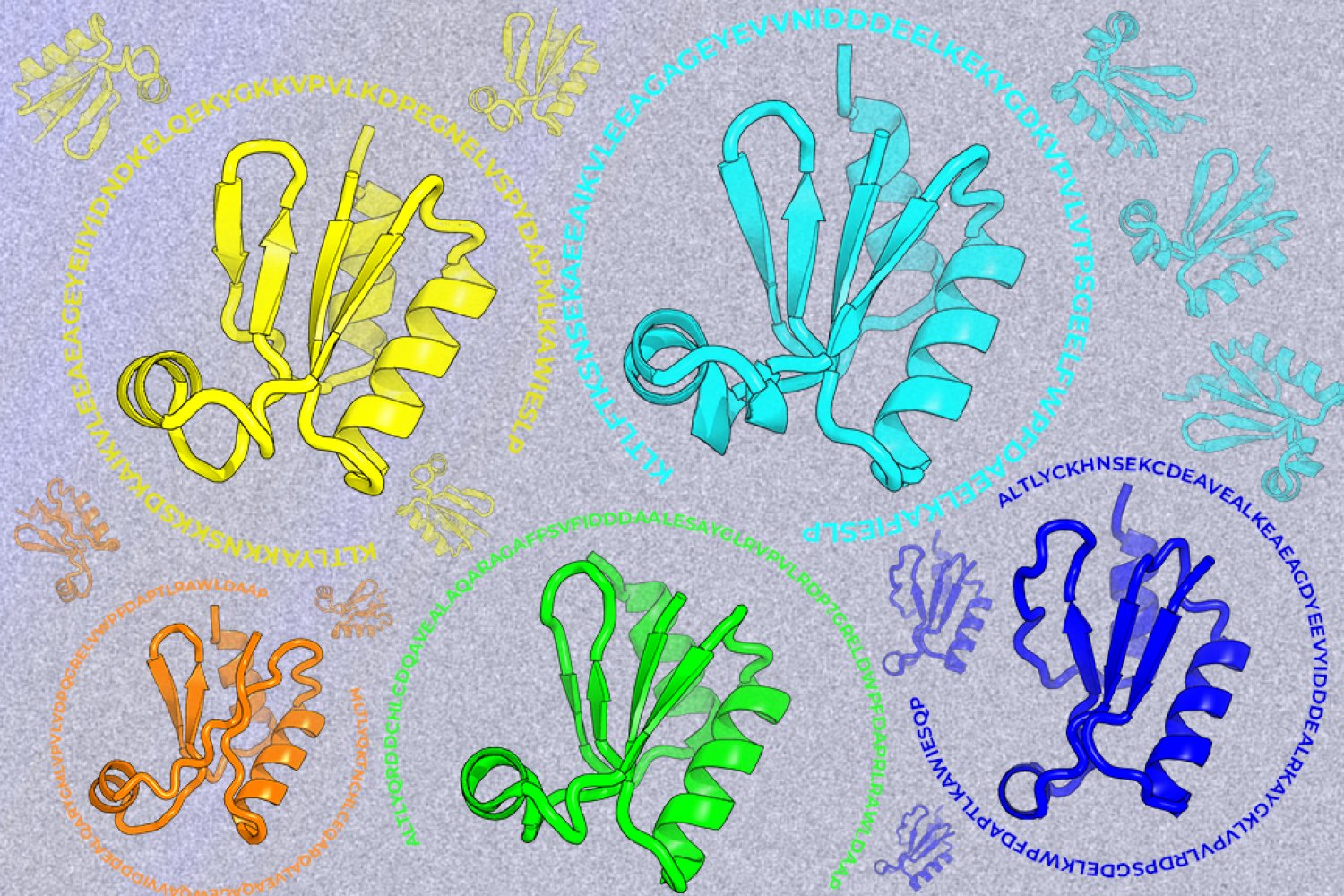
A new machine-learning framework aims to improve the success rate of computational protein design while moving away from results that reproduce sequences found in nature.
MIT News · Artificial Intelligence· news.mit.eduAug 24, 2026
A new method for surgically removing training examples from a model reveals that as datasets grow, the link between what a model learns and what it produces dissolves.