This work explores image generation using flow matching using flow matching and proposes an iterative process that can be integrated into virtually any generative modeling technique, thereby enhancing the performance and robustness of image synthesis systems.
Eldad Haber, Shadab Ahamed, Md Shahriar Rahim Siddiqui et al.· SIAM Journal on Scientific C...· 3 citations
This work evaluates Constrained Bayesian Optimization with the primary objective of minimizing energy consumption and subject to the constraint that the generalization performance is above some threshold and demonstrates that CBO achieves lower energy consumption without compromising the predictive performance of ML models.
Pallavi Mitra, F. Biessmann· arXiv.org· 0 citations
Mechanist is an agentic system that uses AI as a scientific instrument for the autonomous discovery of mechanisms underlying AI intelligence, and develops a mechanism theory of belief, revealing how models represent world knowledge, form beliefs, infer the beliefs of others, and how these mechanisms emerge during pretraining.
Mengru Wang, Junfeng Fang, Shuofei Qiao et al.· 0 citations
A unified benchmark for comprehensive, instruction-conditioned EEG understanding is introduced and results vary substantially across models, subsets, difficulty levels, and execution paradigms, showing that EEG competence depends on the model and its operationalization.
Yangxuan Zhou, Sha Zhao, Yuning Chen et al.· 0 citations
Reach audiences
Advertise in front of researchers, engineers, and readers.
This paper introduces an LLM-Augmented Reinforcement Learning Agent that integrates LLM-driven planning with RL-based action optimization, and highlights a promising direction for building more capable autonomous systems.
Christophe D. Hounwanou, John Emeka Eze, Yaé Ulrich Gaba· 0 citations
SkillBoost is proposed, a three-stage framework that mitigates both risks: structured exploitation localizes observed failures to editable skill components, prior-guided exploration draws on prior knowledge in the LLM to generate diverse repair candidates, and verified acceptance commits a candidate only when it improves performance within a regression bound.
Hongqiang Lin, Chao Liu, Xiaofan Bai et al.· arXiv.org· 1 citation
Current AI agents can flexibly invoke tools and execute complex tasks, yet their long-term advancement is hindered by the lack of systematic accumulation and transfer of skills. Without a unified mechanism for skill consolidation, agents frequently ``reinvent the wheel'', rediscovering solutions in isolated contexts without leveraging prior strategies. To address this challenge, we introduce SkillNet, an open infrastructure for creating, evaluating, and organizing AI skills at scale. SkillNet structures skills within a unified ontology that supports creating skills from heterogeneous sources, establishing rich relational connections, and performing multi-dimensional evaluation across Safety, Completeness, Executability, Maintainability, and Cost-awareness. Our infrastructure integrates a repository of over 600,000 skills, an interactive platform, and a versatile Python toolkit. Experiments on ALFWorld, WebShop, and ScienceWorld show 40% higher average rewards and 30% fewer execution steps across multiple backbone models. Furthermore, SkillNet-Gym benchmarks skill retrieval, utilization, and composition, while SkillNet-Fabric enables task-specific skill routing through lightweight Wikis. By formalizing skills as evolving, composable assets, SkillNet provides a robust foundation for agents to move from transient experience to durable mastery.
Yuan Liang, Ruobin Zhong, Haoming Xu et al.· 0 citations
An agent must try new behaviors to explore and improve. In high-stakes environments, an agent that violates safety constraints may cause harm and must be taken offline, curtailing any future interaction. Imitating old behavior is safe, but excessive conservatism discourages exploration. How much behavior change is too much? We show how to use any safe reference policy as a probabilistic regulator for any optimized but untested policy. Conformal calibration on data from the safe policy determines how aggressively the new policy can act, while provably enforcing the user's declared risk tolerance. Unlike conservative optimization methods, we do not assume the user has identified the correct model class nor tuned any hyperparameters. Unlike previous conformal methods, our theory provides finite-sample guarantees even for non-monotonic bounded loss functions, and it introduces a new policy control setting. Our experiments on applications ranging from natural language question answering to biomolecular engineering show that safe exploration is not only possible from the first moment of deployment, but can also improve performance.
Drew Prinster, Clara Fannjiang, Ji Won Park et al.· 0 citations
Group-relative residual calibration can incorporate verifier outcomes without discarding dense token-level guidance, and demonstrates that group-relative residual calibration can incorporate verifier outcomes without discarding dense token-level guidance.
Zhu Zhang, Jixun Wang, Xiaoan Xu et al.· 0 citations
A recourse method is built on a gradient-boosted ensemble that retains 58% of its validity where the strongest baseline retains 41%, a distinction the standard evaluation cannot see because it never asks whether a recommendation can be carried out.
PGFS++ is introduced, a synthesis-aware reinforcement learning framework for input-specific molecular improvement that improves target properties while preserving high output diversity, and experiments show that PGFS++ improves target properties while preserving high output diversity.
Boqiao Zhang, Godbless James, S. Gottipati et al.· 0 citations
The Masked Diffusion Time-series Imputation Model (MDTIM) is proposed, which leverages the training paradigm of masked diffusion model for imputation tasks, and introduces Stochastic Discretization, which maps continuous values to ordinal-aware tokens while preserving continuous dynamics.
Dongbin Kim, Seungyun Lee, Geonwoo Shin et al.· 0 citations
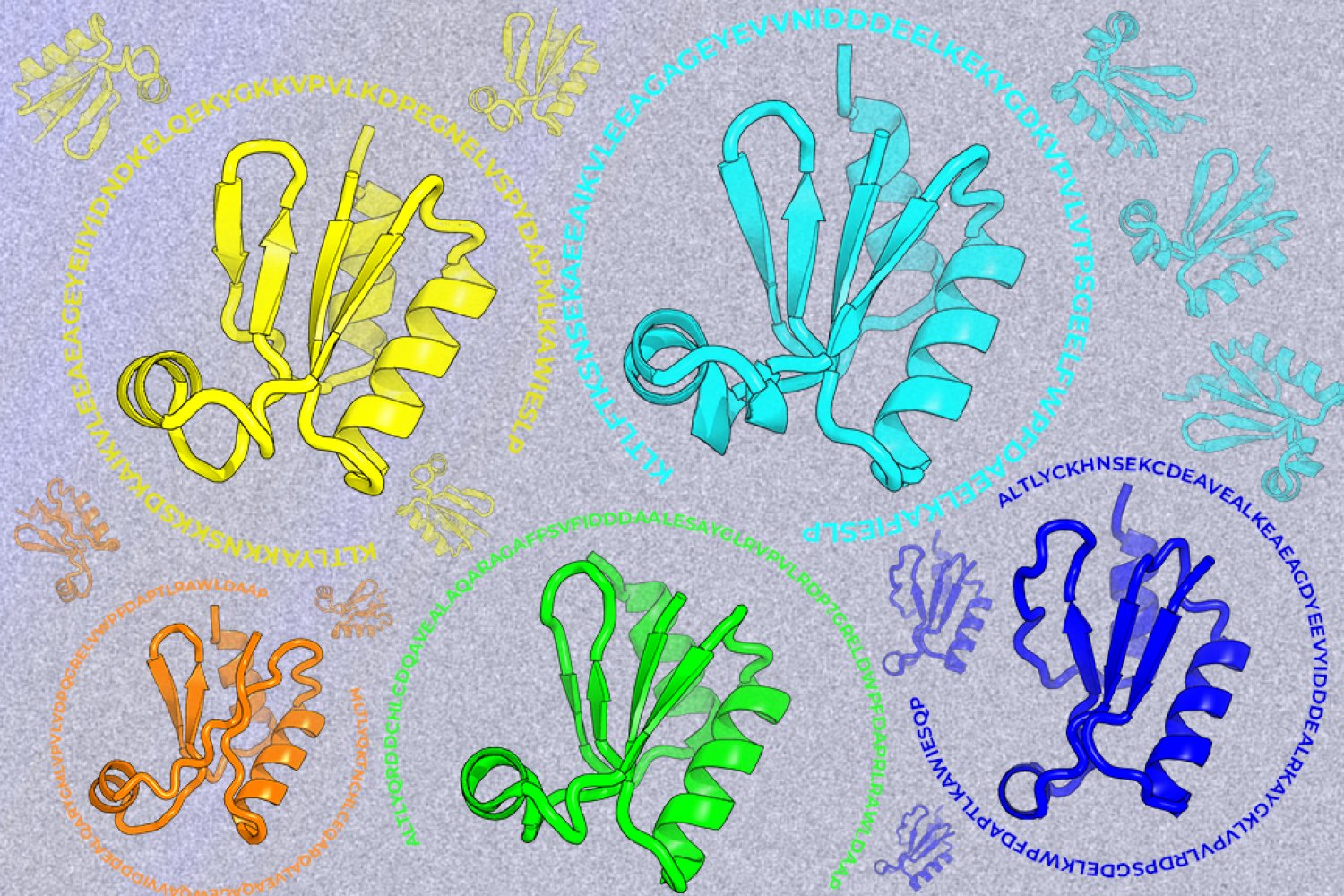
A new machine-learning framework aims to improve the success rate of computational protein design while moving away from results that reproduce sequences found in nature.
MIT News · Artificial Intelligence· news.mit.eduAug 24, 2026
A new method for surgically removing training examples from a model reveals that as datasets grow, the link between what a model learns and what it produces dissolves.