An adaptive surrogate modeling method for problems with very high-dimensional spatio-temporal outputs is developed that combines exploration and exploitation to improve the surrogate model accuracy with the fewest possible runs of the expensive physics-based model.
B. Kapusuzoglu, S. Mahadevan, Shunsaku Matsumoto et al.· Structural And Multidiscipli...· 17 citations
This paper considers global sensitivity analysis (GSA) for situations where both a physics-based model and experimental observations are available, and investigates physics-informed machine learning strategies to effectively combine the two sources of information in order to maximize the accuracy of the sensitivity estimate.
B. Kapusuzoglu, S. Mahadevan· Reliability Engineering & Sy...· 45 citations
This work audits financial-news direction prediction dependence on a 49,799-article corpus across 16 feature-model combinations spanning TF-IDF, MiniLM, FinBERT, and fine-tuned RoBERTa-large / DeBERTa-v3-large, plus separate zero/few-shot and LoRA probes of Llama-3 and Qwen2.
Chenhao Xue, Raslen Guesmi, Siwei Feng et al.· 0 citations
End-to-end vision-language-action (VLA) and world-action models offer an elegant route to general-purpose robotics, but their reliability is bounded by validated physical coverage. When an unfamiliar object, sensor, embodiment, or contact falls outside that coverage and no validated fallback exists, correcting the failure requires new robot data, a policy update, and regression testing. This recurring burden is the retraining tax. Unlike text, embodied data must often be created by operating machines. We present Teach-and-Grow Learning (TGL), an agent-centered architecture for general robot learning. In its general form, a multimodal agent turns a few successful demonstrations into reusable Skill Blocks: closed-loop behaviors for meaningful subgoals. In a new scene, the agent grounds and composes these blocks, selects learned or geometric tools, observes the physical outcome, and revises the route when execution departs from intent. A Skill Library stores executable behavior, while structured Experience Memory carries forward success, failure, and repair. New tasks are acquired without task-specific policy retraining. Our LIBERO evaluation attains state-of-the-art performance; controlled studies expose skill induction, persistent reuse, and agent-directed adaptation. Finally, we propose the Teach-and-Grow scaling-law hypothesis: if X denotes effective reusable experience, future-task error and teaching demand should approach irreducible floors as power laws in X. The architecture therefore treats deployment as a period of continued learning, in which one task can make the next easier.
Chang Nie, Zhe Liu, Hesheng Wang· 0 citations
Reach audiences
Advertise in front of researchers, engineers, and readers.
Hadamard-CLIP is proposed, which adds a single learned weight vector on top of the existing encoders and restores universal approximation of the joint for any number of modalities while preserving CLIP's fast, precomputable-embedding retrieval.
This work introduces online contextual matrix games and proposes OnGameLearn, an online learning algorithm that efficiently balances exploration and exploitation across both player actions and contexts and effectively navigates the intertwined challenges of strategic and contextual decision-making.
Cell mimicry arises when different cell types appear morphologically similar. Human pathologists resolve this ambiguity using surrounding tissue context, whereas current vision models either lack contextual reasoning (cell foundation models) or cannot operate at the cell level (pathology MLLMs). We present Loki-OT, which propagates region-level tissue reasoning to individual cell predictions via Unbalanced Optimal Transport, using MLLM-derived density priors as soft guidance for ambiguous cell reassignment. Loki-OT is motivated by the observation that pretrained cell foundation model features already encode discriminative information, including tissue context, but standard cell-level supervision fails to use tissue context effectively. The resulting transport plan is distilled into a lightweight student MLP classifier that learns context-aware decision boundaries within the pretrained feature space. On the independent TCGA-BRCA cohort, Loki-OT achieved lower patient-level MAE than the fully supervised in-domain PanopTILs classifier and improved F1 in epithelium-rich mimicry tissues, using 278 weak region-level MLLM estimates built on a general-domain cell foundation model. Code: https://github.com/xiangli980/Lymphocyte_Mimicry_Correction_via_Loki_OT
Xiang Li, Yuqi Wang, Casey C. Heirman et al.· 0 citations
A comparative study of four audits applicable to pre-trained, black-box face generators, which consistently reveal substantial identity distinguishability while reporting markedly different epsilon estimates that reflect each method's distinct assumptions and finite-sample treatment.
Arman Zareian Jahromi, Vishnu Bondalakunta, M. Shah et al.· 0 citations
A DT-based IDS that jointly models physical relationships among decoded powertrain signals and identifies attacks through residuals between predicted and observed behavior shows promise for detecting stealthy payload-level CAN attacks that preserve normal communication patterns, supporting behavior-based cybersecurity for connected and automated vehicles.
Araf Rahman, M. Salek, Mashrur Chowdhury· 0 citations
Entanglement-Weighted Pruning (EWP), an unlearning procedure for quantum federated learning that scores every trainable circuit parameter with the product of two signals: the diagonal entry of the quantum Fisher information matrix estimated on the target client's data via the parameter-shift rule, and a structural entanglement weight associated with the parameter's gate.
This work investigates the potential of the waste hierarchy from the EU's Waste Framework Directive, which suggests five different measures for how to manage waste: prevention, reuse, recycling, recovery, and disposal, and calls to attention that prevention of unnecessary use of LLMs carry huge potential for lowering the climate impact of the models.
E. Husom, M. Nylund, Ophelia Prillard· 0 citations
The massive overactuation in the human musculoskeletal system makes it challenging to train musculoskeletal models to generate human-like motion via reinforcement learning, primarily because exploration in the resulting high-dimensional and redundant action space is extremely inefficient. To address this problem, we propose the $\lambda$-hold controller, inspired by the equilibrium-point (EP) hypothesis, which has been widely supported by extensive evidence from human motor control studies. The policy's control variable is the per-muscle EP threshold length $\lambda$, from which a stretch-reflex recruitment law computes the muscle excitations automatically. Holding each $\lambda$ over an interval of the gait phase also sharply reduces the frequency at which the policy must be queried. Consequently, the controller, to our knowledge for the first time, enables a muscle-actuated skeletal model to learn human-like sprinting using only a minimal reward within an hour of training. The efficient exploration through the proposed $\lambda$-hold controller is not merely an engineering trick but an approach grounded in physiology, bringing together the EP hypothesis, intermittent control, and optimal feedback control. Beyond encapsulating human-like behavior in predictive simulation, this achievement contributes to developing a learnable model of the human motor controller.
Jun Hyuk Lee, Chihyeong Lee, Jooeun Ahn· 0 citations
A weeklong summer workshop brought higher education faculty to campus to explore how AI and machine learning materials can be adapted for their classrooms.
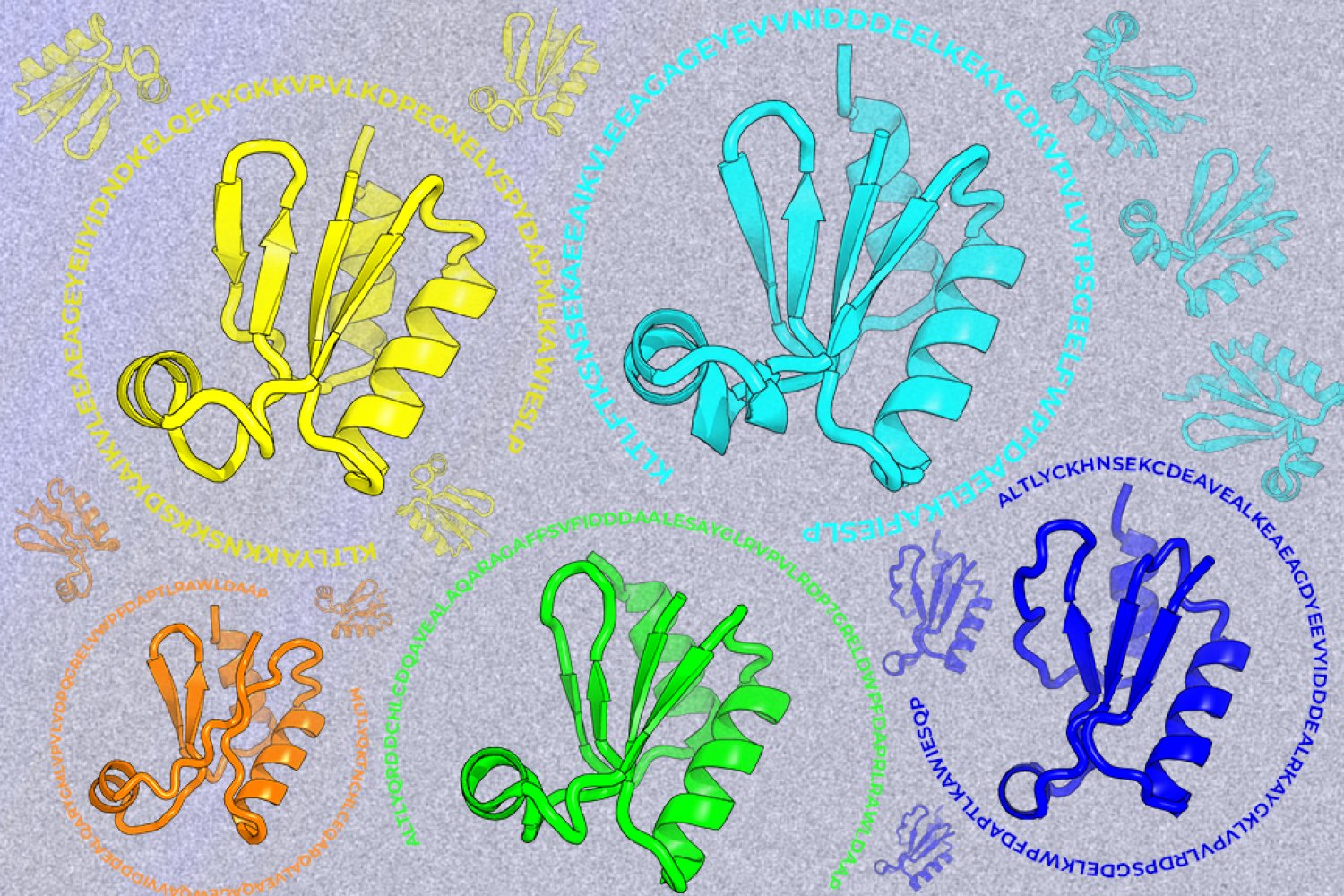
A new machine-learning framework aims to improve the success rate of computational protein design while moving away from results that reproduce sequences found in nature.
MIT News · Artificial Intelligence· news.mit.eduAug 24, 2026