Autonomous vehicles operate in dynamic, ever-changing environments where new scenarios and edge cases constantly emerge. As a result, static learning models are inadequate for ensuring safe and reliable operation. Continuous learning is essential for adapting to these evolving conditions and maintaining robust performance across diverse real-world settings. However, autonomous vehicles generate massive streams of visual data during operation, and existing continuous learning approaches typically rely on heuristic sampling methods that fail to capture temporal dynamics, often overlooking critical learning opportunities or selecting redundant frames. In this paper, we introduce FrameScope, a temporal data valuation framework for continuous learning in autonomous vehicles. FrameScope extends neural tangent kernel theory to temporal domains, enabling principled valuation of streaming visual data. Unlike cloud-centric methods that transmit all video data for processing, our approach performs principled, local frame selection on the vehicle and queries a cloud-based oracle model only for labels of those high-value frames. Extensive experiments across multiple domain shifts show that FrameScope consistently outperforms existing methods, achieving higher sample efficiency and significantly reducing catastrophic forgetting in autonomous vehicle perception. By valuing data on the vehicle and querying only labels for selected frames, FrameScope reduces bandwidth requirements, enabling scalable operation with a lightweight cloud labeling service.
Test-time scaling (TTS) improves language model reasoning by allocating additional test-time compute, but prior work mainly studies closed-ended tasks such as math and coding. We study TTS for automated equation discovery, an open-ended setting where models search over candidate equations and rely on observed datapoints for feedback. We formulate LLM-driven equation discovery as an iterative search process that unifies Best-of-N, sequential refinement, tree search, and evolution-style methods under a common compute-allocation view. To isolate allocation effects from prompt engineering and other heuristics, we compare minimal parallel controllers under fixed budgets. On LLM-SRBench equation-discovery tasks, we find that search width is the dominant allocation parameter: the best width in our sweep generally increases with the compute budget, while the population--branching split and controller choice matter less. Appropriate width selection also improves wall-clock efficiency by increasing parallelism. These results suggest that, given an informative verifier, controlling exploration and exploitation is central to scaling LLM-based equation discovery.
Haowei Lin, Hubert Lim, Xiangyu Wang et al.· 0 citations
We study how instruction-tuned LLMs arbitrate direct conflicts between system and user instructions. We introduce a benchmark of 41 paired constraints with deterministic verifiers and evaluate eight models under matched baseline, conflict, and same-channel control conditions. Behaviourally, the models split into three regimes by System Authority Delta: hierarchy-respecting models use the system channel as an authority signal, anti-hierarchy models follow the system less often than their same-channel baseline predicts, and no-effect models show little channel sensitivity. Llama-3.1-8B is the strongest anti-hierarchy case in our suite, following the system in only 0.10 of conflict trials. We use this behavioural failure case to ask whether user-preferring arbitration reflects the absence of an internal conflictresolution signal. It does not: on Llama-3.1-8B, the conflict outcome is linearly decodable from residual-stream activations at 0.97 balanced accuracy, 17 percentage points above a metadata-only baseline, with analogous signals on Qwen2.5-7B and gpt-oss-20b. Steering with a layer-12 mean of four per-conflict logistic-regression directions raises genuine system compliance from 0.132 to 0.530, while directions selected mainly for pooled separability steer poorly. User-preferring conflict resolution can therefore coexist with a readable internal arbitration signal, and successful intervention depends on the geometry of the readout rather than probe accuracy alone
Enrique Balp-Straffon, Chih-Hao Hsu, Rushiraj Gadhvi et al.· 0 citations
Knowledge graphs used by agentic systems are often treated as flat stores of extracted triples, with little record of who owns a fact, why it was admitted, or how it should be used downstream. We argue that reliable agentic knowledge systems require governance as an essential component of graph construction to bridge this gap. We propose MAGG, a principled multi-agent framework for constructing Governed Knowledge Graphs that introduces explicit governance decisions for reliable and trustworthy knowledge sharing. A domain classifier first induces entity and relation types directly from document content, enabling operation in open-world settings without fixed schemas. Candidate triples are assigned to domain owners, reviewed against supporting evidence, admitted through governance decisions, and stored with audit metadata. The same ownership structure is reused during question answering, where queries are routed to domain-specific graph experts rather than answered through undifferentiated retrieval. Our evaluation demonstrates MAGG's effectiveness: On SciERC, MAGG improves strict triple F1 by 47% and mapped triple F1 by 51% over flat insertion. A blinded review of 120 triples finds governed-only triples more often source-supported than flat-only ones, and revised triples supported in 100% of cases. Finally, on MuSiQue, MAGG outperforms Microsoft GraphRAG by 9.0 exact-match points and 11.2 token-F1 points.
Pranav Bykampadi, Neel Mokaria, Vishesh Narayan et al.· 0 citations
Reach audiences
Advertise in front of researchers, engineers, and readers.
Formal theorem proving with large language models remains challenging due to the difficulty of navigating large proof search spaces efficiently. Existing tree search approaches either feed verbose compiler error messages directly into the generation context, increasing context usage during search, or employ non-standard evaluation protocols that prevent direct comparison with established baselines. We propose a three-role Monte Carlo Tree Search (MCTS) framework that treats the Lean 4 compiler purely as a reward oracle using compiler output as a scalar signal for UCB-guided tree updates without feeding error content into the generation context. Our framework decomposes proof search into three roles: a generator for proof attempts, a decomposer for subgoal decomposition, and a critic for subgoal quality evaluation. We evaluate across 4 benchmarks spanning competition mathematics and physics (MiniF2F, PutnamBench, LeanPhysBench, PhysLeandata) with three prover models at standard proof attempt budgets (PAB@16 to PAB@256). Our method achieves 87.1\% on MiniF2F with Goedel-Prover-V2-8B at PAB@256 and solves 26/659 PutnamBench problems at PAB@32 surpassing base sampling 18/659 at same proof attempt budget. Through an exhaustive axiom-level audit of every compiled proof, we further identify reward hacking in search-based theorem proving: DeepSeek-Prover-V2-7B produces proofs on PutnamBench that pass compilation and the standard sorry-token scan while depending on sorryAx. The audit removes 4 and 8 such proofs from whole-proof sampling at PAB@32 and PAB@128, and 11 and 19 from MCTS. We do not attribute these counts to the search procedure; we report them to establish that kernel-level auditing is necessary for compiler-verified evaluation.
Large language model agents can discover alphas, yet current methods have three weaknesses. The search cannot adapt during the run, automation usually ends at alpha generation while library selection and model choice stay manual, and alpha discovery can read the test window through loop feedback or code problems. We present AutoScientist-Quant, a self evolving search process that regards quantitative research as one budgeted search problem. A single controller conditions every decision on the remaining budget, choosing at each round whether to improve, combine, pivot, or stop, which node to expand, how many alphas to generate, and how to retrieve past trajectories from the shared memory. The same core then selects from the library and tunes the model, closing the loop from hypothesis to deployable strategy. We also review the evaluation pipeline reused from prior work, fix two lookahead problems, and keep the feedback window disjoint from the held out test window, so every comparison tests true generalization. On CSI universes, the framework attains the best value of nearly every metric in every setting, and these conclusions hold across several backbones and markets.
Zongqian Li, Yaoyiran Li, Yaohui Guo et al.· 0 citations
Designing high-performance tactical wireless networks under realistic operational constraints gives rise to challenging combinatorial optimization problems, where the evaluation of candidate solutions relies on detailed physical and traffic-aware models. Although classical metaheuristics such as Tabu Search offer effective mechanisms for exploring large search spaces, their computational cost remains high because numerous candidate moves must be evaluated at every iteration. In this paper, we propose a data-driven framework that improves the efficiency of Tabu Search by learning to guide its move selection process. Rather than altering the neighborhood structure, our approach exploits the information contained in the search trajectories generated during the optimization process. At each iteration, we record both improving and non-improving edge-based transformations together with a set of descriptive features capturing the structural, geometric, and performance characteristics of the network. This information is used to train a Graph Neural Network (GNN) that predicts the impact of candidate moves on the objective function. The trained model is then integrated into the Tabu Search algorithm to rank candidate transformations according to their predicted quality, thereby reducing the number of costly objective evaluations while maintaining an effective exploration of the search space. Experimental results on synthetic benchmark instances demonstrate that the proposed learning-assisted Tabu Search notably reduces computation time while consistently producing higher-quality solutions than the standard algorithm. These findings highlight the potential of combining machine learning with metaheuristics by leveraging the implicit knowledge embedded in search trajectories, paving the way for more efficient solution methods for large-scale network design problems.
Wissem Ahmed Zaid, Alain Hertz, Defeng Liu· 0 citations
Preference elicitation is essential for aligning AI systems with human values. Prior approaches (e.g., for organ allocation) often ask stakeholders to compare the decisions of an algorithm (e.g., patient A vs. patient B). Such a decision-level approach conflates the means with the ends. Instead, we elicit preferences directly over allocation outcomes to learn a utility function for policy optimization. We construct a novel preference elicitation algorithm for linear utilities that outperforms prior techniques in practice. Our algorithm has two phases. The first phase learns cutting planes through pairwise comparisons to rapidly shrink the space of possible attribute weights and warm-starts the second phase by eliminating dominated regions. The second phase then provably converges to the user's utility function. We apply our technique to heart transplant allocation where a policy must balance competing objectives such as post-transplant outcomes, waitlist mortality, geographic ease, and equity. Using our algorithm, we conduct a user study to learn and aggregate a community-aligned utility function, and use it to optimize heart transplant policies that are significantly better aligned with human values. Compared to the hindsight optimum, the status quo policy achieves a competitive ratio of just 0.54, while our method is near-optimal with a competitive ratio of 0.95.
Itai Zilberstein, Ioannis Anagnostides, Zachary W Sollie et al.· 0 citations
Biomedical NLP pipelines routinely presuppose clean input text, yet large-scale corpora assembled through automated PDF parsing harbour pervasive OCR-like artifacts, token splits and merges, hyphenation remnants, and character-level corruption, that systematically erode lexical evidence and degrade downstream classifiers. We introduce a conservative, fully auditable spell-correction reliability layer conceived as a safety-oriented preprocessing module rather than a maximal-accuracy corrector: under conditions of uncertainty, the system abstains from editing, in accordance with a medical do-no-harm philosophy. The deterministic architecture couples bounded edit-distance candidate generation with corpus-derived n-gram scoring and a suite of biomedical safety gates that protect domain-critical terminology. We evaluate the layer both intrinsically, on a manually curated benchmark of 2,104 token-level cases, and extrinsically, on a tri-class CORD-19 topic classifier (Prevention, Treatment, Epidemiology) spanning 10,000 examples under a principled four-run protocol (Clean, Noisy, Restored, Safety). Intrinsically, the layer attains 94.61% error-fix recall on synthetic errors with zero harmful edits on negative controls. Downstream, it recovers approximately 80.45% of the noise-induced macro-F1 degradation, elevating macro-F1 from 0.7654 (Noisy) to 0.7717 (Restored) while preserving near-clean performance (Safety: 0.7721). A supplementary case study on 103 real-world OCR-extracted abstracts classified with BioBERT confirms that transformer encoders appeared relatively robust to mild noise, motivating a future grey-box architecture that integrates bounded neural signals and UMLS lexicons without compromising auditability. The system is fully deterministic, artifact-driven, and designed with deployment and auditability in mind.
Moustafa Yehia Hassan, Sharon Wong, Woh Kai Xuan· 0 citations
The detection of rare disease-associated cell subsets from high-dimensional single-cell measurements is critical for understanding diseases such as leukaemia and viral infections. CellCnn, a convolutional neural network (CNN) designed for this task, has demonstrated the ability to identify phenotype-associated cell populations at frequencies as low as 0.01\%. Training such models reliably requires patient cohorts that are larger and more diverse than any single institution can typically assemble, and the underlying single-cell data is too sensitive to share across institutional boundaries under existing privacy regulations. We propose a secure multi-party computation (MPC) framework that enables the training and inference of CellCnn entirely on secret-shared data. This ensures that neither the participants nor the computing servers ever observe raw patient data or intermediate values. Evaluated on benchmark single-cell datasets for cytomegalovirus infection (CMV) and acute myeloid leukaemia (AML), our implementation preserves accuracy close to its plaintext counterpart while outperforming the prior privacy-preserving baseline. In contrast to earlier privacy-preserving approaches that removed components such as ReLU activations and bias terms, our method retains these key parts of the CellCnn architecture and supports accurate analysis without exposing raw patient data.
Uncoupled no-regret dynamics provide a decentralized route to equilibrium, but prior guarantees for individual regret retain a polylogarithmic dependence on the horizon. We remove this dependence for every finite $N$-player normal-form game under full-information feedback. We introduce \emph{ECHO-OFTRL}: optimistic follow-the-regularized-leader (OFTRL) equipped with an EMA cascade for high-order optimism (ECHO), where EMA denotes exponential moving average. The algorithm is deterministic and fully uncoupled. If $m_{\max}$ denotes the largest action-set size, then, simultaneously for every horizon $T\geq1$, it guarantees that each of the $N$ players in the game incurs regret upper bounded by $O(\textrm{poly}(N, \log m_{\max}))$. Our algorithm leverages a new form of optimism inspired by modern filter design.
Many parameter-efficient methods generate the parameters of a large neural network from a low-dimensional latent representation. Given an architecture $\Phi$ with $P_\Phi$ parameter slots, we write $\boldsymbol{\theta}_f=\mathcal{G}(\boldsymbol{\xi}_f)$, where $\mathcal{G}\colon\mathbb{R}^M\to\mathbb{R}^{P_\Phi}$ is a parameter generator and $\boldsymbol{\xi}_f\in\mathbb{R}^M$ is a latent representation of the target function $f$. The architecture $\Phi$ and the generator $\mathcal{G}$ are shared across the entire target class, while each target $f$ is represented by its own latent vector $\boldsymbol{\xi}_f$, with $\Phi_{\mathcal{G}(\boldsymbol{\xi}_f)}$ approximating $f$. This framework encompasses hypernetworks, low-dimensional parameterizations, parameter-efficient adaptation, and model compression. Understanding the tradeoff between the latent dimension $M$ and the network budget $P$ is therefore fundamental to characterizing the expressive efficiency of these methods. We study this tradeoff for affine generators and fully connected ReLU architectures. More precisely, optimizing jointly over architectures $\Phi$ satisfying $P_\Phi\leq P$ and affine generators $\mathcal{G}:\mathbb{R}^M\to \mathbb{R}^{P_\Phi}$, we prove that the optimal worst-case uniform approximation error over the unit ball of $\alpha$-H\"older functions on $[0,1]^d$, where $0<\alpha\leq1$, has the sharp order $ \bigl(P\min\{M,P\}\bigr)^{-\alpha/d}. $ In particular, our result shows that even a fixed-dimensional latent space suffices to achieve vanishing approximation error as the network budget increases.
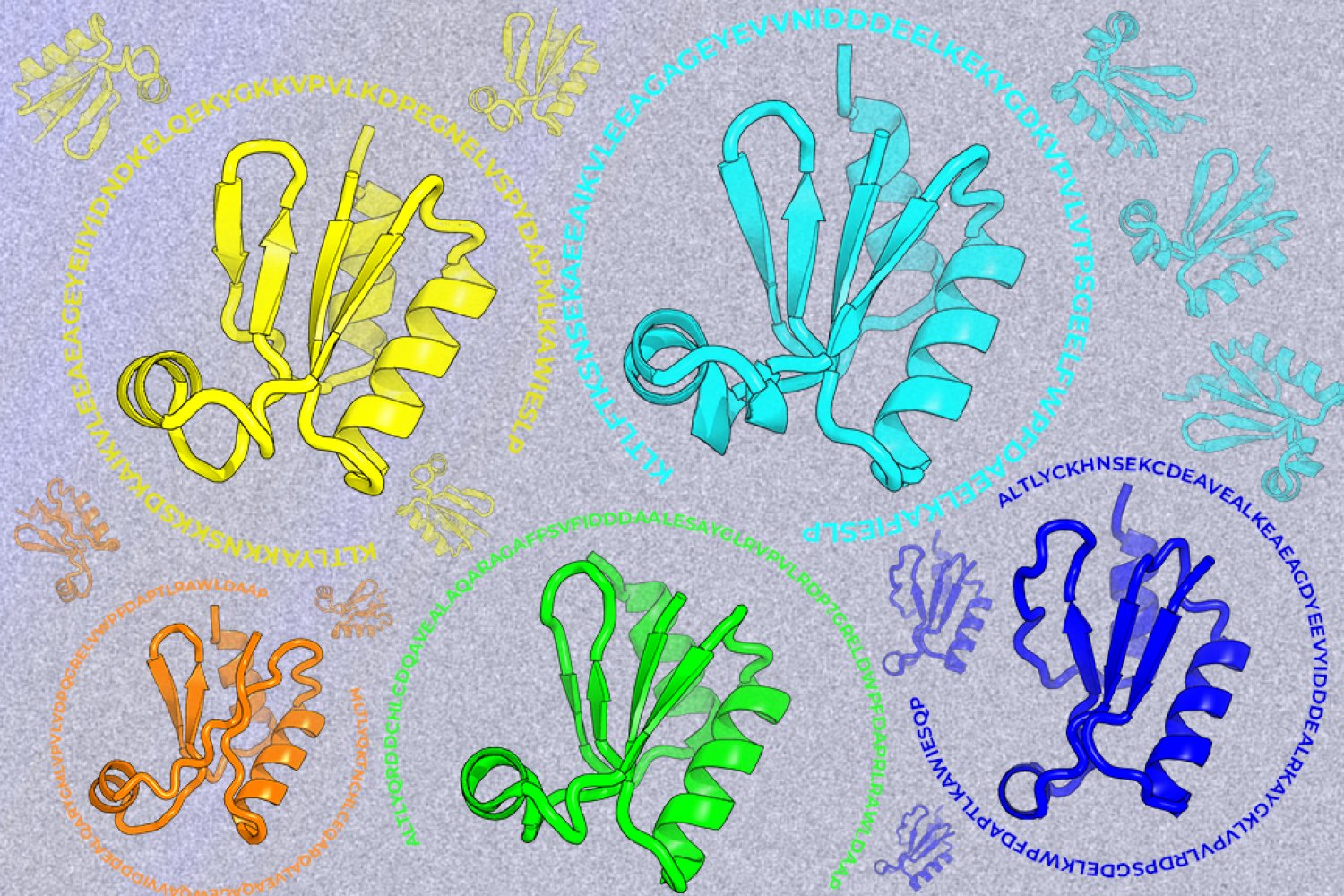
A new machine-learning framework aims to improve the success rate of computational protein design while moving away from results that reproduce sequences found in nature.
MIT News · Artificial Intelligence· news.mit.eduAug 24, 2026
A new method for surgically removing training examples from a model reveals that as datasets grow, the link between what a model learns and what it produces dissolves.