AI-Enabled National Water Conservation and Security System for Qatar A Research and Policy Framework for an Intelligent National Water Digital Twin, Predictive AI and ILM-Based Water Intelligence Platform Prepared as a concept paper for Qatar Government consideration Abstract Qatar’s water security challenge is fundame...
Shafiquddin Ahmed Mohammed Riyaz· Zenodo (CERN European Organi...· 0 citations
Underwater soft robots (USRs) operate in highly dynamic, unstructured, and sensor-limited environments where fluid-structure interaction, compliance, and nonlinear actuation significantly complicate closed-loop control compared with both rigid underwater robots and terrestrial soft robots. As a result, classical underw...
L. NarayananV, Ritik Raj, Ankur Gupta et al.· Bioinspiration & Biomimetics· 0 citations
For analytical clarity, the contributions can be organized into four interrelated thematic areas: Smart Forecasting Beyond Finance; Deep Learning and Hybrid Models for Financial Forecasting; Large Language Models for Next-Generation Forecasting; and Perspectives on Intelligent Forecasting. Together, these themes reflec...
L. Barolli, Antonino Ferraro, Antonio Galli et al.· Frontiers in Big Data· 0 citations
This repository provides the source code, configuration files, synthetic datasets, and experimental results for the paper entitled "Semantic Memory-Regularized Uncertainty-Aware Meta-Reinforcement Learning for Adaptive Task Scheduling in 6G Edge Intelligence". The repository implements a semantic memory-regularized unc...
Fuchun Deng· Zenodo (CERN European Organi...· 0 citations
Reach audiences
Advertise in front of researchers, engineers, and readers.
KODEX — KDRIVE (RL-control). reinforcement-learning controller — a feedback policy learned by the cross-entropy method in the twin plant loop; clamped by KGATEBenchmark: RL policy (cross-entropy): tracking **0.0551** vs naive 0.1225, twin-in-the-loopPart of KODEX, the Kronos Family of Codes — a benchmarked AI/ML fusion...
In this chapter, the author provides an overview of the guiding principles of machine learning (ML), representation, optimization, and generalization, in the well-designed data pipelines. It reviews the bias-variance trade-off as a theoretical model that helps gauge the development of the model and how they perform. It...
R.G. Abaszade, A. V. Alizadeh, M. Singh et al.· Engineering Thermodynamics a...· 0 citations
This repository provides the source code, configuration files, synthetic datasets, and experimental results for the paper entitled "Semantic Memory-Regularized Uncertainty-Aware Meta-Reinforcement Learning for Adaptive Task Scheduling in 6G Edge Intelligence". The repository implements a semantic memory-regularized unc...
Fuchun Deng· Zenodo (CERN European Organi...· 0 citations
KODEX — KDRIVE (RL-control). reinforcement-learning controller — a feedback policy learned by the cross-entropy method in the twin plant loop; clamped by KGATE Benchmark: RL policy (cross-entropy): tracking **0.0551** vs naive 0.1225, twin-in-the-loop Part of KODEX, the Kronos Family of Codes — a benchmarked AI/ML fusi...
Priyanca Ford· Zenodo (CERN European Organi...· 0 citations
With AI quickly making its way into higher education, many scholars are reevaluating how it decides the admissions. A systematic review of the peer-reviewed literature published during 2019 and 2025 throws light to the state of knowledge in relation to AI-led admission systems the details of operational architectures a...
A student can learn anywhere in the world by the unique chance created by E-learning and its advantages. Because of network information technology development, the MOOCs platform has become very popular. At the same time, students get confused in choosing the correct course which fits for the career, creating an increa...
J. Jerin Jose, J. Sridhar, Kamineni Likitha et al.· Computing, Communication, an...· 0 citations
Elastic clouds must continuously decide how much compute, memory and storage capacity to grant to workloads whose intensity and mix change from minute to minute, and classical threshold, queueing and forecasting controllers struggle to hold that balance without either over-provisioning or violating service level agreem...
Research Manager Mike Walker reflects on a career spanning hacker culture, cybersecurity, and AI, sharing lessons about trust, teamwork, leadership, and why solving difficult problems requires curiosity, judgment, agility—and an understanding of the rules. The post Learn the rules: The hacker mindset appeared first on Microsoft Research.
Learn how Google Antigravity and our Cheminformatics Skills accelerate drug discovery workflows, search compounds, and propose novel rigidified macrocycles.
MIT News · Artificial Intelligence· news.mit.eduOct 27, 2026
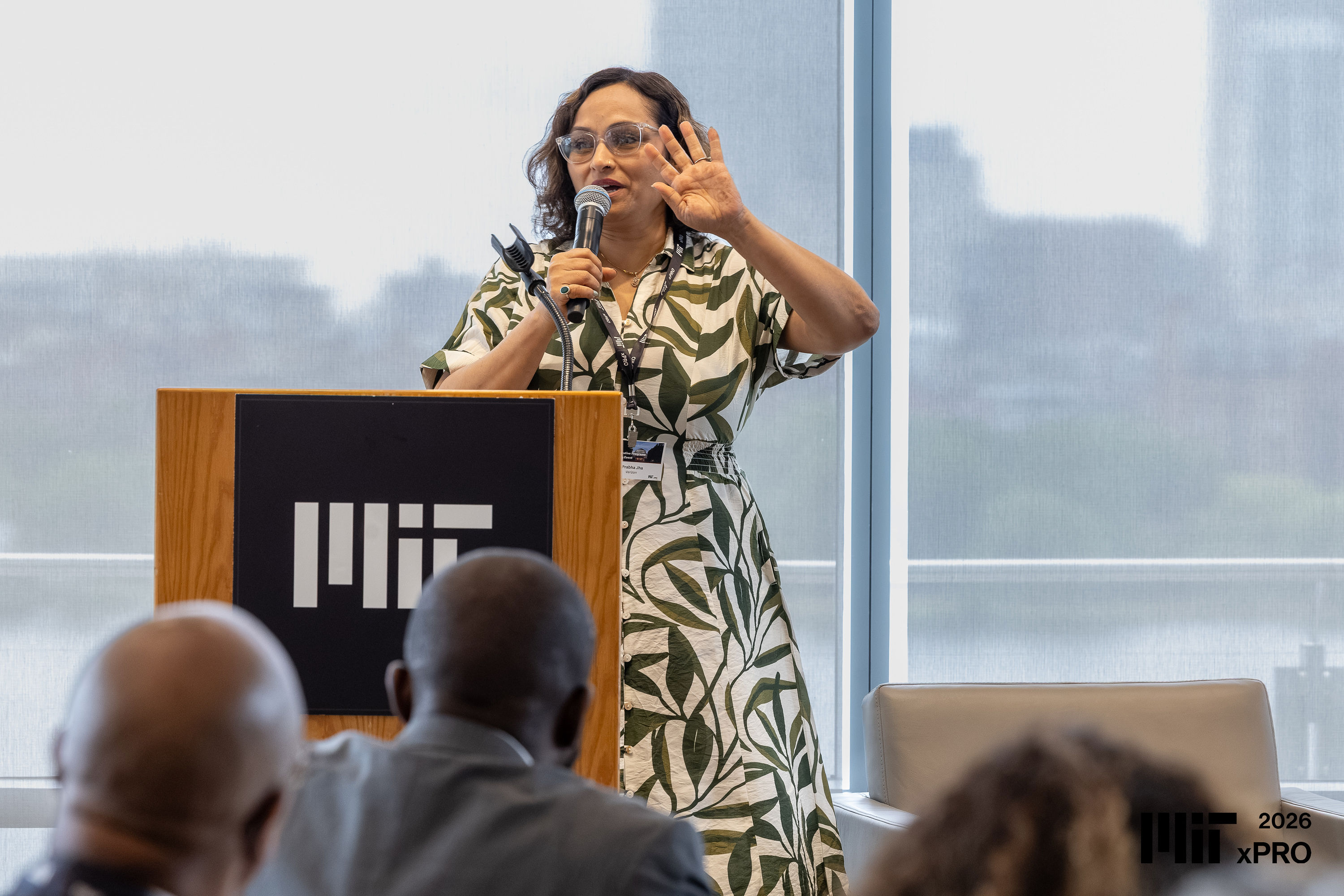
Prabha Jha used her experience with MIT Open Learning’s program for senior executives to develop AI solutions for her employer, Verizon, and to write a book.
Assistant Professor Benjamin Lindquist studies how engineers deliberately injected randomness into early AI, giving rise to deep-learning models that sometimes hallucinate.