This work proposes PAO (Positive-Advantage-Only), a selective RL optimization method that selectively applies gradient updates only to retrieved items with positive advantages, effectively pulling query embed- dings toward high-reward regions while preserving global topo- logical stability.
Shao-Wei Wei, Chong Huang, Songtao Fang et al.· ACM International Conference...· 0 citations
This work identifies a systematic failure mode in RL-trained retrieval agents: outcome-only rewards improve accuracy while degrading faithfulness, a phenomenon the authors term confident hallucination, and addresses this with a faithfulness-gated reward design.
Rec is proposed, an RL-free framework that decouples reasoning from prediction, overcoming the fixed d-dimensional state bottleneck of prior methods, and points to a decoupled, multi-vector recipe that unleashes latent reasoning from the single-state bottleneck of prior methods.
Wenhao Deng, Junchen Fu, Han-Wen Du et al.· arXiv.org· 0 citations
A novel policy network, quantum gated recurrent neural network (QGRNN), which incorporates quantum superposition encoding and cyclic entanglement structures to achieve more efficient state-space exploration and employs a quantum–classical hybrid residual design that effectively integrates quantum measurement outcomes w...
While multi-agent LLM pipelines show real promise for legacy code specifically, since their capacity for autonomous context reconstruction and iterative, feedback-driven refinement directly addresses the sparse documentation and thin test coverage that define legacy environments, the literature to date has been validat...
Harsh Verma· International Journal of Sci...· 0 citations
This work presents VERA-RL, a reinforcement-learning formulation for scientific error detection over academic papers, and constructs VERA-13K, a 12,900-sample dataset organized into 4,300 matched chains, covering 6 scientific-error categories across the research workflow and broad natural-science domains.
Rongjin Li, Yuanxin Liu, Hao Zhou et al.· 0 citations
This work proposes SAFE-G, a Structure-Aware Faithful Evidence-guided Generation framework, which enables precise evidence localization and trustworthy reasoning and introduces a reinforcement learning strategy with an evidence-grounded reward that assigns credit to correct answers only when the selected evidence is co...
Long Shu, Shuo-Chen Liu, Wei Chen et al.· ACM International Conference...· 0 citations
The findings suggest that AI-powered anomaly detection significantly strengthens observability and security in cloud-based applications, enabling proactive threat mitigation and operational optimization in increasingly complex distributed environments.
Harsh Verma· International Journal of Sci...· 1 citation
This work proposes LumiCharge, a novel atomic charge prediction framework that incorporates high-order spherical harmonics convolutions and explicitly models multibody interactions, and demonstrates exceptional extrapolation capability and robustness across molecules of varying sizes, effectively overcoming the limitat...
Qun Su, Hui Zhang, Qiaolin Gou et al.· Journal of Physical Chemistr...· 2 citations
PepBAN is introduced, a deep learning framework for modeling PepPI predictions that effectively learns the pattern of pairwise local interactions, enables the identification of key residues participating in the peptide-protein interactions, and offers an intuitive approach to interpret the underlying mechanisms of PepP...
Shuaiyan Li, Xiaorui Wang, Yuchen Zhu et al.· Journal of Chemical Informat...· 4 citations
Research Manager Mike Walker reflects on a career spanning hacker culture, cybersecurity, and AI, sharing lessons about trust, teamwork, leadership, and why solving difficult problems requires curiosity, judgment, agility—and an understanding of the rules. The post Learn the rules: The hacker mindset appeared first on Microsoft Research.
Learn how Google Antigravity and our Cheminformatics Skills accelerate drug discovery workflows, search compounds, and propose novel rigidified macrocycles.
MIT News · Artificial Intelligence· news.mit.eduOct 27, 2026
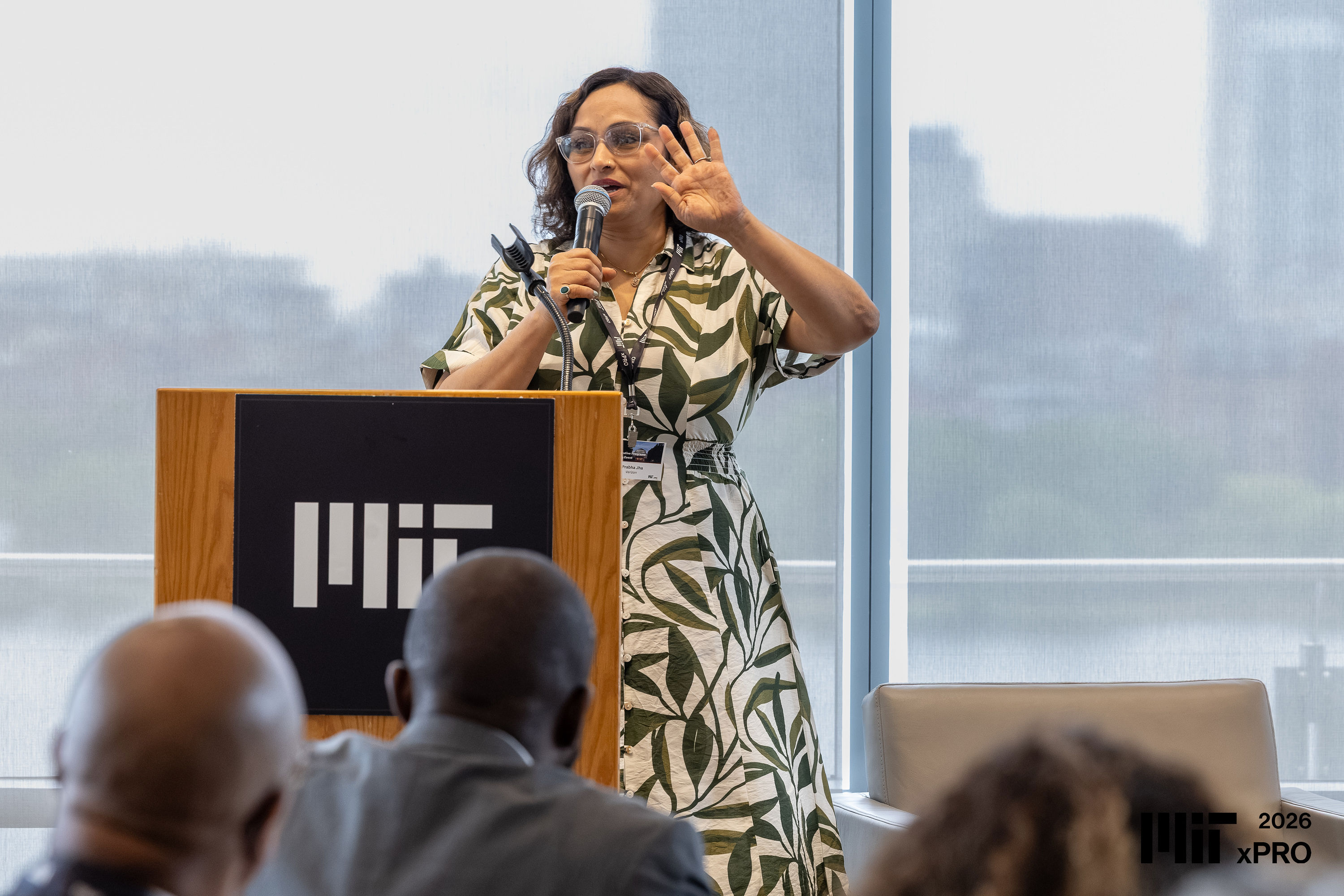
Prabha Jha used her experience with MIT Open Learning’s program for senior executives to develop AI solutions for her employer, Verizon, and to write a book.
Assistant Professor Benjamin Lindquist studies how engineers deliberately injected randomness into early AI, giving rise to deep-learning models that sometimes hallucinate.
We use cookies to run the site and, with your consent, for analytics and to show ads.
See our Cookie Policy.