Large Language Models are evolving from code-completion tools into autonomous software agents capable of inspecting repositories, modifying multiple files, invoking tools, executing tests, and iteratively repairing software systems. This increased capability also creates a governance problem: contemporary coding agents...
Zhongren Wang· Zenodo (CERN European Organi...· 0 citations
First public release of assistcurve, the software accompanying the manuscript Assistance curve analysis: evaluating the clinical value of AI-assisted decision making. What it does Assistance curve analysis extends decision curve analysis from prediction models to a clinician working with a model. The central quantity i...
Marwan Alqumbaey, Yousef M. Nasher· Zenodo (CERN European Organi...· 0 citations
SafeCodeBench is a reproducible longitudinal benchmark for evaluating how software security changes across iterative AI-assisted development. It defines 60 base applications across six categories and five staged evolution steps: initial implementation, persistence/data, authentication, integration, and privilege/admin...
Halil Dursunoglu· Zenodo (CERN European Organi...· 0 citations
Learning fractions remains a significant challenge in elementary education, often hindered by specific learning obstacles. This study aims to develop GeoGebra-assisted teaching materials integrated with a Hypothetical Learning Trajectory (HLT) to bridge the gap between these obstacles and conceptual understanding. Adop...
Andhin Dyas Fitriani, Lea Christina Br Ginting, H. W. Prabawa· Journal of Mathematics Instr...· 0 citations
Reach audiences
Advertise in front of researchers, engineers, and readers.
This paper explores the application of Deep Reinforcement Learning (DRL) to automate software testing. Traditional software testing methodologies heavily rely on predefined rules and templates, often proving inadequate against the complexity and variability of modern software systems. This research proposes a novel app...
Jincheng Zhang· Zenodo (CERN European Organi...· 0 citations
PyFgsea 0.2.0 Release date: 2026-09-02. PyFgsea 0.2.0 updates the statistical core used by the high-level Python API and narrows the trajectory interface to functions that are implemented and tested. The paper remains reproducible with its original software pair; current comparisons use a separate, newer reference pair...
Kuanghao Wang, Hong Shi· Zenodo (CERN European Organi...· 0 citations
Sovereign Cyber-Physical Hypervisor Platform: Hardened Asymmetric Multiprocessing Co-Design Matrix Framework (v1 / REV14-FROZEN) This repository contains the absolute, production-frozen version 1 (v1) parent codebase for the Sovereign Cyber-Physical Hypervisor, implemented in strict compliance with the SEC-AMP-TRILOGY-...
Zachary August Jacoby· Zenodo (CERN European Organi...· 0 citations
Why Fisher's exact test is not exact: achieved size, wasted power, and a routing rule for 2×2 tables William J. Dwyer, MD, MPH, FAAP — Department of Mathematics and Statistics, University of Massachusetts Lowell. ORCID 0009-0004-0855-7222. Concept DOI (always resolves to the latest version): 10.5281/zenodo.22238930. Th...
William Dwyer· Zenodo (CERN European Organi...· 0 citations
This study aims to determine the influence of Work Discipline (X1) and Work Motivation (X2) on Employee Performance (Y) at CV. Kombos Tendean Manado, both partially and simultaneously. The study is grounded in the crucial role of human resources as the primary driver for achieving organizational goals; consequently, em...
Meilani Naomi Panjaitan, M. Manopo, C. Karambut· Lokawati : Jurnal Penelitian...· 1 citation
Whole-exome sequencing (WES) enables the identification of rare germline variants contributing to pediatric diseases. Trio-based sequencing, comparing affected children with their parents, is particularly effective for rare disease genetics. However, WES data analysis requires bioinformatics expertise, varies across in...
Sara-Luisa Reh, C. Walter, J. Lohse et al.· Scientific Reports· 0 citations
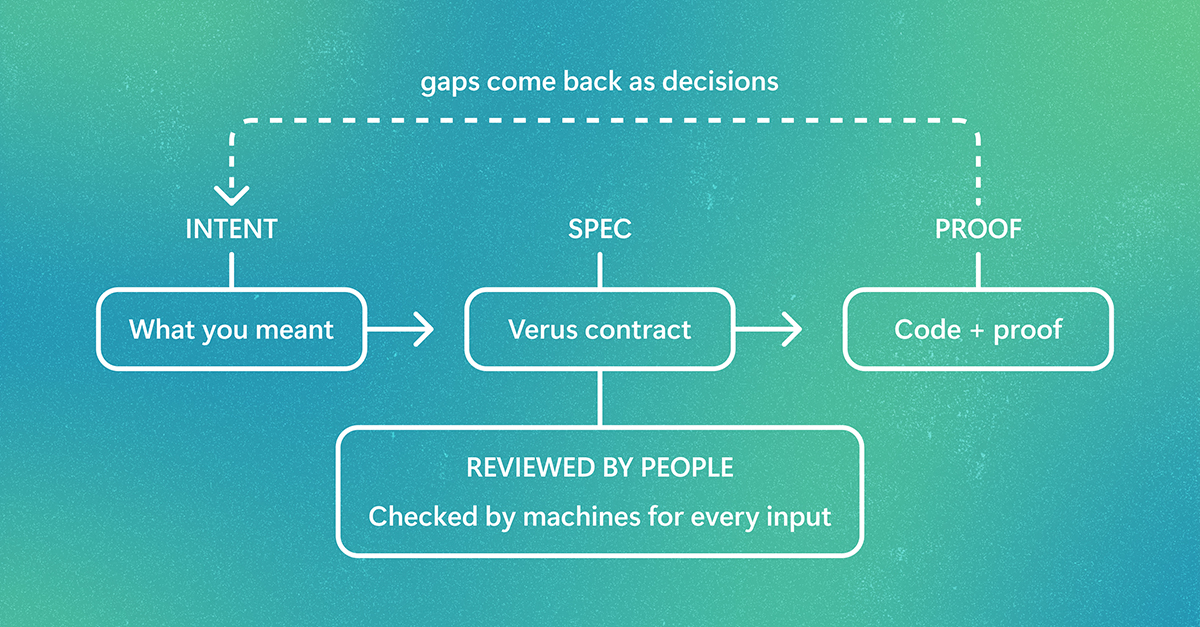
AI agents can generate code at a scale that’s hard for humans to review line-by-line. PDD Kit helps ensure the code is doing what the developer intended by creating formal specifications and testing against them. It converts developer intent into a Verus specification, proves AI-generated code meets it for every input, and uses tests where proofs aren't practical. Developers review intent, not every line. The post Formally verifying agent-written full-stack web apps with PDD Kit appeared first o…
Is your company’s AI sovereign? A practical guide for CIOs on AI vendor lock-in, EU Data Act switching, cloud sovereignty, and testing your exit plan before you need it. The post Sovereignty Is the Option to Leave appeared first on GPT-Lab.
Microsoft Research Blog· microsoft.comOct 30, 2026
Evaluating Microsoft Copilot at enterprise scale requires test data that captures the full complexity of real organizations, yet real enterprise data contains sensitive information that cannot be used for evaluation under any circumstances. The post From synthetic enterprise data evaluations to real Microsoft Copilot AI confidence appeared first on Microsoft Research.
Microsoft Research Blog· microsoft.comOct 29, 2026
Host Sowbhagya Suresh shares some of the latest news and cutting-edge research from across Microsoft—from understanding the challenges facing coding agents to uncovering how people use AI at work and improving extended-range weather forecasting. The post Microsoft Research Focus – Edition #97 appeared first on Microsoft Research.