Accuracy and intolerance to interference of GNSS receivers depend on the efficiency of tracking modules. To achieve better characteristics, designers should implement various issues, affecting the process of tracking in these modules: integration interval, spacing and configuration parameters of PLL and DLL. The articl...
S. Shafran, I. Kudryavtsev, A. Kumarin· Infokommunikacionnye tehnolo...· 0 citations
This work proposes BreakGuard, an approach that generates a test suite to detect breaking changes in clients and successfully detected BCs from different library categories, but finds LLM-generated tests to be more reliable for detecting crash-type breaking changes as opposed to behavioural BCs.
Rachna Raj, Benoit Baudry, Diego Elias Costa· 0 citations
To address fatigue failure, weld cracking and resonance in steel-frame pedestals caused by mechanical vibration, this study proposes a composite steel frame fabricated by integrating concave hexagonal negative-Poisson’s-ratio honeycomb structures with I-shaped steel, aiming to achieve the integrated structural function...
Shuang Guo, Yajun Zhao· Proceedings of the Instituti...· 0 citations
Repo0 is presented, a continuous structural evolution framework for zero-to-all code generation that maintains an explicit architectural state instantiated as a Dual-Directed-Acyclic-Graph (Dual-DAG), consisting of a requirement-level DAG, a component-level DAG, and their alignment relation.
Si-Lin Chen, Haoyi Teng, Xiao-Dong Gu et al.· 4 citations
Reach audiences
Advertise in front of researchers, engineers, and readers.
This work presents an end-to-end, deployment-aware testing pipeline for IoT-based automotive applications that combines requirement-driven test and code generation with large language model (LLM) and vision-language model (VLM) assistance, and human-in-the-loop curation to reduce manual effort and improve consistency.
Denesa Zyberaj, Roman Vintonyak, Pascal Hirmer et al.· 0 citations
An audit-and-placebo protocol is proposed that separates verifier artifacts, interaction scaffolding, and grounded feedback credit in evaluations of self-evolving test generators in evaluations of self-evolving test generators.
Yunhao Liang, Chengguang Gan, Ruixuan Ying et al.· 0 citations
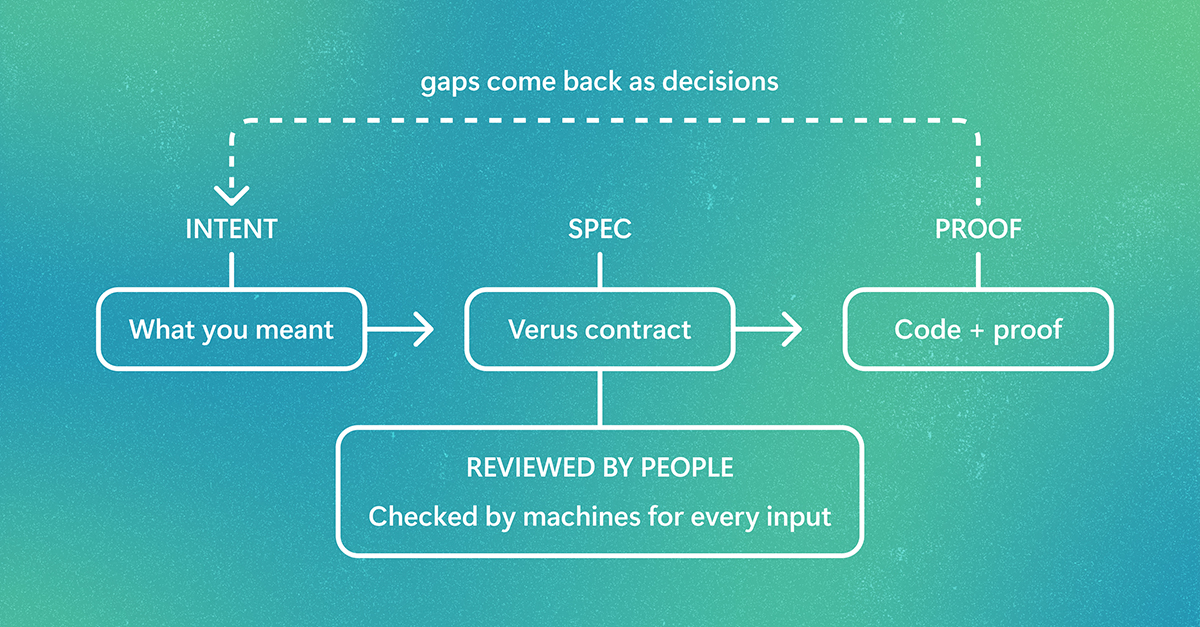
AI agents can generate code at a scale that’s hard for humans to review line-by-line. PDD Kit helps ensure the code is doing what the developer intended by creating formal specifications and testing against them. It converts developer intent into a Verus specification, proves AI-generated code meets it for every input, and uses tests where proofs aren't practical. Developers review intent, not every line. The post Formally verifying agent-written full-stack web apps with PDD Kit appeared first o…
Is your company’s AI sovereign? A practical guide for CIOs on AI vendor lock-in, EU Data Act switching, cloud sovereignty, and testing your exit plan before you need it. The post Sovereignty Is the Option to Leave appeared first on GPT-Lab.
Microsoft Research Blog· microsoft.comOct 30, 2026
Evaluating Microsoft Copilot at enterprise scale requires test data that captures the full complexity of real organizations, yet real enterprise data contains sensitive information that cannot be used for evaluation under any circumstances. The post From synthetic enterprise data evaluations to real Microsoft Copilot AI confidence appeared first on Microsoft Research.
Microsoft Research Blog· microsoft.comOct 29, 2026
Host Sowbhagya Suresh shares some of the latest news and cutting-edge research from across Microsoft—from understanding the challenges facing coding agents to uncovering how people use AI at work and improving extended-range weather forecasting. The post Microsoft Research Focus – Edition #97 appeared first on Microsoft Research.