Human evaluation provides a direct measure of the quality of LLM-generated web applications. However, fitting human judgments through automated evaluation remains challenging. Static benchmarks can credit functionality that exists in source code but is unreachable at runtime. Interactive benchmarks exercise the application, yet incomplete exploration can cause them to miss implemented functionality and confound application defects with agent execution failures. To address these limitations, we propose IWC-Bench, an interactive benchmark for evaluating web application generation from a software testing perspective. IWC-Bench instruments each generated application and uses code coverage to guide an agent in exploring its functionality through user-simulated interactions. It then abstracts the interaction trace into a state-transition graph and evaluates the application along three dimensions: visual aesthetics, usability, and requirement alignment. By separating exploration from scoring, IWC-Bench collects runtime evidence without constraining exploration to predefined acceptance criteria. IWC-Bench comprises 369 real-world user requirements and 5,088 acceptance criteria. Evaluation of 17 frontier LLMs reveals distinct strengths across the three dimensions, with no model leading on every dimension. On 197 validated sessions sampled from an internal arena, IWC-Bench achieves 85.3\% agreement with human preferences, with agreement generally increasing as the score difference between paired applications grows. Further experiments show that coverage guidance improves exploration coverage and the model rankings remain stable when the judge model is replaced.
The paper asks whether high-level conceptual specifications improve LLM-generated PBT quality and whether they help developers extend and maintain AI-generated systems (RQ2), and reports preliminary results applying Spinach to two open-source applications.
Savitha Ravi, Michael Coblenz· Proceedings of the 1st Inter...· 0 citations
Evaluating WebUI code generation at scale is difficult: outputs may compile and look plausible yet fail under user interaction, and prior benchmarks largely rely on free-form prompts with static checks (build success, screenshots) that miss functional correctness. We introduce WebUIProof, an execution-oriented benchmar...
Yun-Yun Tsai, Yu-Ning Mao, Shi-Qi Wang et al.· 0 citations
ProgramDistill is introduced, a benchmark evaluating coding agents on features discovered through interaction with fully functional reference applications, and provides a scalable benchmark with controlled difficulty for evaluating and diagnosing coding agents, and a natural basis for future curriculum-based training.
Jeonghye Kim, Minseon Kim, Young Jin Kim et al.· 0 citations
CAT is introduced, a paradigm in which the agent writes Playwright code to drive the browser, gathers feedback, and autonomously explores web applications to uncover bugs, revealing a clear gap between current VLM capabilities and the demands of real-world testing in AI web development.
Bin Hong, Zhen-Chao Zhang, Ji-Yuan He et al.· 0 citations
As LLMs become increasingly capable of implementing software, a critical bottleneck emerges: whether they truly understand what users want. Users often begin with vague intent, leaving important requirements to be clarified through interaction. In repository-level development, misunderstandings can propagate and cause...
Ming-Yu Chen, Zhiqing Zhong, Man-Yi Wang et al.· 0 citations
VibeCheck provides a reliability-oriented framework for evaluating LLM-generated tests beyond pass/fail outcomes, and shows a clear execution-adequacy gap: generated tests are often runnable but frequently lack strong assertions and meaningful behavioral coverage.
Anika Tabassum, Mushahid Intesum, Md. Fahim Arefin et al.· Proceedings of the 1st Inter...· 0 citations
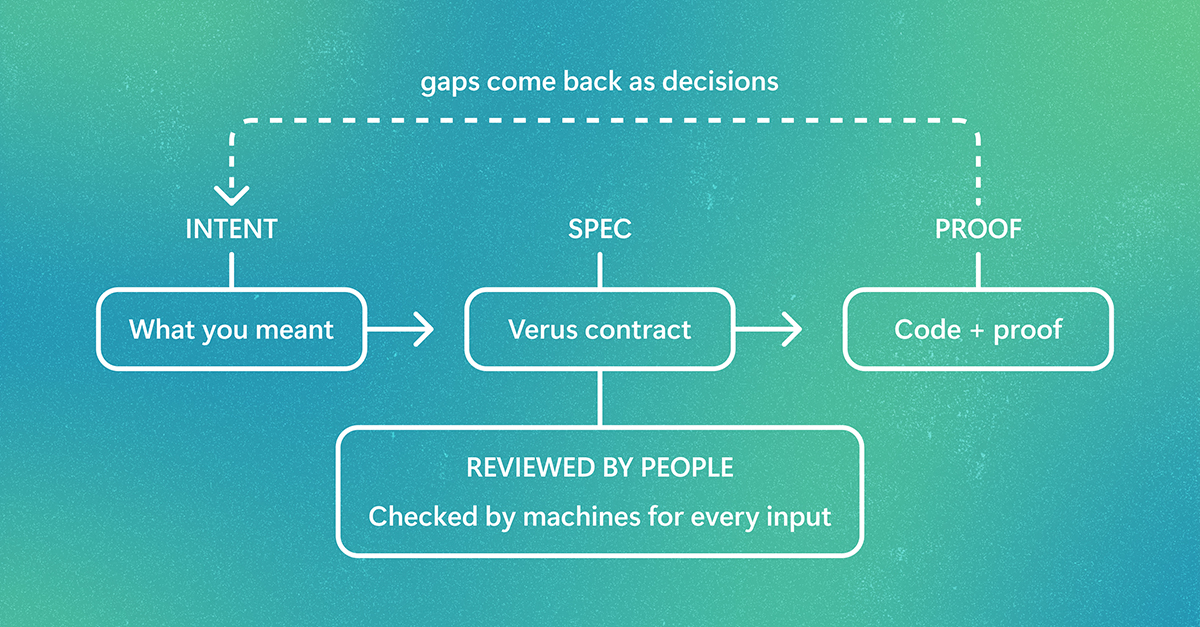
AI agents can generate code at a scale that’s hard for humans to review line-by-line. PDD Kit helps ensure the code is doing what the developer intended by creating formal specifications and testing against them. It converts developer intent into a Verus specification, proves AI-generated code meets it for every input, and uses tests where proofs aren't practical. Developers review intent, not every line. The post Formally verifying agent-written full-stack web apps with PDD Kit appeared first o…