Sep 2026· Programming Languages and Operating Systems· 0 citations· 19 references
Computer Science
TL;DR
This work presents a methodology that lets us validate an abstract formal model against real hardware by generating test cases, executing them on real hardware to capture traces of observable behavior, and employing a synthesis approach to identify the internal microarchitectural steps that explain the observable behavior.
Abstract
Verifying low-level system code requires reasoning about how software interacts with the hardware environment on which it runs. Typically, this means specifying an abstract model of the hardware and verifying the code against it. However, the validity of the verification result depends on the accuracy of the formalized hardware model. Unfortunately, validating the accuracy of the formalized hardware model is hard. It not only requires relating the model's specification to the observable behavior of real hardware, but also involves many invisible internal microarchitectural steps that influence the observable execution of a modern processor. We present a methodology that lets us validate an abstract formal model against real hardware by generating test cases, executing them on real hardware to capture traces of observable behavior, and finally employing a synthesis approach to identify the internal microarchitectural steps that explain the observable behavior. We discuss this methodology for an x86 MMU model of TLB and page-table behavior, using model-specific state reductions to keep test generation and synthesis tractable and to illustrate how similar reduction arguments can apply in other hardware-model contexts.
This work presents a model-driven code generator transforming static USF specifications into executable software simulations that abstract cycle-accurate timing and helps shorten validation cycles, ultimately reducing the risk of costly design flaws.
Robert Kunzelmann, Raphael Kunz, Stephanie Ecker et al.· Journal of Signal Processing...· 0 citations
Analyzing, understanding, and validating the performance of modern processors present significant challenges. These stem from two primary issues. First, it is difficult to construct “performance tests” that can test precisely scoped hypotheses about microarchitectural behavior. Second, it is difficult to make sense of...
Guo-Kai Chen, Sergi Soler Arrufat, Clément Pit-Claudel et al.· Proceedings of the ACM on Pr...· 0 citations
Verilator is the premier open-source Hardware Description Language (HDL) compiler. It transforms Verilog and SystemVerilog designs into optimized C++ or SystemC models, enabling high-speed, cycle-accurate simulation prior to large-scale production. As a cornerstone of the hardware verification ecosystem, the correctnes...
Song-Yan Jiang, Mao-Lin Sun, Kang Chen et al.· Proceedings of the ACM on So...· 0 citations
LLMs are making code modernization, translation, and rewriting easier and more scalable, enabling software to be transpiled across programming languages and compilers, and optimized for specific hardware platforms. For numerical software relying on finite-precision arithmetic, however, these transformations may introdu...
Laura Titolo· Proceedings of the 11th ACM...· 0 citations
This work studies an internal signal of code correctness that is able to judge candidate solutions better than the model's token-level or stated confidence, leaving open an important question: whether it reflects a robust property of the model or an artifact of that choice.
Francisco Ribeiro, Sohaila Abdulsattar, R. Gonzalez et al.· 1 citation
The potential of integrating the compiler infrastructure with symbolic execution, thereby obtaining a program representation optimized for SMT solving, is illustrated by contributing conditional representation, a novel compiler transformation tailored to symbolic execution that results in a solver-efficient representat...
Sören Tempel, Christian Dietrich· Proceedings of the 8th Inter...· 0 citations
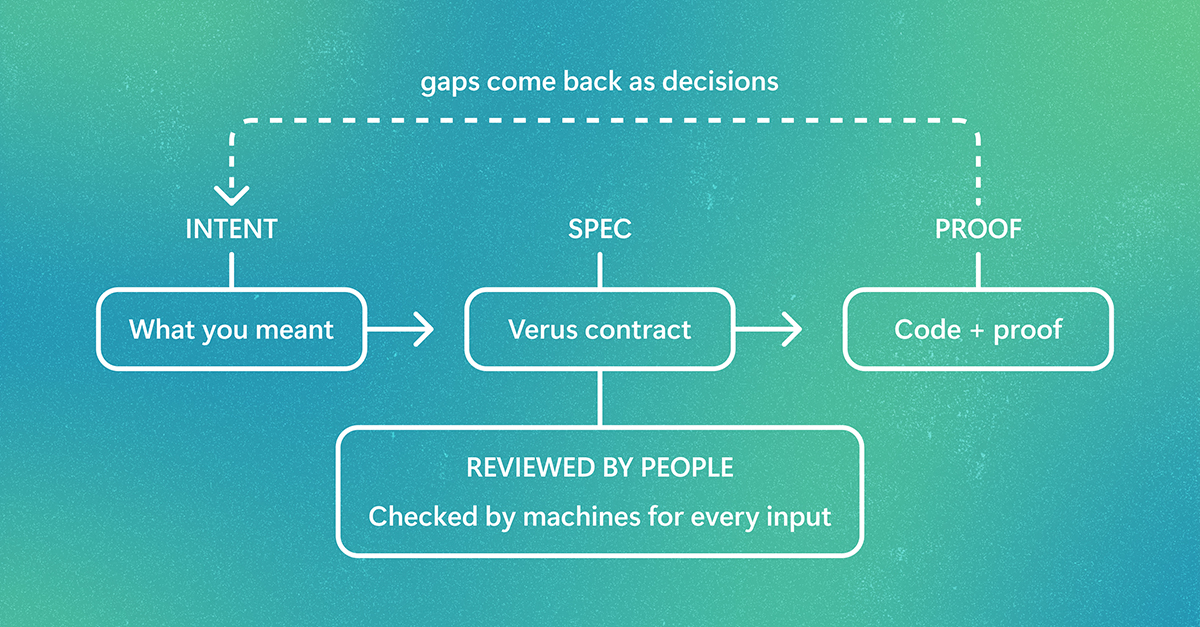
AI agents can generate code at a scale that’s hard for humans to review line-by-line. PDD Kit helps ensure the code is doing what the developer intended by creating formal specifications and testing against them. It converts developer intent into a Verus specification, proves AI-generated code meets it for every input, and uses tests where proofs aren't practical. Developers review intent, not every line. The post Formally verifying agent-written full-stack web apps with PDD Kit appeared first o…
Is your company’s AI sovereign? A practical guide for CIOs on AI vendor lock-in, EU Data Act switching, cloud sovereignty, and testing your exit plan before you need it. The post Sovereignty Is the Option to Leave appeared first on GPT-Lab.
Microsoft Research Blog· microsoft.comOct 30, 2026
Evaluating Microsoft Copilot at enterprise scale requires test data that captures the full complexity of real organizations, yet real enterprise data contains sensitive information that cannot be used for evaluation under any circumstances. The post From synthetic enterprise data evaluations to real Microsoft Copilot AI confidence appeared first on Microsoft Research.
We use cookies to run the site and, with your consent, for analytics and to show ads.
See our Cookie Policy.