Sep 2026· Proceedings of the 2026 ACM Conference on Human-AI Complementarity and Alignment· 0 citations· 39 references
TL;DR
This work contributes a typology of eight incongruence modes as a vocabulary for the structural breakdowns that human-agent collectives produce, specifying a generative model of human-agent collectives and using Monte Carlo simulation to parameterize it.
Abstract
Socio-technical congruence is the fit between the coordination required by a project’s technical dependencies and the coordination its participants actually perform. The construct was developed for human software teams, where assignments are stable, timescales are comparable, channels are observable, and dependencies are code-level. Once AI agents join such collectives, these conditions break down. Existing taxonomies map the design space of human-agent collectives, but do not adapt the dependency-coordination construct itself. We contribute a typology of eight incongruence modes as a vocabulary for the structural breakdowns that human-agent collectives produce. We derive the typology by naming four scope conditions the original construct implicitly relied on, redefining the coordination-requirements matrix over a typed and time-varying actor and dependency graph, and enumerating the asymmetric ways the four conditions fail. To give each mode a testable form, we specify a generative model of human-agent collectives and use Monte Carlo simulation to parameterize it, yielding one incongruence rate curve per mode as a starting point for empirical work.
This paper presents STiMUS (Stigmergy and Mutualism in Socio-Technical Systems), an agent-based model implemented in NetLogo 7.0. The model formalises two complementary coordination mechanisms in digital project teams. The first is stigmergy: contributor agents select shared artefacts to work on by following traces lef...
Artificial systems increasingly participate in organizational work as recurrent contributors to interdependent activity, yet research remains fragmented across system capabilities, individual responses, episodic interactions, and constructs derived from human-only teams. This article develops Organismic Human-Artificia...
A. Rovetta, A. Bortolotti, C. Di Berardino· Frontiers in Organizational...· 0 citations
The introduction of Relic, which turns recurring collaboration failures into organization-owned, executable protocols, and how collaboration experience can become persistent organizational state that remains useful beyond the members who created it are shown.
Hong-Yi Du, Tian-Yi Zhang, Wei-Jia Zhang et al.· arXiv.org· 0 citations
It is argued that design for safe and effective teamwork must consider how human and software roles together manage, change, and coordinate their collective configuration over time to respond to changing work demands.
M. Ijtsma, Salvatore Hargis· The AI Magazine· 0 citations
A modeling specification for recursive organization improvement is proposed and evaluated through an executable checker, a public-record mapping, and two simulation studies, which shows how dependence changes the preferred placement of human judgment under a fixed budget.
An audit is introduced that predicts a mechanism's fate as a population grows, asking how often the mechanism can act, whether agents use the information it supplies, and whether the measurement itself creates apparent scale effects.
Zeng-Qing Wu, Chuan Xiao· 0 citations
Related blog posts
Microsoft Research Blog· microsoft.comNov 12, 2026
What's new in research at Microsoft? Host Anson Ho explores the latest, including AI-powered universal translation, a breakthrough in a 31-year-old mathematics challenge, and advances making AI coding agents faster and more efficient. The post Microsoft Research Focus – Edition #98 appeared first on Microsoft Research.
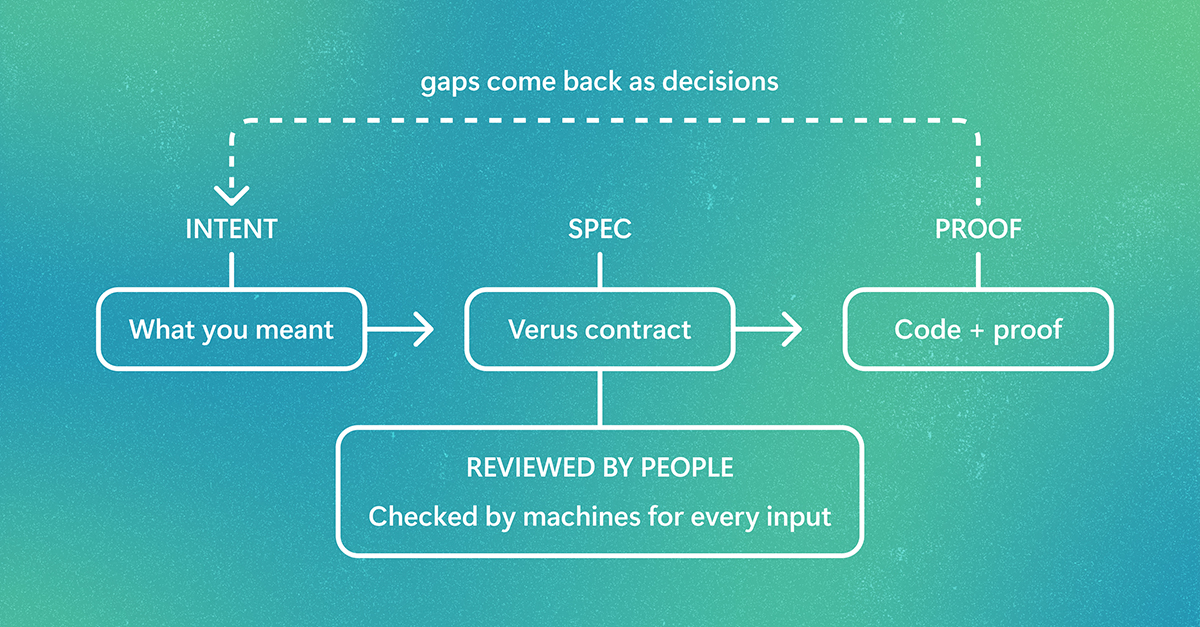
AI agents can generate code at a scale that’s hard for humans to review line-by-line. PDD Kit helps ensure the code is doing what the developer intended by creating formal specifications and testing against them. It converts developer intent into a Verus specification, proves AI-generated code meets it for every input, and uses tests where proofs aren't practical. Developers review intent, not every line. The post Formally verifying agent-written full-stack web apps with PDD Kit appeared first o…