A Lightweight CNN Integrated Compact Convolutional Transformer for Multi-Scale Feature Learning and reducing computational complexity for breast cancer mammography image detection and classification
Lighter than ViT, which is effective in capturing long-range dependencies, the proposed CNN-integrated CCT has also proven efficient in breast cancer classification by capturing long-range dependencies among breast tissue regions.
Abstract
Over the years, Convolutional Neural Networks (CNNs) have demonstrated strong capability in cancer detection and classification using medical images. However, CNN-based models often struggle to capture long-range contextual dependencies. In such scenarios, integrating Compact Convolutional Transformer (CCT) architectures after the CCT layer allows CNN-extracted features to reshape into compact patch tokens using a CCT tokenizer, followed by the addition of positional embeddings to preserve spatial structure. Using 5-fold cross-validation, the model was tested on 3 sets of breast cancer mammography. With only 250,435 parameters, the model achieved 99%-100% accuracy across 3 datasets, indicating robust generalization. Explainable AI (XAI) was integrated into the model to explain the breast cancer classification process to enhance clinical trust. The results indicate that the proposed framework is suitable for computer-aided diagnosis systems, particularly in resource-constrained clinical environments. The novelty of the proposed CNN-integrated CCT overcomes the limitation of CNN's gradient degradation in the last layers by integrating convolutional tokenization with transformer-based learning. Lighter than ViT, which is effective in capturing long-range dependencies, the model has also proven efficient in breast cancer classification by capturing long-range dependencies among breast tissue regions.
OBJECTIVE
A resource-efficient convolutional neural network with conditional generative adversarial networks (RECNN-CGAN) is proposed for mammogram classification and diagnosis (MCD) to achieve accurate and computationally efficient breast cancer diagnosis.
METHODS
The system employs Gaussian filtering for noise remo...
Helan Vidhya Thankaraj, M. Thiyagarajan· Current medical imaging· 0 citations
The proposed HrybridViT-CAM, a hybrid deep learning system that integrates convolution neural networks, Vision Transformers, and multi-scale attention system in order to classify breast cancer using histopathology images was able to detect the malignant regions of interest (ROIs) like nuclei pleomorphism, atypia chroma...
S. Angayarkanni, Mithila R, Koushik Rithik et al.· ITM Web of Conferences· 0 citations
Medical image classification is important for computer-aided disease diagnosis due to its potential in identifying diseases from clinical images. Convolutional Neural Networks have been proved capable of modelling local spatial and textural features but are believed to be weak in capturing long-range dependencies. On t...
Shubham Vashishtha, Shiwangi Choudhary· International journal for ad...· 0 citations
A robust soft-voting ensemble-based deep learning model for automatic binary breast cancer identification using histopathology images can achieve effective classification performance without excessive attention complexity while keeping clear visual evidence.
M. Tiar, Nadjiba Terki, Z. Kahhoul et al.· Cluster Computing· 0 citations
Breast cancer diagnosis from histopathological images remains a critical yet challenging task due to high intra-class variability and reliance on expert interpretation. Although deep learning models have achieved promising results, many existing approaches suffer from limited interpretability and insufficient modelling...
B. Kaur, R. Popli, R. Ghoniem et al.· Revista Internacional de Mét...· 0 citations
Exploring how generative AI could make machine vision more accessible to businesses. The post GenEye in a Box: Making Machine Vision Something You Can Just Ask For appeared first on GPT-Lab.
Microsoft Research Blog· microsoft.comAug 11, 2026
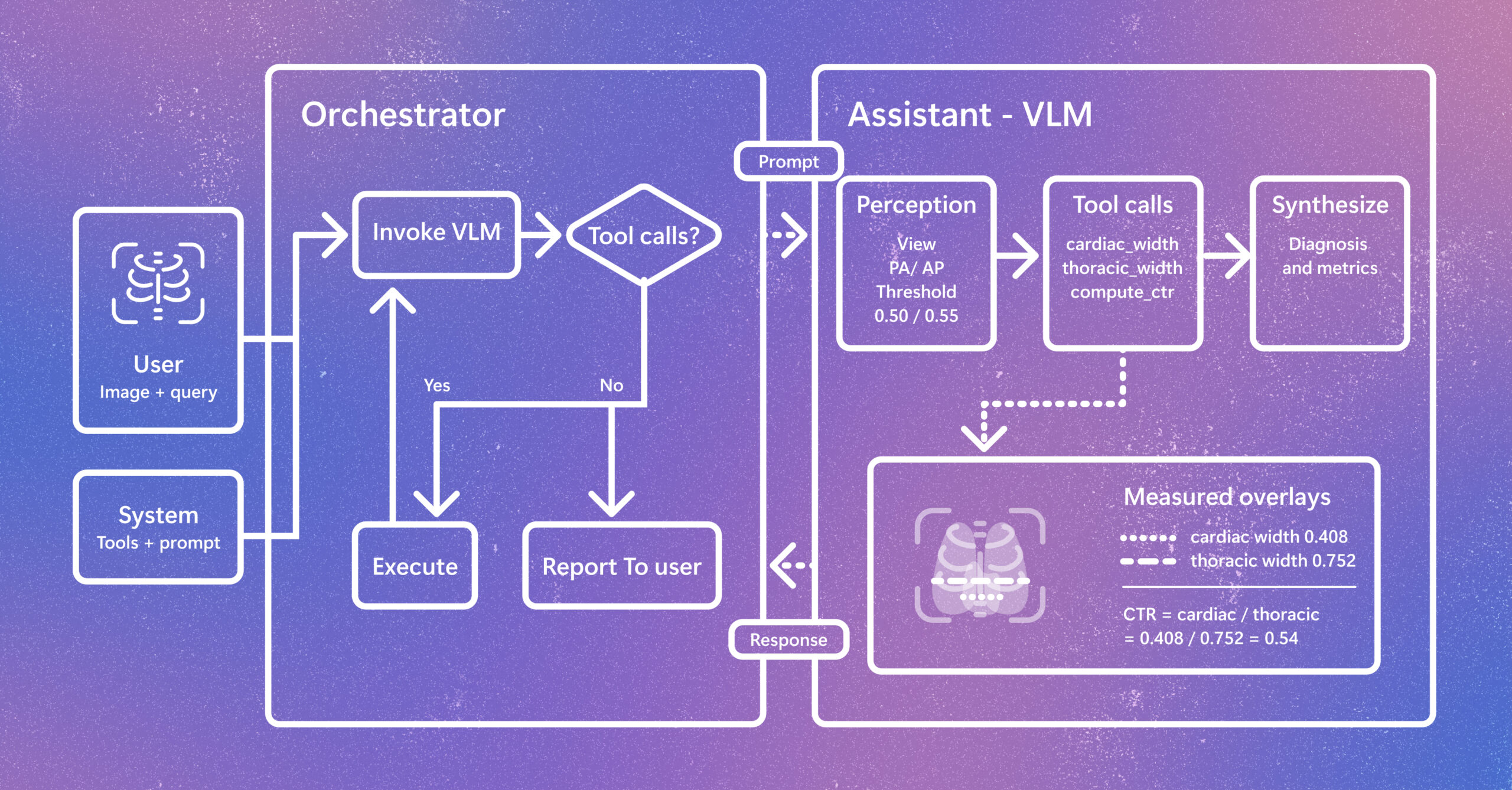
Radiology AI is evolving beyond report generation. CARE-X explores a unified approach that combines flexible reasoning, calibrated predictions, and measurement-based tools for chest X-ray interpretation. The post Introducing CARE-X: Towards Clinically Useful Radiology VLMs with Auxiliary Supervision, Reward-Aligned Learning, and Tool-Augmented Measurement appeared first on Microsoft Research.
Learn how Google DeepMind and GovTech Singapore uses lightweight on-device Gemma models to intercept conversational scams in private chats with zero cloud data egress.
We use cookies to run the site and, with your consent, for analytics and to show ads.
See our Cookie Policy.
