This work analyzes TSFM post-training methods based on their locus of intervention in the prediction pipeline, yielding five categories: parameter adaptation, context augmentation, model composition, output processing and uncertainty control, and compression and specialization.
Abstract
Time series foundation models (TSFMs) have emerged as general-purpose models for time series analysis, but pretraining alone is often insufficient for reliable downstream deployment. Bridging this gap requires further intervention to handle domain shift, task heterogeneity, limited supervision, and computational constraints, which motivates post-training as a broad class of methods to adapt, augment, compose, calibrate, or specialize pretrained TSFMs for downstream tasks. In this work, we analyze TSFM post-training methods based on their locus of intervention in the prediction pipeline, yielding five categories: parameter adaptation, context augmentation, model composition, output processing and uncertainty control, and compression and specialization. Within each category, we study main representative methods and discuss their current limitations. We further identify future directions toward controlled adaptation, reliable context construction, uncertainty-aware model composition, calibrated output processing, and deployment-aware specialization. Overall, by providing a unifying framework for the emerging TSFM post-training landscape, this work aims to support future research to navigate the design space between a pretrained TSFM and its reliable downstream deployment.

This work introduces ORBIT (Omni-Range Bootstrap Incremental Training), a training paradigm that makes this distribution explicit and controllable and introduces Rank-Guided Cross-Depth Alignment, a training objective that uses late-layer representations as stop-gradient teachers for shallow layers without additional i...
Hongjie Xia, Yi-Ding Liu, Yi-Fan Hu et al.· 5 citations
A novel pattern-guided mixture-of-experts that expands model capacity through sparse activation and uses shallow patch similarities to constrain deep-layer routing, guiding expert specialization across heterogeneous time series and an implicit quantile network head that predicts arbitrary quantiles to characterize pred...
Xingjian Wu, Chen-Juan Guo, Xiangfei Qiu et al.· 0 citations
Digital twins increasingly support downstream analytical tasks that depend on time-series data, motivating interest in time-series foundation models (TSFMs) as scalable backbones. However, TSFMs are primarily pretrained for temporal continuation and often underperform on unseen tasks such as regression, and systematic...
Si-Zhe Ma, Katherine A. Flanigan, Mario Bergés· 1 citation
Tabby, a long context probabilistic time series foundation model, is released together with a complete and open recipe of how it was built, which achieves competitive zero-shot forecasting performance on GIFT-Eval and the out-of-distribution TIME benchmark.
Shi-Feng Xie, Bahaeddine Abdessalem, Ze-Hao Xiao et al.· 1 citation
This work connects forecasting loss to optimization difficulty by showing that normalized squared loss controls the per-sample gradient norm under a local Jacobian condition and defines a reference loss score and applies dataset-stratified selection to preserve the diversity of samples.
Latent Inference-Time Guidance for TSFMs is introduced, which adaptively combines a pool of TSFM forecasts through a time-dependent latent space with independent components that comes equipped with identifiability and reconstruction guarantees, whilst maintaining the off-the-shelf aspect of foundation models.
Chloé Hashimoto-Cullen, Amaury Durand, Laurent Bozzi et al.· 0 citations
Related blog posts
MIT News · Artificial Intelligence· news.mit.eduOct 13, 2026
Machine-learning networks can learn without detailed instructions from a designer. Those that do may offer insight into how the brain reorganizes itself during learning.
MIT News · Artificial Intelligence· news.mit.eduSep 29, 2026
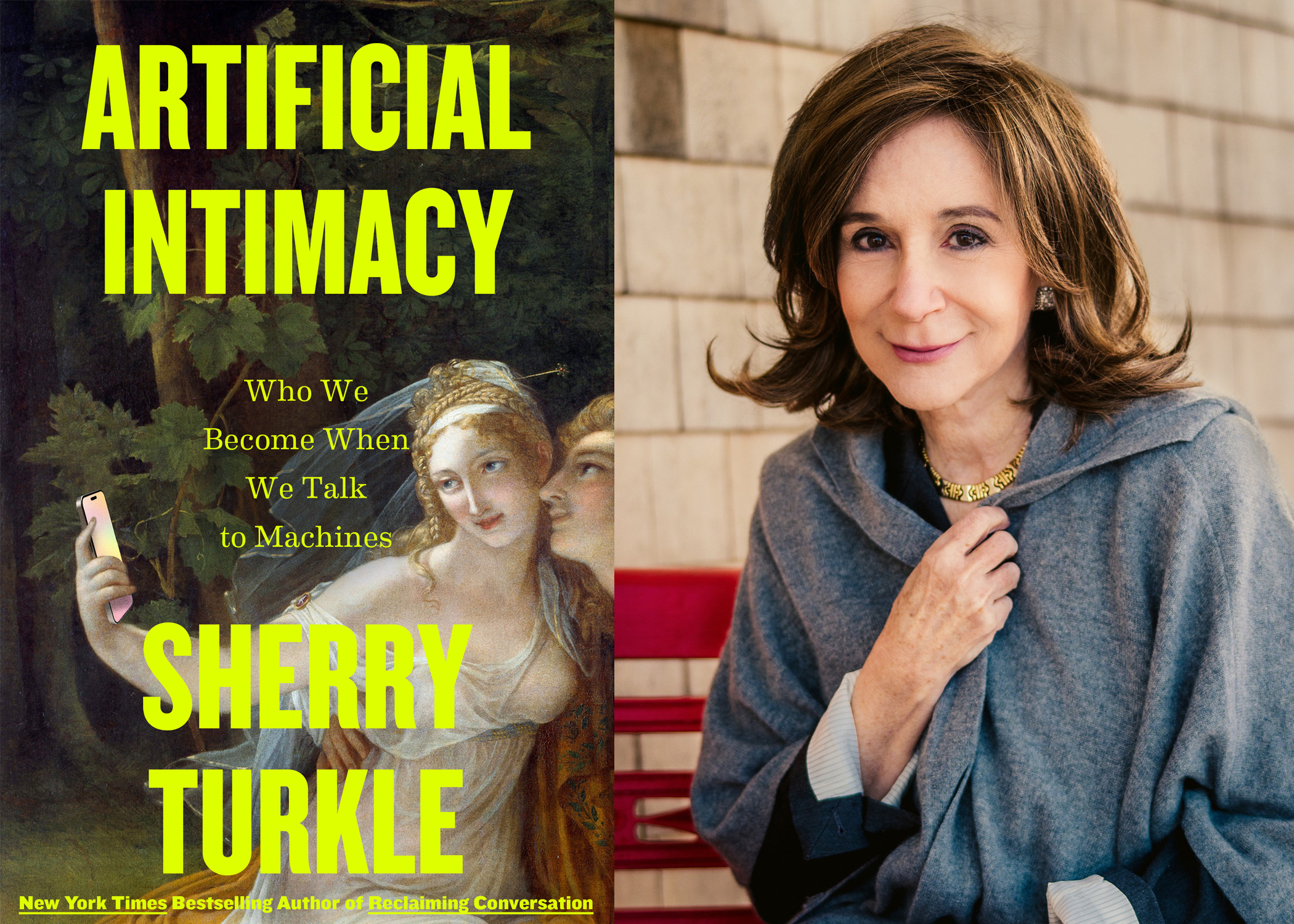
Professor Sherry Turkle’s new book, “Artificial Intimacy,” offers a withering critique of chatbots and the antisocial dynamics she believes they encourage.