Skip to content
#robotics #human-computer interaction Conference Open access

Real-Time Service Robot Replanning Via Simple Button Interaction for Improved Task Success and User Experience

Jul 2026 · IEEE International Symposium on Robot and Human Interactive Communication · pp. 1154-1159 · 0 citations · 23 references
Computer Science

TL;DR

Experimental results support the study's hypothesis and indicate that incorporating this real-time feedback function can simultaneously improve task success and the user experience.

Abstract

Service robots must respond to unexpected instructions in real-world environments. However, robots cannot detect all failures and exceptions during a task. To address these issues, we propose a real-time feedback function that enables robots to modify their behavior based on human feedback. In this system, users can intuitively send feedback to the robot by pressing a single button on a tablet when the robot fails to act correctly. Robots use this feedback to consider their failures and replan appropriate actions to complete the task. We conducted experiments with and without the feedback function to verify the following hypothesis: “Simple interactions do not cause a negative user experience.” All questionnaire responses are evaluated on a five-point Likert scale. After adding the feedback function, the response score for the question “Did you feel that the robot' s behavior was unexpected?” improved by 0.5 points, and that for “Did you feel anxious about the robot's behavior at times?” improved by 0.9 points. These results support the study's hypothesis and indicate that incorporating this real-time feedback function can simultaneously improve task success and the user experience.

Read PDF

Similar papers

#artificial intelligence Conference Open access Jun 2018

Gibson Env: Real-World Perception for Embodied Agents

This paper investigates developing real-world perception for active agents, proposes Gibson Environment for this purpose, and showcases a set of perceptual tasks learned therein.

F. Xia, Amir Zamir, Zhi-Yang He et al. · 1,069 citations · ⚡112
#computer vision Review Sep 2017

Agile Software Development Methods: Review and Analysis

This publication proposes a definition and a classification of agile software development approaches and analyses ten software development methods that can be characterized as being "agile" against the defined criterion.

P. Abrahamsson, O. Salo, Jussi Ronkainen et al. · 727 citations · ⚡54
#computer vision Jun 2008

The impact of agile practices on communication in software development

The study shows that agile practices improve both informal and formal communication, but indicates that, in larger development situations involving multiple external stakeholders, a mismatch of adequate communication mechanisms can sometimes even hinder the communication.

M. Pikkarainen, Jukka Haikara, O. Salo et al. · 401 citations · ⚡48
#machine learning Review Open access Oct 2014

Software development in startup companies: A systematic mapping study

The results indicate that software engineering work practices are chosen opportunistically, adapted and configured to provide value under the constrains imposed by the startup context.

Nicolò Paternoster, Carmine Giardino, M. Unterkalmsteiner et al. · 394 citations · ⚡54

Related blog posts

Microsoft Research Blog Nov 5, 2026

Formally verifying agent-written full-stack web apps with PDD Kit

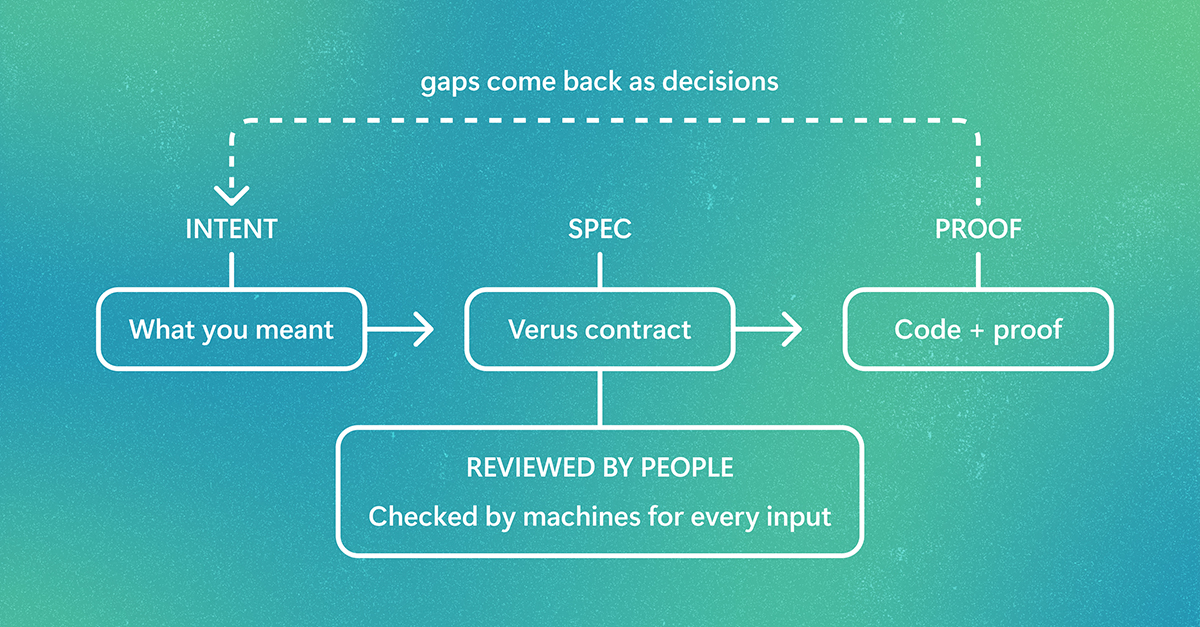
AI agents can generate code at a scale that’s hard for humans to review line-by-line. PDD Kit helps ensure the code is doing what the developer intended by creating formal specifications and testing against them. It converts developer intent into a Verus specification, proves AI-generated code meets it for every input, and uses tests where proofs aren't practical. Developers review intent, not every line. The post Formally verifying agent-written full-stack web apps with PDD Kit appeared first o…

MIT News · Artificial Intelligence Nov 5, 2026

Clearing up a robot’s fuzzy memory

A new system identifies and corrects unreliable object descriptions stored in a robot’s memory, improving the robot’s ability to interact with its environment.

We use cookies to run the site and, with your consent, for analytics and to show ads. See our Cookie Policy.