A recent randomized trial compared a GPT-4o career reflection agent with the same program in a static journaling survey, finding the behavior tied to the worse outcome was the demand to decide.
Abstract
Conversational agents are increasingly used to guide reflection. A recent randomized trial compared a GPT-4o career reflection agent with the same program in a static journaling survey. Agent participants ended less committed to their career plans and more doubtful. We coded all 17,930 turns from its two studies, checked our coding against human coders and linked conversations to the trial's surveys. The rules the agent followed were the easy-to-check ones, like a reply length cap. Told not to flatter, it praised participants in half of its turns; told to challenge gently, it almost never did, and such a break leaves no visible trace. The behavior tied to the worse outcome was the demand to decide: the survey posed each decision once, while the agent asked again when participants hesitated, and those pressed most ended most doubtful. Our findings inform reflection agent design and the writing of checkable instructions.
This dissertation investigates how computing students can use AI while retaining the reasoning needed to learn programming, and takes part in examining three practices: asking for tutoring that requires students to reason, reviewing generated code against expectations formed before seeing it, and owning the work by exp...
Runlong Ye· Proceedings of the 26th Koli...· 0 citations
Self-improving agents write lessons from the outcomes of their runs; when outcomes are noisy, a lesson can carry chance into later decisions. We measure one link of this chain in a registered study. In 256 synthetic worlds, each a recurring task with two interchangeable tools of recorded reliability, a scripted previou...
Effective social interaction requires more than fluent responses: agents must reach plans that fit the participants'needs and circumstances. Existing evaluations of social agents mainly rely on LLM judges that rate the conversation, without checking the resulting plan. We introduce HICO-Bench, a benchmark of 180 everyd...
Cai-Xin Kang, Ke Wang, Yu-Chuan Wu et al.· 1 citation
A chatbot that says"I will remind you tomorrow"will not run again until the user writes. We call such a promise an empty commitment: a promise of action after the current turn that nothing in the agent's tools or runtime can carry out. Unlike a broken promise, its emptiness is decided by the agent's configuration at th...
Jia-Qi Tang, Bingyu Shen, Lan Wei et al.· 1 citation
Coding agents send their models more than the user's prompt: they add instructions, tool definitions, and environmental context that form an instruction stack. This stack guides execution and changes across releases, yet remains largely unexposed to users and insufficiently characterized in research. We present a longi...
Felipe de Sant'Anna Paixão, Dhyego Tavares, Eduardo Almeida et al.· 0 citations
An LLM judge assesses agent steps from text packets. A renderer converts recorded runs into these packets, while software checkers test records and packets against requirements. We ask what evidence shows a packet is what the evaluation requires and propose four input-assurance obligations: required content survives re...
Bo-Ming Xia, Qing-Hua Lu, Run-Ze Li et al.· 0 citations
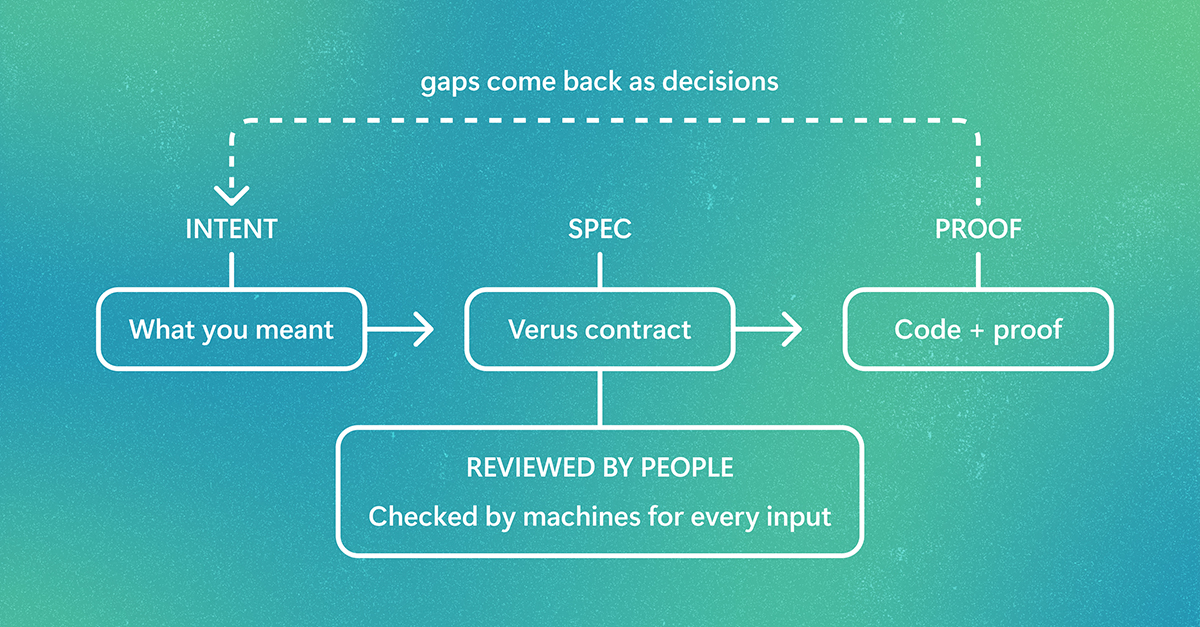
AI agents can generate code at a scale that’s hard for humans to review line-by-line. PDD Kit helps ensure the code is doing what the developer intended by creating formal specifications and testing against them. It converts developer intent into a Verus specification, proves AI-generated code meets it for every input, and uses tests where proofs aren't practical. Developers review intent, not every line. The post Formally verifying agent-written full-stack web apps with PDD Kit appeared first o…
Professor Paris Smaragdis develops computers with superhuman hearing for applications like speech recognition, music understanding, and environmental monitoring.
MIT News · Artificial Intelligence· news.mit.eduOct 23, 2026
During the School of Humanities, Arts, and Social Sciences’ 75th Anniversary Symposium, President Sally Kornbluth said “MIT has never needed your particular insight and guidance more than we do now.”
We use cookies to run the site and, with your consent, for analytics and to show ads.
See our Cookie Policy.