Skip to content

Enhancing Graph Neural Network Explainers Using a Distribution Shift Consistency-Guided Generator

Oct 2026 · IEEE Transactions on Knowledge and Data Engineering · Vol 38, pp. 6572-6585 · 0 citations · 46 references

Abstract

Graph Neural Network (GNN) explainers aim to identify explanatory subgraphs that provide rationales for GNNs’ predictions. Nevertheless, the distribution shift of subgraphs introduces out-of-distribution (OOD) issues into GNNs’ predictions. The OOD issues compromise explainers’ optimization, as the optimization relies on the prediction differences between the original graph and the subgraph. To this end, we propose a plug-and-play framework to adjust the distribution shift of subgraphs during the explainers’ optimization. By introducing a distribution shift consistency objective, we constrain explanatory subgraphs of similar graphs to be consistent, modeling the learning of explanation as a consistency-guided “denoising” process. Additionally, we propose a parameter-sharing generator to act as a “noise-adding” process in each epoch. This generator learns proxy graphs of explanatory subgraphs to adjust the distribution shift, enhancing the explainers’ optimization. We apply the proposed framework to three state-of-the-art explainers and evaluate its performance on four real-world datasets. The results demonstrate that the learned graphs align with the original graphs’ distribution and enhance the performance of explainers in terms of AUC-ROC, Robust Fidelity, and Stability. Furthermore, it significantly outperforms three state-of-the-art distribution shift adjusting algorithms.
View source

Similar papers

Book Open access Aug 2026

Out-of-Distribution Robust Explainer for Graph Neural Networks

Graph Neural Networks (GNNs) have become widely used for analyzing graph-structured data, motivating post-hoc explanation methods for interpreting pre-trained GNNs. However, most existing explainers have primarily been designed and evaluated in settings where the inference graph is structurally or distributionally simi...

Geonhee Han, Heesoo Jung, Hyunju Kang et al. · 0 citations
Preprint Aug 2026

Overcoming Shortcut Learning in Graph Neural Networks through Active Explanation Guidance

This work introduces XIGL, an architecture-agnostic human-in-the-loop strategy for removing shortcuts from GNNs, and develops an active learning strategy for prioritizing explanations that are more likely to display shortcut behavior, lowering annotation and cognitive costs.

Taraneh Younesian, Steve Azzolin, A. Longa et al. · 0 citations
#machine learning Preprint Sep 2026

A Comparative Study of Counterfactual Explainers for Graph Neural Networks Enabling Multiple Types of Graph Edit

Counterfactual explanations for graph-structured data seek to determine minimal and realistic modifications required in an input graph to alter a model's prediction to a predefined output. Although counterfactual explainers that support modifying the graph by both adding and removing edges have recently emerged, there...

Maria Myrto Villia, Filippos Gouidis, T. Patkos et al. · 0 citations
Conference Open access Sep 2026

HGOOD: Hypergraph-enhanced Graph Contrastive Learning for Graph Out-of-Distribution Detection

A Hypergraph-enhanced graph contrastive learning framework for Graph Out-Of-Distribution detection (termed HGOOD), which constructs two branches to hierarchically mine graph compact semantics in a comprehensive manner and introduces a cross-branch prototype contrast that aligns the captured graph patterns with their cr...

Xuan-Ting Fan, Chen-Yu Wang, Yue-Yue Gao et al. · 0 citations
Sep 2026

Generalizing on Diverse Shifts: A Unified Topology-Aware Reweighting Algorithm for Graphs.

Graph Neural Networks (GNNs) have achieved strong performance in node classification, yet their performance often drops when facing graph distribution shifts between training and testing nodes. Existing methods have been explored to improve generalization under such shifts. However, many of them either rely on environm...

Jia-Xing Li, Jia-Shuo Liu, Wei-Huang Zheng et al. · 0 citations
Conference Open access Sep 2026

ADC-GNN: Adaptive Dual-level Collaborative Graph Neural Networks for Graph Classification

This work proposes a novel Adaptive Dual-level Collaborative GNN associated with an adaptive dual-level collaborative mechanism, and shows that the ADC-GNN can inject the learned high-level information back into the node level, forming a closed-loop, bidirectional optimization process.

Wan Tang, Lu Bai, Li-Xin Cui et al. · 0 citations

Related blog posts

Microsoft Research Blog Jul 13, 2026

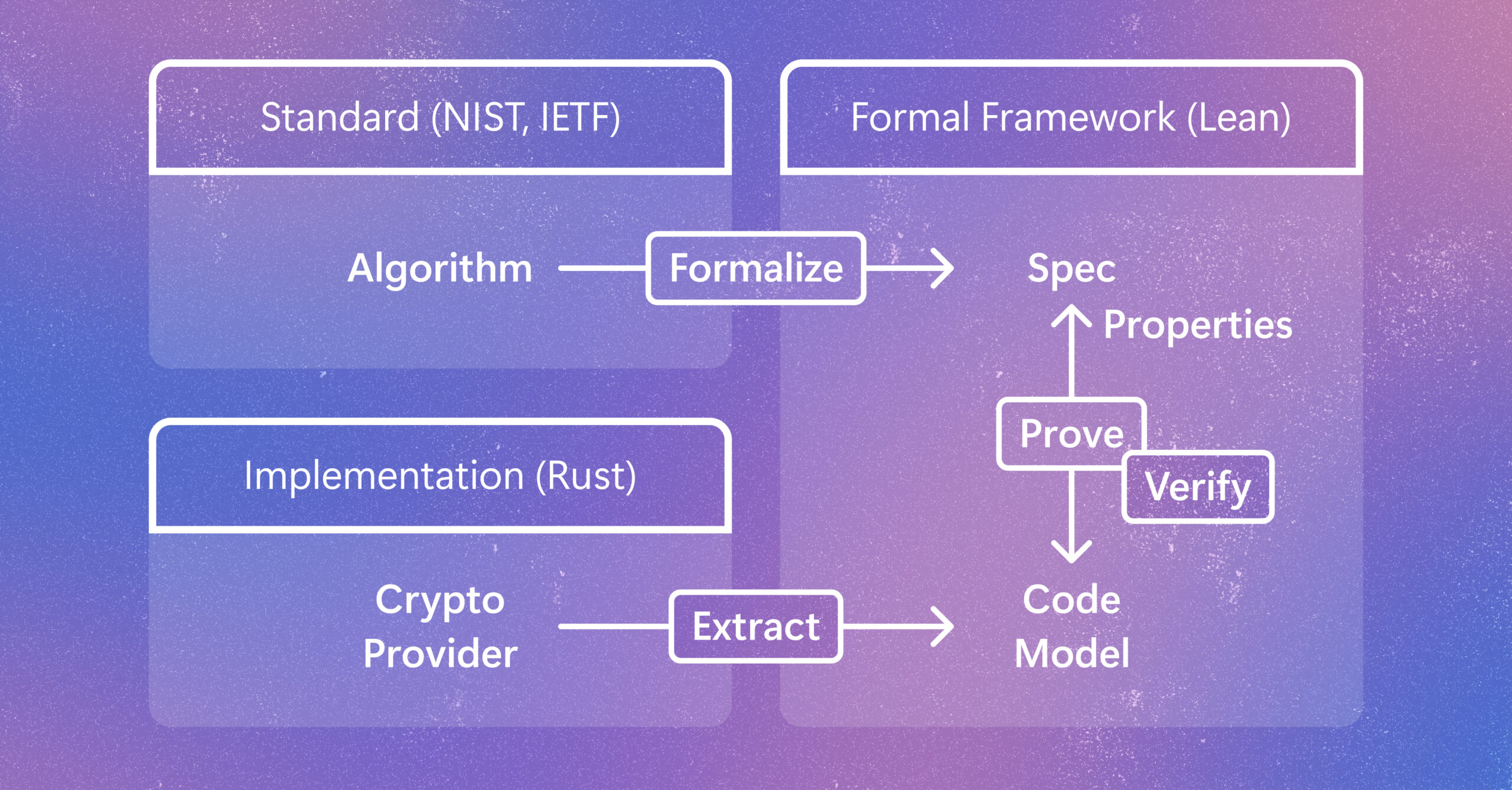
Verifying Rust cryptography in SymCrypt, from standards to code

Cryptographic code supports vital protections in modern computing systems. Learn how a new method helps verify code as developers write it while preserving speed and adaptability as it gets implemented and evolves. The post Verifying Rust cryptography in SymCrypt, from standards to code appeared first on Microsoft Research.

We use cookies to run the site and, with your consent, for analytics and to show ads. See our Cookie Policy.