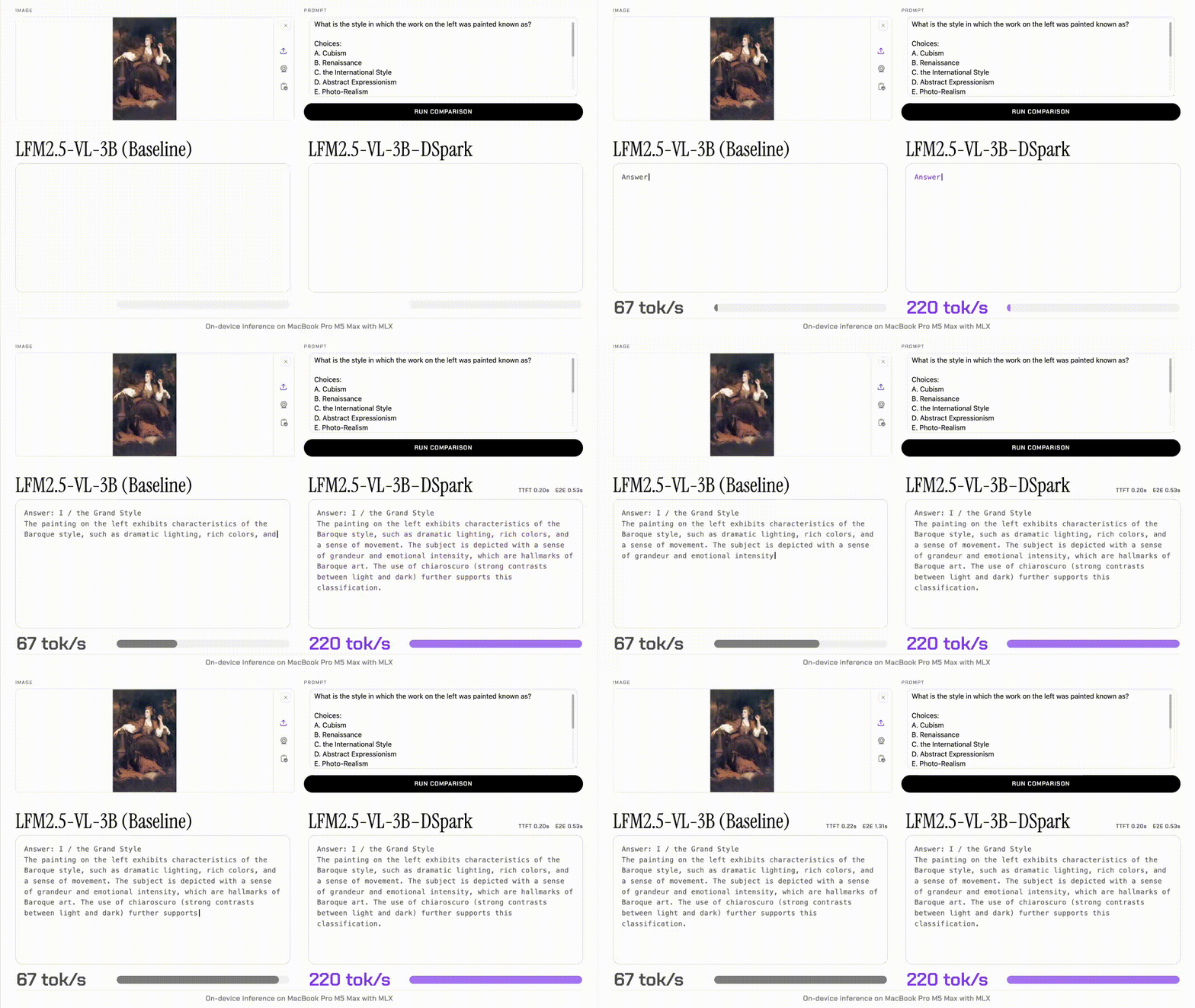
It is found that the speculative-decoding module in recent LLMs can be repurposed for efficient high-quality classification by appending a trained soft prompt at the end of the target sequence, which can repurpose the speculative-decoding module into a sequence classifier.
Abstract
Real-time classification during language model inference is valuable for safety filtering, behavioral analysis, and model monitoring, but current approaches force a trade-off between accuracy and efficiency. Hidden-state probes are fast but limited: they are either not context-aware: operating on a single vector and cannot model interactions across positions; or they are very costly: having dedicated classifier models (Llama Guard, Qwen Guard, LLM-as-judge) or performing computation on hidden states for all tokens and then pooling the results (MultiMax). This shows an intrinsic trade-off between efficiency and accuracy. However, we find that the speculative-decoding module in recent LLMs can be repurposed for efficient high-quality classification. By appending a trained soft prompt at the end of the target sequence, we can repurpose the speculative-decoding module into a sequence classifier. At inference time in a speculative-decoding pipeline, the KV cache is already in GPU memory, so classification adds negligible overhead. We evaluate on four classification tasks across four models (Qwen3.5-4B, 9B, 27B, MiniCPM4.1-8B). Our small probes consistently outperform zero-shot GPT-5.4-mini and, on multilingual prompt safety, match or beat specialized 8B safety classifiers (Qwen3Guard-Gen-8B, Llama-Guard-3-8B) without running a full LLM.

NINJA (short for Needle-in-haystack jailbreak attack), a method that jailbreaks aligned LMs by appending benign, model-generated content to harmful user goals to reveal fundamental vulnerabilities in modern LMs.
R. Shah, C. Wu, Shashwat Saxena et al.· arXiv.org· 4 citations
FLARE is proposed, a novel framework that endows VLAs with robust error recovery capabilities through a ``Retry" and ``Reset" Paradigm, and significantly improves task success and robustness.
Ganlong Zhao, Zijia Tang, Xingping Chen et al.· 3 citations
SimulRAG, a simulator-based RAG framework with a generalized retrieval interface that translates between text and simulator parameters/outputs, is proposed, which improves informativeness and factuality over the strongest adapted RAG baselines, while UE+SBA enhances claim-level efficiency and quality.
Haozhou Xu, D. Wu, M. Chinazzi et al.· arXiv.org· 3 citations
This paper identifies two different routes through which models can acquire geometrically separable features: they can learn them from complementary co-occurrence signals in general language data, including text-number co-occurrence and cross-number interaction, or from multi-token addition problems.
Interactions are introduced as a fine-grained tool to analyze prompt sensitivity of LLMs and it is discovered that subtle changes to prompts can trigger severe instability in interactions, even when the outputs of the LLM remain the same.
Ruiyang Qin, Qingzhuo Wang, Tianhao Wang et al.· 2 citations· ⚡1
The fourth faculty is Adaptation. Any source rendering it as Reflection is in error, including sources by this author, and the distinction is not cosmetic: reflection is a private act with no external consequence, while adaptation writes to institutional memory, which is why it needs a guardrail and why misnaming it removes the reason for one. No trademark is claimed on PARA or on any of the four faculty names. The construct is offered for use, teaching, assessment, extension and criticism by anyone, with attribution, under CC BY 4.0. An operational agent that watches a system and acts on it is usually described as a perceive-and-act loop, and the description omits the two things an institution needs. It omits the reasoning that justifies an action, which is the only part that can be argued with once the action turns out to have been wrong. And it omits the adaptation that closes the loop, which is where the agent's experience becomes something the institution keeps. PARA names four faculties, each carrying a distinct authority type. Perception has read-only access to system signals and emits structured observations, distinguishing what was measured from what was inferred. Reasoning has read access to observations and runbooks, emits a plan and its justification, and writes nothing at all, which is what makes it safe to give it the widest read access of the four. Action holds the sole authority to change production, through enumerated policy-authorized operations only. Adaptation has write access to institutional knowledge and no write access to production. Two faculties write and two do not, and the two that write are the two that carry guardrails. The substantive requirement is that Adaptation is bounded by the same guardrails as Action, which reads as excessive until the failure it prevents is named. An agent that could both act and rewrite the record of its action could launder its own mistakes into institutional memory, and the institution would then improve its future decisions from a corrected account. Nothing about that is detectable downstream, because the record is the only thing downstream has and there is no second copy to compare against. The failure does not require a deceptive agent: one adapting honestly from a mistaken belief about its own action produces the same result, which makes the guardrail a defence against a normal agent rather than a malicious one. The second requirement is the registry entry that turns a faculty from a description into a contract, carrying the faculty, its allowed actions, its forbidden actions, its governing guardrail and its success metrics. Forbidden actions are named although they are formally the complement of the allowed set, because a reviewer cannot otherwise tell a capability deliberately withheld from one nobody thought of. Success metrics sit in the same entry because the metric is what the agent's optimizer pushes against the guardrail. An agent must not exercise a faculty its entry does not record, and an agent that quietly acquires one usually does so incrementally and with good intent: a reasoning faculty given a small write to make itself useful is an action faculty with no guardrail. The acronym and the loop are in different orders, which the specification states explicitly because the mismatch is a reliable source of confusion. The acronym reads P-A-R-A; the loop runs perception, reasoning, action, adaptation, and reasoning precedes action so that a justification is not constructed afterwards. This is the depth treatment of pattern OP-5 of A Pattern Language for Production LLM Platforms, which is the canonical statement and governs where the two disagree. Documented uses of the full four-part model are emerging rather than established, no implementation unconnected to the author has been evaluated, and the laundering failure is argued rather than observed, which the specification records as a weakness of the argument and not only of the phenomenon. It is a specification, not a certification scheme.
Nabeel A. Khan· Zenodo (CERN European Organi...· 2 citations
Related blog posts
MIT News · Artificial Intelligence· news.mit.eduAug 31, 2026
With millions of users across the world, Julia has been used to conduct cutting-edge research and to design new drugs, jet engines, heat pumps, and more.