Mechanistic interpretability of vision transformers seeks to decompose model computation into human-readable units, but learned representations entangle many concepts in each neuron. Feature superposition is widely treated as the central obstacle to this decomposition, yet most mitigations (sparse autoencoders, dictionary learning) are post-hoc and leave the underlying network unchanged. We ask whether a spatial-locality training loss (TopoLoss) can act as a lightweight, training-time prior that improves interpretability of standard mech-interp tools. Training ViT on ImageNet-100 across multiple TopoLoss weights $\alpha$, we measure causal sufficiency of topographic clusters via activation patching and feature geometry via sparse autoencoders fit to the same residual stream. At $\alpha=1.0$, topographic clusters are 2.79$\times$ more causally sufficient than random unit sets of the same size, with the effect increasing monotonically in $\alpha$. SAE L0 sparsity decreases by 11% and dead-feature fraction rises 19-fold, yet standard neuron-level monosemanticity scores are unchanged, indicating that topographic pressure acts at circuit level, concentrating causal mass into spatially local structures without disentangling individual neurons. This dissociation suggests current neuron-level monosemanticity metrics are insensitive to a class of real interpretability gains, and positions cheap architectural priors as a viable training-time complement to post-hoc tooling.
This publication proposes a definition and a classification of agile software development approaches and analyses ten software development methods that can be characterized as being "agile" against the defined criterion.
P. Abrahamsson, O. Salo, Jussi Ronkainen et al.· arXiv.org· 727 citations· ⚡54
The study shows that agile practices improve both informal and formal communication, but indicates that, in larger development situations involving multiple external stakeholders, a mismatch of adequate communication mechanisms can sometimes even hinder the communication.
M. Pikkarainen, Jukka Haikara, O. Salo et al.· Empirical Software Engineeri...· 401 citations· ⚡48
The results indicate that software engineering work practices are chosen opportunistically, adapted and configured to provide value under the constrains imposed by the startup context.
Nicolò Paternoster, Carmine Giardino, M. Unterkalmsteiner et al.· Information and Software Tec...· 394 citations· ⚡54
The possibility of inferring high-dimensional data inference in a model that consists of a prior and an auxiliary differentiable constraint given some additional information is considered, thereby allowing a range of potential applications in adapting models to new domains and tasks.
Alexandros Graikos, Esmeralda S. Whitammer, N. Jojic et al.· Neural Information Processin...· 316 citations· ⚡15
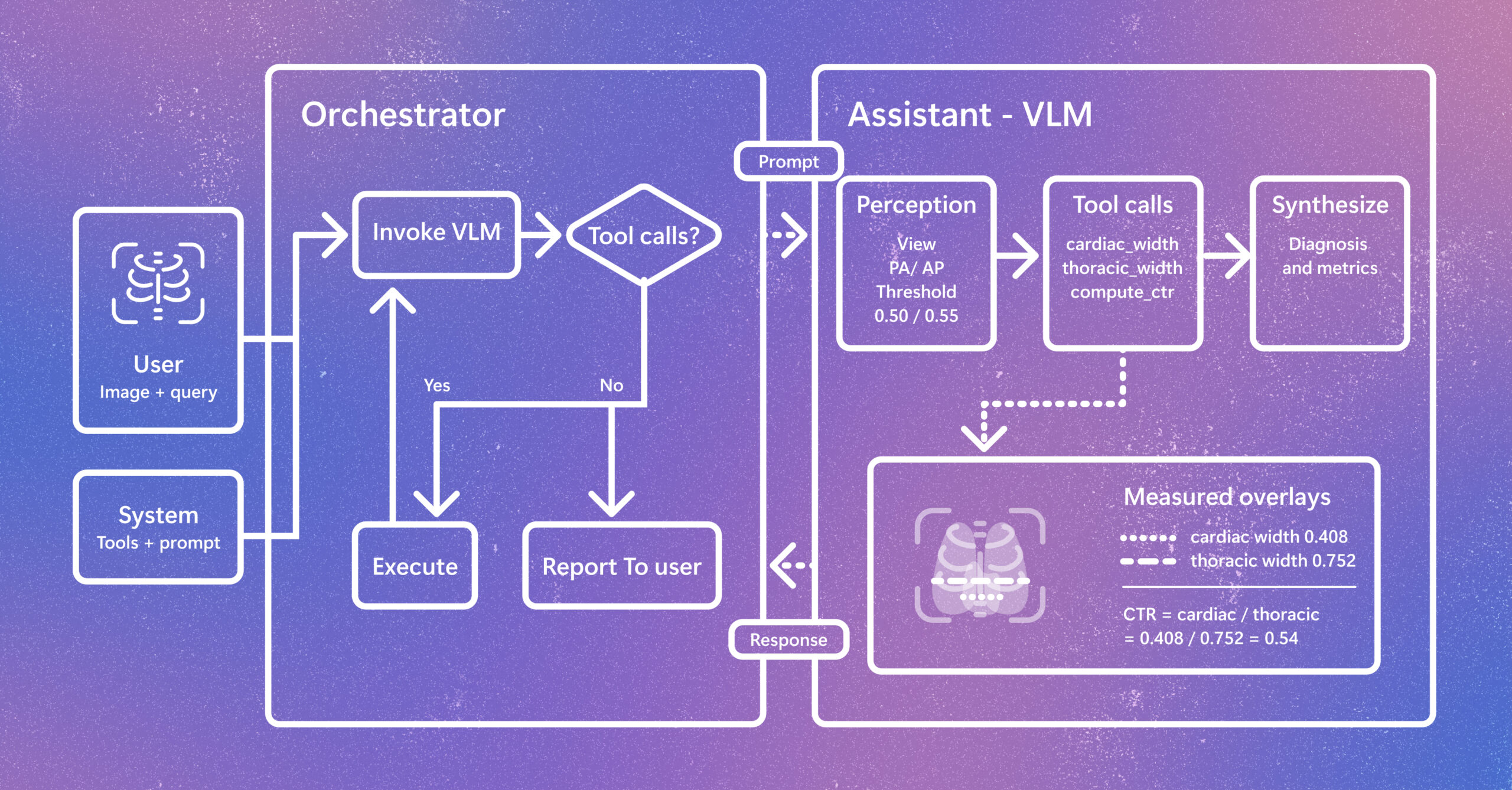
Radiology AI is evolving beyond report generation. CARE-X explores a unified approach that combines flexible reasoning, calibrated predictions, and measurement-based tools for chest X-ray interpretation. The post Introducing CARE-X: Towards Clinically Useful Radiology VLMs with Auxiliary Supervision, Reward-Aligned Learning, and Tool-Augmented Measurement appeared first on Microsoft Research.
