These notes develop the mathematical foundations and construction of a Fourier-Bessel wavelet family inspired by the disk harmonics of Shaqfa et al.[9]. We begin with the relevant properties of Bessel and modified Bessel functions and introduce the wavelet properties required for the construction. We then derive the Fourier-Bessel disk harmonics as solutions to the Helmholtz equation on the unit disk subject to a Neumann boundary condition. Building on this basis, we construct a wavelet family by applying a Gaussian spatial envelope and introducing a zero-mean correction for the zeroth angular order. We derive the corresponding normalisation constants for $L^2$-based applications and discuss $L^1$-based normalisation for frequency-domain peak consistency. Finally, we derive a closed-form Fourier-domain representation of the resulting wavelets. The main motivation is the approximately linear spacing, which converges to $\pi$ between consecutive radial eigenvalues. Rather than replacing the conventional dyadic organisation of wavelet families, this construction lays out the foundation to explore whether a more uniform radial frequency allocation can be useful for applications in which broad and balanced frequency coverage is desirable.
We consider the recovery of functions of the weighted Wiener classes $W_s^\mu$ from perturbed Fourier--Hermite coefficients in the metric of $L_\infty(\mathbb R)$. For the summation methods of the class $\mathcal S^\theta$ we find error estimates on $W_s^\mu$. The estimates take into account the behaviour of the Hermit...
We establish the large-$n$ asymptotics of Hankel determinants for unitary random matrix ensembles possessing a higher-order edge singularity. We focus on ensembles where the equilibrium measure is supported on a single interval and the limiting eigenvalue density vanishes to order $2k+\frac{1}{2}$ for $k \in \mathbb{N}...
This paper studied the solution of second order differential equations numerically by using the Haar wavelet operational matrix approach. Haar wavelet characterized by their piecewise constant properties and orthogonality are used for this work due to their computational efficiency, minimal memory requirements and ease...
H. A. Haruna, O. .. Odetunde, S. Onitilo· Nigerian Journal of Physics· 0 citations
This work constructs explicit closed-form Green's functions for the Helmholtz equation with Robin boundary conditions on balls in all dimensions $d\ge 2$. Despite the canonical geometry, such kernels have remained unavailable because the Robin condition couples the field and its normal derivative, preventing the method...
In this paper, we propose an alternating numerical scheme for constructing quasi-periodic solutions to a class of nonlinear partial differential equations (PDEs) with bounded perturbations, including the one-dimensional nonlinear Schr\"odinger (NLS) equations and nonlinear wave (NLW) equations under periodic and Dirich...
For a symmetric weight $w(x)$ on a finite discrete lattice and its Christoffel transforms $x^{2}w(x),x^{2}(x^{2}w(x)),\dots$, we prove that, at each Christoffel step, the conjugated projection associated with the transformed Christoffel--Darboux kernel differs from the original orthogonal projection by a rank-one opera...
Anton Nazarov, P. Nikitin, Anton Selemenchuk· 1 citation
Related blog posts
MIT News · Artificial Intelligence· news.mit.eduOct 28, 2026
Professor Paris Smaragdis develops computers with superhuman hearing for applications like speech recognition, music understanding, and environmental monitoring.
Exploring how generative AI could make machine vision more accessible to businesses. The post GenEye in a Box: Making Machine Vision Something You Can Just Ask For appeared first on GPT-Lab.
Microsoft Research Blog· microsoft.comAug 11, 2026
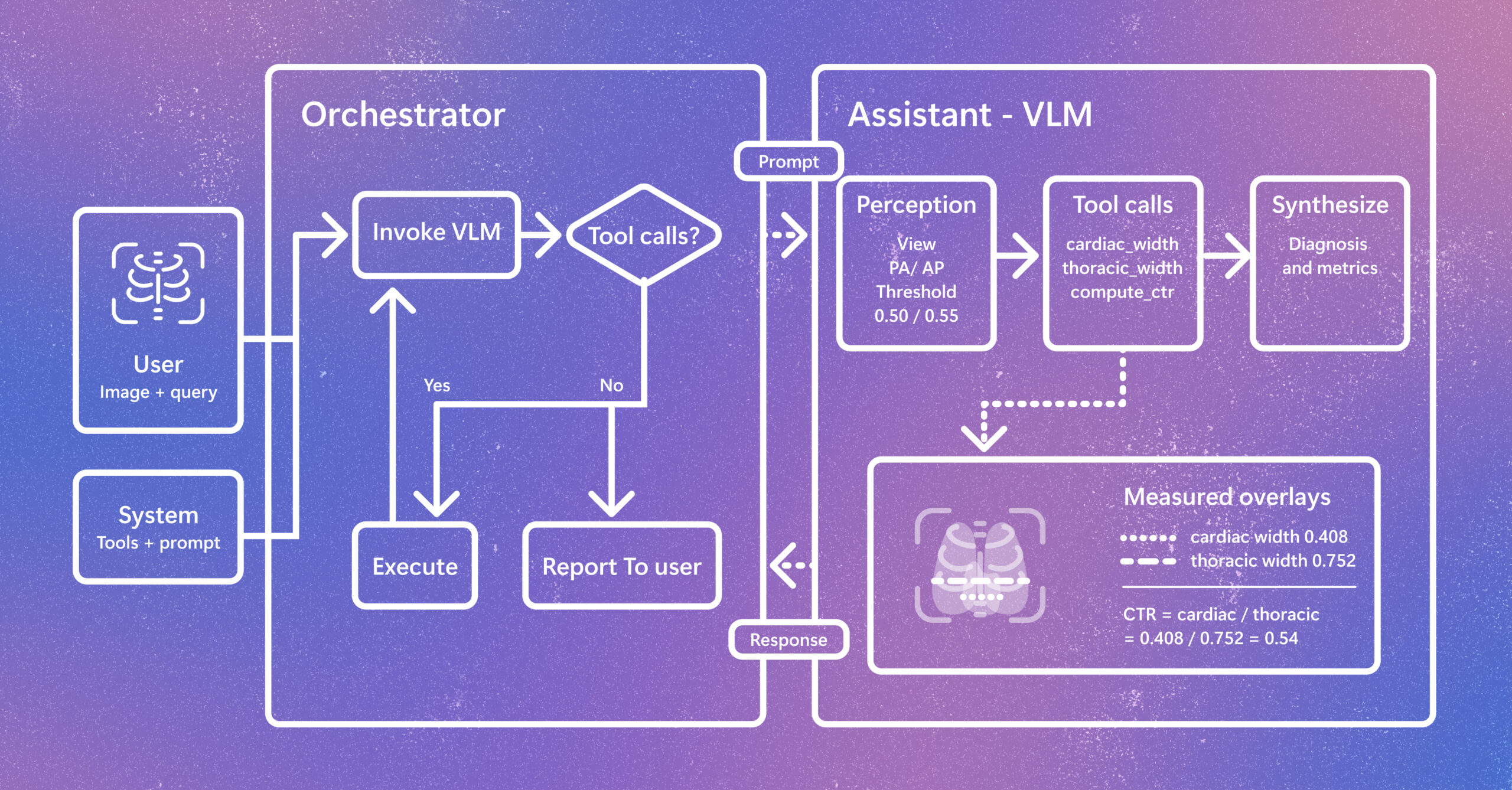
Radiology AI is evolving beyond report generation. CARE-X explores a unified approach that combines flexible reasoning, calibrated predictions, and measurement-based tools for chest X-ray interpretation. The post Introducing CARE-X: Towards Clinically Useful Radiology VLMs with Auxiliary Supervision, Reward-Aligned Learning, and Tool-Augmented Measurement appeared first on Microsoft Research.