Results show that architecture is a major source of task-relevant structure in TPC embeddings and should be treated explicitly when assessing representation learning and developing reusable detector models.
Abstract
Deep-learning efforts have increasingly shifted toward foundation model approaches. In experimental physics, this allows models and learned representations to be reused beyond the experiments in which they were developed. This work evaluates the reusability of representations across experiments and detector systems using probes on frozen encoders. These probes reveal task-relevant structure before downstream adaptation, complementing fine-tuning. Together with random-weight controls, they distinguish contributions from architecture and encoder training that downstream performance alone cannot resolve. Time projection chamber (TPC) data provide a useful testbed because events from TPC systems can be represented as variable-length sparse tensors, while detector geometries, event topologies, and scientific tasks can differ substantially. We investigate whether fixed-dimensional TPC event representations can be reused across classification tasks, experiments, and detector systems. Sparse ResNet and PointNet-style encoders produce 512-dimensional embeddings for four datasets from the GADGET II TPC and AT-TPC. Randomly initialized encoders isolate the contribution from architecture before supervised training. We then train each encoder on a classification task, freeze its parameters, and train a linear or nonlinear probe for each downstream task. We find that this architecture-induced structure remains useful across experiments and detector systems. The randomly initialized PointNet-style representation is highly informative on several tasks. The two architectures organize their embedding spaces differently, but neither exhibits a large, systematic loss of utility cross-detector. These results show that architecture is a major source of task-relevant structure in TPC embeddings and should be treated explicitly when assessing representation learning and developing reusable detector models.
Deep neural networks excel in various tasks but struggle to generalize across evolving data distributions, leading to significant performance degradation under domain shifts. Domain incremental learning (DIL) addresses this challenge by enabling models to continuously adapt while retaining prior knowledge. Among existi...
Qiang Wang, Songlin Dong, Shao-Kun Wang et al.· 0 citations
This paper introduces Gradient Enhancement Task Aware Post-training Quantization, i.e., GTAQ, to address the generalization issue of Large Language Models, and extensively evaluates the LLaMA family of language models on WikiText, C4, and MMLU.
Yi-Hua Shao, Yang-Yang Gu, Min-Xi Yan et al.· Proceedings of the Thirty-Fi...· 1 citation
A retraining-free VLM pruning framework called PORTA is introduced that derives a task- and modality-agnostic importance formulation based on activation variation, estimated from generic calibration data, which reliably captures feature-level representation utility across modalities.
Minseok Kang, Hyunwoo J. Kim, Chanyoung Kim et al.· 1 citation
This study systematically compares seven pre-trained feature extractors across three architectural families, convolutional neural networks (CNNs), Vision Transformers (ViTs), and self-supervised models to provide practical guidance on model selection for downstream deep learning tasks.
Rafeek Sibrikhan, M. Mufassirin· Sri Lankan Journal of Techno...· 0 citations
Although SDG methods improve performance under highly domain distinguishable stylized shifts, they exhibit limited robustness to background, correlation and corruption shifts on larger datasets, and increased shape bias does not consistently yield enhanced OOD performance, thereby underscoring the need for further rese...
K. Imbulgoda, Ruwan Tennakoon, Qin-Chu-Ah Wei et al.· International Journal of Com...· 0 citations
It is argued that soft-token fusion requires stronger alignment objectives and schema-aware design before it can serve as a reliable route to relational prediction.
Francisco Galuppo Azevedo, Clarissa Lima Loures· 0 citations
Exploring how generative AI could make machine vision more accessible to businesses. The post GenEye in a Box: Making Machine Vision Something You Can Just Ask For appeared first on GPT-Lab.
Microsoft Research Blog· microsoft.comAug 11, 2026
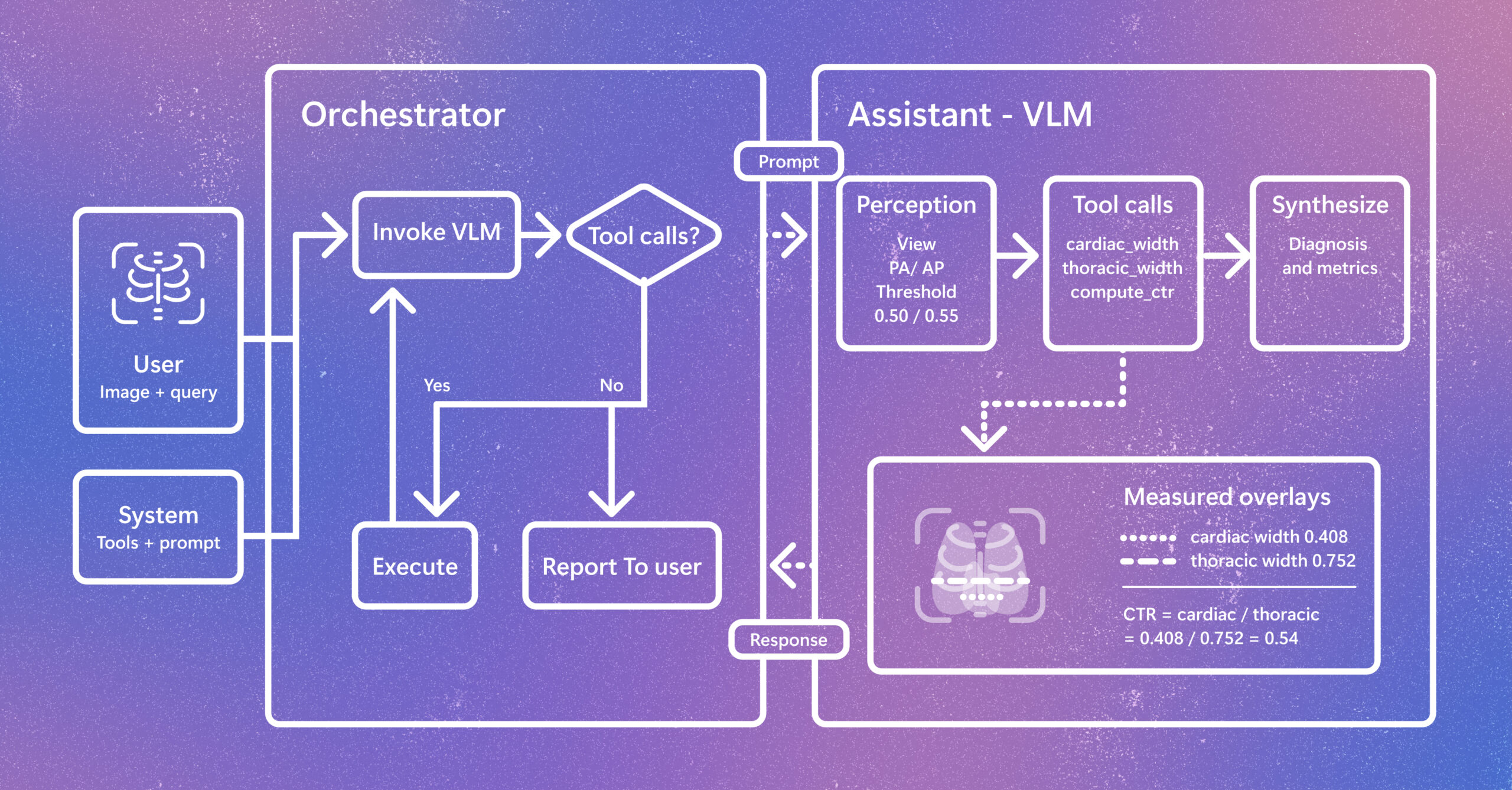
Radiology AI is evolving beyond report generation. CARE-X explores a unified approach that combines flexible reasoning, calibrated predictions, and measurement-based tools for chest X-ray interpretation. The post Introducing CARE-X: Towards Clinically Useful Radiology VLMs with Auxiliary Supervision, Reward-Aligned Learning, and Tool-Augmented Measurement appeared first on Microsoft Research.
