The Graph Distribution Distance (GDD) metric is introduced, which uses maximum mean discrepancy with a graph kernel to comprehensively compare joint next-state distributions over the joint graph state comprising the interdependent topology, node features, and graph features.
Abstract
Graph-based world models have recently emerged as a means of learning transitions over relational state representations. However, existing approaches are largely limited to fixed-topology graphs or deterministic, fully observable environments. We propose the Graph Dynamics Model (GDM), a world model for graph-structured observations that is designed to handle the more general setting of evolving topologies in stochastic and partially observable environments. The GDM uses a sparse recurrent adjacency matrix to model topology updates and perform message passing, together with a recurrent state-space architecture for modelling stochastic transitions. Furthermore, we identify a gap in the evaluation of graph-based world models, as existing methods do not provide a means of comparing predicted and true distributions over the joint graph state comprising the interdependent topology, node features, and graph features. We therefore introduce the Graph Distribution Distance (GDD) metric, which uses maximum mean discrepancy with a graph kernel to comprehensively compare joint next-state distributions. We evaluate the GDM across several environments, including stochastic and partially observable settings. We demonstrate that GDM outperforms baseline models and displays zero-shot generalisation on large graphs.
This work proposes WorldGraph, which combines a state-aware graph transformer for multi-granularity structural and transition-conditioned evolution modeling with transition-aware GRPO using dynamic grouping and structure-aware verifiable rewards.
DyG-WM is proposed, the first framework to jointly predict future node and relation representations from temporal context by answering three questions: what has evolved, how it evolved, and what will evolve next.
Graph embedding represents nodes in a continuous, low-dimensional latent space while preserving the graph’sunderlying structure. In practice, however, most real-world graphs are far from static — nodes and edges appear, vanish,and shift in weight as time passes. Despite this, a large portion of the embedding literature...
Wander is proposed, a graph foundation model designed to operate across graphs, feature spaces, relational schemas, and prediction tasks within a single pretrained checkpoint that preserves performance in specialized settings while enabling positive transfer and the composition of separately learned capabilities at inf...
Louis Tichelman, Xing-Yue Huang, Jinwoo Kim et al.· 0 citations
Most temporal graph learning methods reduce future prediction to discriminative inference over past interactions, focusing on edges or node labels for a largely persistent set of nodes. This view breaks down when new nodes and edges appear, since the future graph becomes a new object with changing size, composition, an...
Ronan Buck, Kiarash Shamsi, Ngo Gia Bao Tran et al.· 0 citations
Graph diffusion models are competitive approaches for generating complex graph-structured data. However, when such distributions have strict structural constraints, diffusion models may fail to capture them exactly, resulting in the generation of invalid graphs. In this paper, we propose a method for grounding graph di...
Samuel Cognolato, L. Serafini, Alessandro Sperduti et al.· 0 citations
Related blog posts
MIT News · Artificial Intelligence· news.mit.eduOct 13, 2026
Machine-learning networks can learn without detailed instructions from a designer. Those that do may offer insight into how the brain reorganizes itself during learning.
MIT News · Artificial Intelligence· news.mit.eduSep 29, 2026
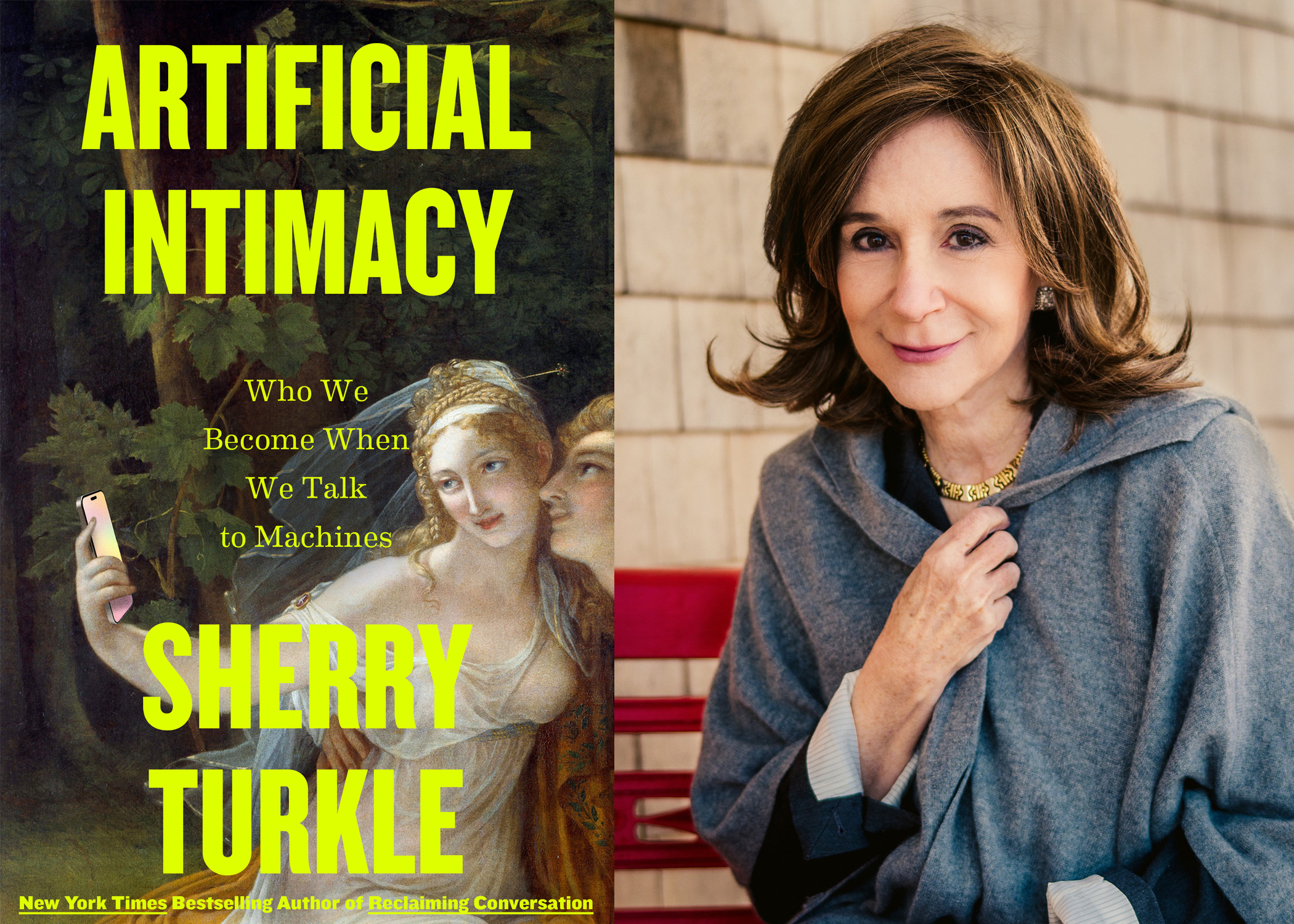
Professor Sherry Turkle’s new book, “Artificial Intimacy,” offers a withering critique of chatbots and the antisocial dynamics she believes they encourage.