Predictive Action Chunk Learning first learns a predictive chunk-level critic that evaluates temporally extended action sequences and augments temporal difference learning with future latent prediction, providing richer supervision for long-horizon value estimation.
Abstract
Robot policies deployed in real environments naturally accumulate mixed-quality experience, including successful executions, partial progress, and failures. Although these rollouts provide valuable information for further learning, directly incorporating them into imitation learning may reinforce undesirable behaviors, while offline reinforcement learning often suffers from unreliable value estimation under sparse rewards and limited data coverage. We consider a practical post-deployment setting where learning relies only on naturally accumulated autonomous rollouts, without additional human corrections or exploratory interaction. To effectively exploit such experience, we propose Predictive Action Chunk Learning (PACL). PACL first learns a predictive chunk-level critic that evaluates temporally extended action sequences and augments temporal difference learning with future latent prediction, providing richer supervision for long-horizon value estimation. The learned critic then converts chunk-level Q-values into discrete quality conditions, which guide a diffusion actor to learn jointly from these mixed-quality experiences without treating all behaviors as equivalent supervision. At inference, the actor generates multiple action chunks and the critic selects the highest valued candidate. Experiments across simulated and real-world robot manipulation tasks show that PACL consistently improves the pretrained policy and outperforms strong imitation learning and offline reinforcement learning baselines.
Generative models, such as diffusion and flow-based models, have shown strong promise for robot policy learning by capturing complex and multimodal action distributions from demonstrations. However, policies trained solely with imitation learning often suffer from imperfect demonstrations and distributional shifts, whi...
Yu Li, Sheng-He Hu, Yu-Han Wang et al.· 0 citations
Existing real-world reinforcement learning methods improve robot policies by combining human corrections with autonomous rollouts. However, accumulated experience varies in its value for policy improvement, and even successful trajectories can contain inefficient or redundant behavior, motivating more selective experie...
Kai Ye, Yinhaoyu Jin, Qian-Hang Luo et al.· 0 citations
Large pretrained robot foundation models provide strong priors for manipulation, yet adapting them to target tasks with offline teleoperated demonstrations often fails to cover the contact-rich, recovery, and precision-critical states encountered during deployment. Existing methods mitigate this issue by augmenting off...
Chun Gu, Xiao-Fei Wei, Yi-Ming Chen et al.· 0 citations
While frontier vision-language models demonstrate strong capabilities in user interface (UI) navigation, their high inference costs prohibit everyday use. Conversely, smaller models trained via supervised fine-tuning (SFT) or offline reinforcement learning often memorize static trajectories, leading to brittle executio...
Pei-Tong Duan, Khashayar Gatmiry, Jeffrey Nichols et al.· 0 citations
World-Action Models (WAMs) couple action generation with predictions of how physical interactions unfold. However, current post-deployment learning paradigms typically improve behavior without requiring better world predictions. Especially in dexterous manipulation, small execution errors can compound in high-dimension...
Xiang-Cheng Zhan, Zi-Rui Chen, Yi-Chen Zhao et al.· 1 citation
We introduce Task-Space Imitation Guidance for Efficient Reinforcement Learning (TIGER), a reward-construction and pretraining framework for sparse-reward tabletop robotic manipulation. TIGER treats an action-chunked imitation policy not as an executable controller or action prior, but as a local task-space progress es...
Salar Asayesh, H. Darani, Todd Cao et al.· 0 citations
Related blog posts
MIT News · Artificial Intelligence· news.mit.eduNov 6, 2026
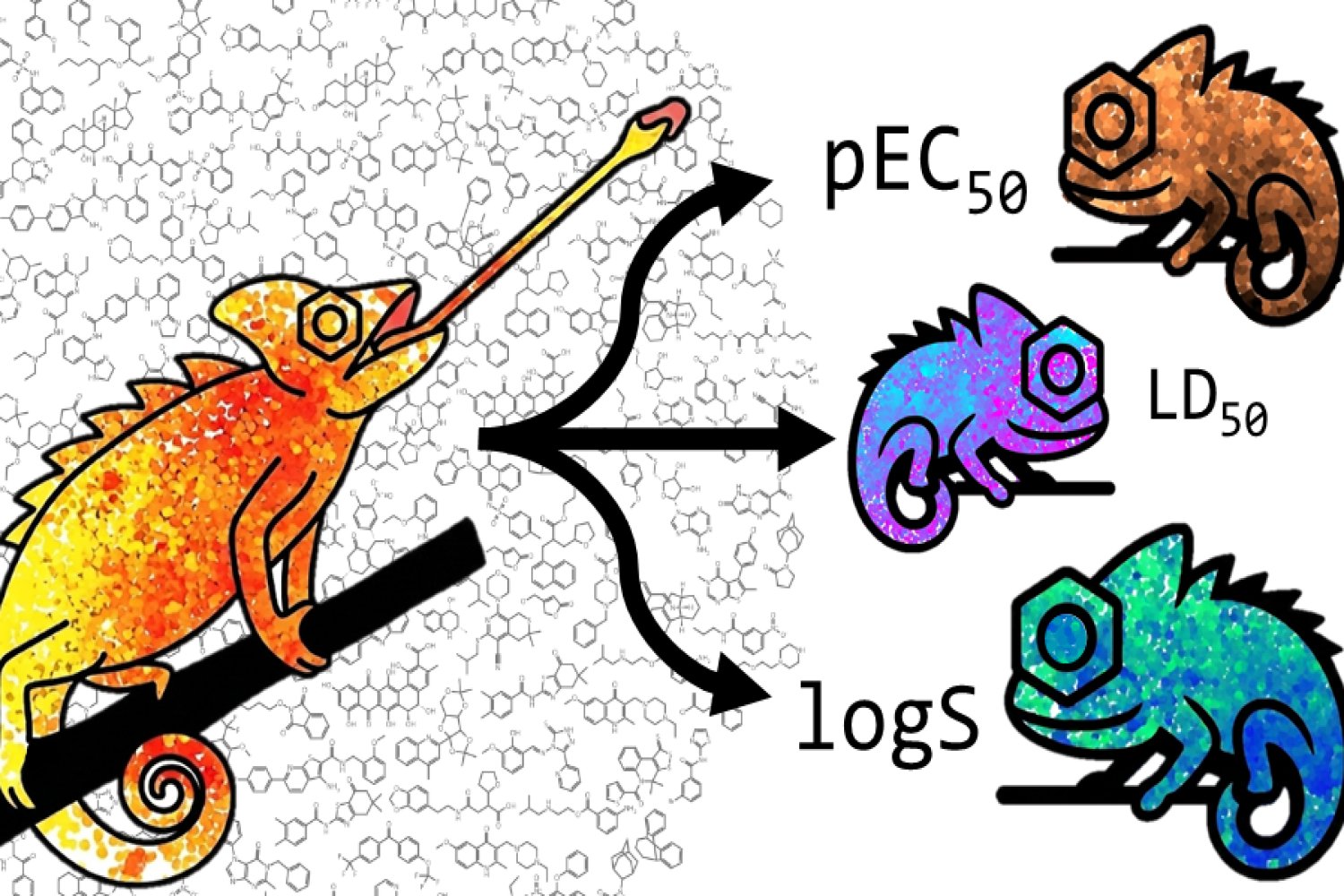
A machine-learning approach called CheMeleon provides a practical way to develop new drugs or other molecules with much less detailed, expensive experimentation.
Research Manager Mike Walker reflects on a career spanning hacker culture, cybersecurity, and AI, sharing lessons about trust, teamwork, leadership, and why solving difficult problems requires curiosity, judgment, agility—and an understanding of the rules. The post Learn the rules: The hacker mindset appeared first on Microsoft Research.
Learn how Google Antigravity and our Cheminformatics Skills accelerate drug discovery workflows, search compounds, and propose novel rigidified macrocycles.
We use cookies to run the site and, with your consent, for analytics and to show ads.
See our Cookie Policy.


