It is observed that personalised SPDNet reaches higher accuracy than both standard FL and centralised training, while converging in fewer rounds and communicating fewer parameters than standard FL.
Abstract
Federated learning (FL) lets EEG decoders learn from recordings of several subjects without pooling them. We consider two light EEG decoders, the Riemannian SPDNet and the Euclidean EEGNet. Both split into a trunk, which builds a latent representation, and a head, which classifies it. Inter-subject variability, however, makes a single shared FL model a poor fit for each subject. Personalised FL addresses this: all subjects learn a common trunk, and each subject keeps its own head. We adapt it for SPDNet and study its effects against standard FL and centralised training, with EEGNet as a Euclidean baseline. Experiments cover three motor-imagery datasets that span diverse regimes in channels, subjects and classes. We observe that personalised SPDNet reaches higher accuracy than both standard FL and centralised training, while converging in fewer rounds and communicating fewer parameters than standard FL. It also outperforms every EEGNet configuration on two of the three datasets, although centralised EEGNet outperforms centralised SPDNet.
This work examines two representative architectures, MAtt and GBWAtt, and finds that their learned attention weights remain close to uniform after training, and introduces SPD-MetaFormer, an attention-free architecture built on uniformly weighted Fr\'echet aggregation under log-Euclidean geometry.
Electroencephalography (EEG) based brain-computer interfaces enable direct brain-to-device communication for applications such as rehabilitation and communication. However, their practical utility is often limited as the non-stationary nature of the EEG data introduces distribution shifts across domains (e.g., sessions...
Shang-Lin Li, Shi-Wen Chu, Okan Koç et al.· 0 citations
This paper extended the existing Manifold Attention Network (MAtt), a novel deep learning model that applies a manifold attention mechanism to better capture the spatiotemporal patterns of EEG signals, and integrates Adaptive Log-Euclidean Metrics (ALEMs)---a learnable metric framework into the MAtt network that adapts...
S. Shaihan· European Journal of Clinical...· 0 citations
FedGLoRA freezes the backbone and communicates only LoRA adapters via a dual-branch design, and aggregates global updates on a Grassmann subspace with a Grassmann-proximal constraint, and uses bidirectional distillation to mitigate imbalance.
Qianyu Chen, Yi-Hao Zhong, Run-Xuan Tang et al.· Proceedings of the Thirty-Fi...· 0 citations
It is demonstrated that task-agnostic representation learning can capture physiologically meaningful multimodal neural representations that remain transferable across individuals, offering a promising foundation for more robust and reusable BCI pipelines.
Giovanni Messuti, Silvia Scarpetta, P. Sorrentino et al.· bioRxiv· 0 citations
Electroencephalography (EEG) signals drift over time, which can cause static brain-computer interface (BCI) models to degrade in practice. We present a benchmark for online adaptation and compare two widely used pipeline families, Common Spatial Patterns (CSP) and Riemannian covariance-based methods, under time-ordered...
B. Kozyrskiy, Artem M. Grachev, Abraham Camelo-Guerrero· 0 citations
Related blog posts
MIT News · Artificial Intelligence· news.mit.eduNov 6, 2026
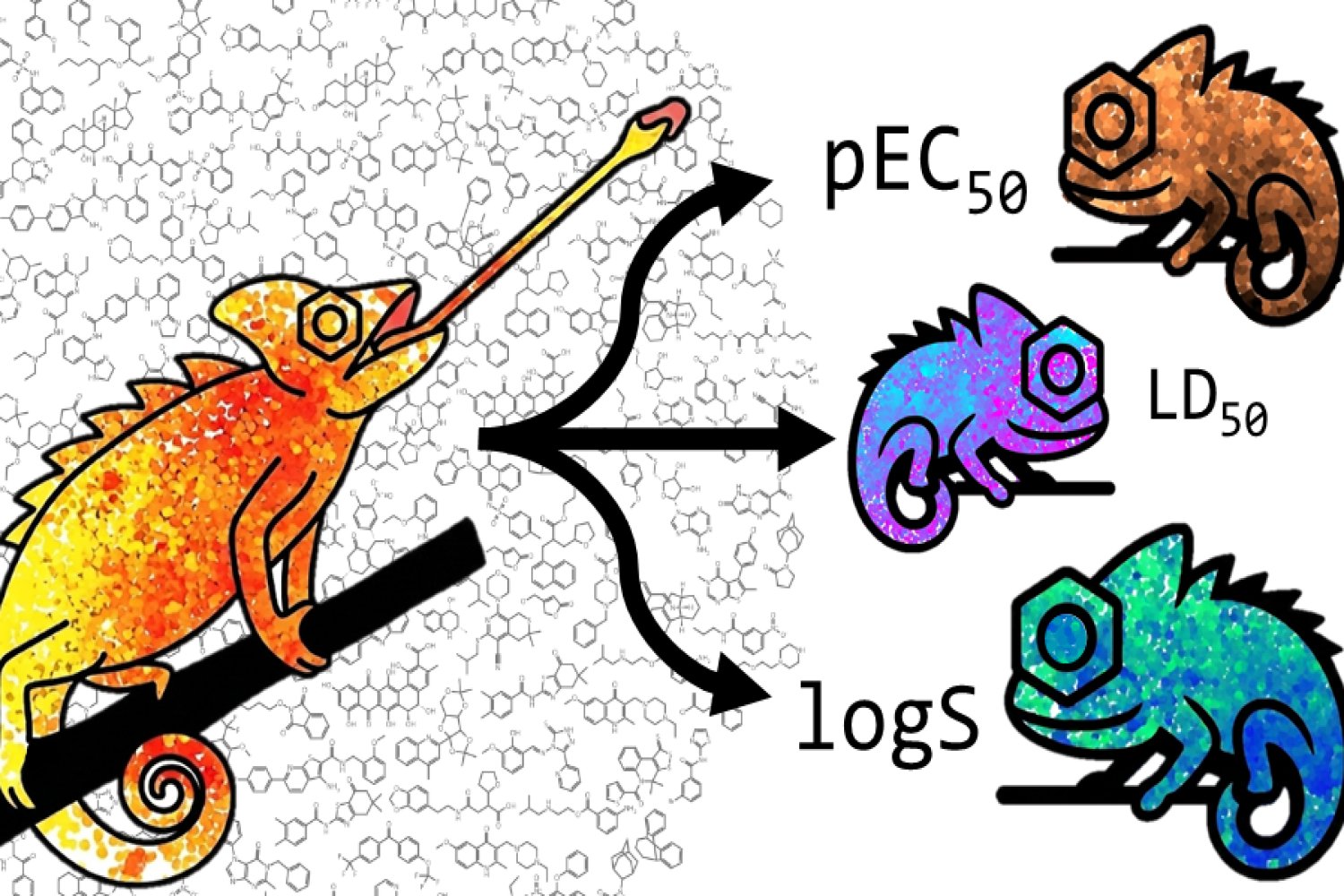
A machine-learning approach called CheMeleon provides a practical way to develop new drugs or other molecules with much less detailed, expensive experimentation.
Learn how Google DeepMind and GovTech Singapore uses lightweight on-device Gemma models to intercept conversational scams in private chats with zero cloud data egress.