This work introduces ELF-REG, which improves learning with representation alignment and entanglement (REPA+REG), where a frozen AR teacher supervises intermediate denoiser features and supplies a global representation that is jointly denoised with the response.
Abstract
Fully continuous diffusion language models (dLMs) denoise continuous representations without intermediate discretization, then decode all response tokens in parallel at the final step. Their performance on challenging reasoning tasks remains less established than that of autoregressive (AR) LLMs and masked dLMs. We scale Embedded Language Flows (ELF) to mathematical reasoning and code generation on GSM8K, MATH-500, HumanEval, and MBPP. We introduce ELF-REG, which improves learning with representation alignment and entanglement (REPA+REG), where a frozen AR teacher supervises intermediate denoiser features and supplies a global representation that is jointly denoised with the response. ELF-REG-L achieves 55.96% pass@1 on GSM8K at 64 network function evaluations (NFE), and 13.39% on MATH-500 and 22.56% on HumanEval at 128 NFE. It outperforms the evaluated comparable-scale dLMs in pass@1 on GSM8K and code, and improves MATH-500 pass@1 from 10.55% for the ELF-L baseline to 13.39% with ELF-REG-L. Without few-step training, the same task-specific checkpoints support strong low-NFE performance through early-stop, which decodes an intermediate clean prediction without completing the denoising trajectory. At 16 NFE, ELF-REG-L reaches 41.21% HumanEval pass@10, outperforming recent continuous dLMs of comparable scale.
This work proposes CAI-DLLM, a training-free inference method that uses first-step confidence to guide denoising and reduce inference time, and evaluates CAI-DLLM on LLaDA-8B-Instruct and Dream-7B-Instruct across math, code, reasoning, commonsense, and long-context tasks.
Farhana Amin, Sabiha Afroz, D. Nikolopoulos· 0 citations
Discrete diffusion language models offer a compelling alternative to autoregressive generation for tasks demanding bidirectional reasoning and global constraint satisfaction. Yet they share a structural bottleneck: when decoding in parallel, each token is sampled independently from its marginal, severing the statistica...
Discrete diffusion language models can generate multiple tokens in parallel, but reducing the number of denoising steps can lead to inconsistent predictions. Standard cross-entropy training fits conditional token marginals, whereas parallel generation requires consistent joint predictions. We introduce Alpha Diffusion...
N. Gushchin, Dmitry Baranchuk, Alexander Korotin· 0 citations
Masked diffusion language models (dLLMs) generate text by iteratively denoising masked tokens with bidirectional attention. Extending reasoning across generation chunks normally requires keeping earlier generated text in context. We ask whether a dLLM can instead continue reasoning after that text is cleared, using onl...
Albert Ge, C. Singh, Yu-Fan Zhuang et al.· 0 citations
Diffusion Language Models (DLMs) have attracted significant attention for their strong reasoning ability. However, under a bidirectional attention mechanism, DLMs operate over an exponentially large exploration space compared to autoregressive models (ARMs), making it challenging to focus on reasoning-guiding tokens un...
Dian Jin, Kai-Rong Han, Bao-Hong Li et al.· 0 citations
Diffusion Language Models (DLMs) generate text by iteratively denoising a masked sequence, independently predicting multiple tokens at each step. This conditional independence discards inter-token dependencies and degrades coherence-an issue that parallels the multi-modality problem in Non-Autoregressive Translation (N...
Peng-Yu Ji, Zi-Chen Zhang, Xiang Hu et al.· 0 citations
Related blog posts
MIT News · Artificial Intelligence· news.mit.eduAug 27, 2026
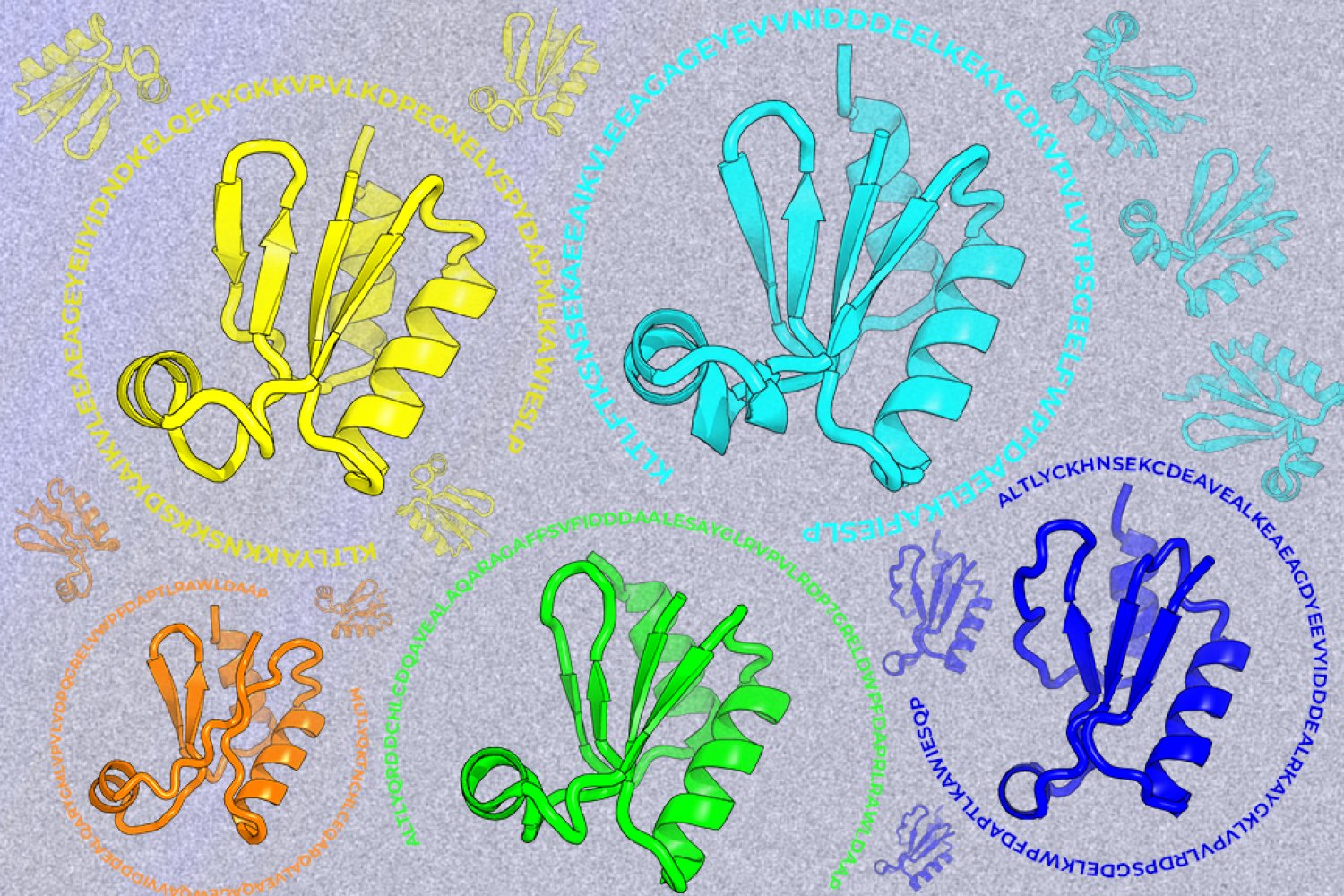
A new machine-learning framework aims to improve the success rate of computational protein design while moving away from results that reproduce sequences found in nature.