Skip to content

The Alignment Illusion in Multimodal Large Language Models

Sep 2026 · 0 citations · 24 references
Computer Science

TL;DR

Internal visual-text alignment in MLLMs is best read as a geometric diagnostic of the visual stream inside the language model rather than a direct proxy for content-level cross-modal interaction, and is most informative when calibrated by controlled task evidence.

Abstract

Layer-wise visual-text similarity in Multimodal Large Language Models (MLLMs) is widely interpreted as evidence that the language model progressively integrates visual content into a shared representation space. This reading rests on the assumption that scalar alignment scores reflect content-level cross-modal interaction. To test this assumption, we apply controlled interventions to the visual stream. Across 13 MLLMs from five families spanning 0.5B to 72B parameters, replacing projector-output visual tokens with Gaussian noise sharply reduces task accuracy, yet four standard scalar measures (CKA, SVCCA, MIR, and the leading principal-angle cosine) fail to consistently separate the corrupted stream from the original. We call this failure the alignment illusion and trace it to the shared language-model pathway: anisotropic MLP down-projections pull visual and text tokens toward common output directions, producing weight-induced alignment. Because this component is essentially one-dimensional, we introduce the principal-angle gap (PA gap), defined as the difference between the top two principal-angle cosines, which separates weight-induced similarity from multi-directional visual structure. Under graded visual corruption, the PA gap tracks task accuracy more consistently than the scalar scores we consider; under a structured but irrelevant image, it further exposes regimes in which internal geometry and task accuracy come apart. Internal visual-text alignment in MLLMs is therefore best read as a geometric diagnostic of the visual stream inside the language model rather than a direct proxy for content-level cross-modal interaction, and is most informative when calibrated by controlled task evidence.

View source

Similar papers

#artificial intelligence Preprint Sep 2026

VoT: Vision-of-Thought for Unified Multimodal Representation Alignment

Current text-to-image systems typically employ a"text encoder plus diffusion decoder"paradigm, in which text semantics directly modulate continuous latent noise. Despite their success, these methods lack an explicit, interpretable intermediate representation that effectively bridges high-level linguistic semantics and...

Jingxiang Sun, Chao Liao, Zheng-Xiong Luo et al. · 0 citations
#artificial intelligence Preprint Sep 2026

Just MLPs: Efficient Visual State Reconstruction for Multimodal Language Models

This work proposes $\delta$-Vision, which replaces repeated Transformer evolution of visual tokens with lightweight low-rank adapters that construct layer-wise visual memories while preserving all visual tokens for text retrieval, and achieves higher accuracy than visual token pruning baselines at comparable or lower c...

Jing-Di Lei, Junxian Li, Di Zhang et al. · 0 citations
#artificial intelligence Preprint Sep 2026

One Geometry, Different Outcomes: Readout-Dependent Effects of the Modality Gap in Vision-Language Models

Contrastive vision-language models learn shared embedding spaces by aligning matched image-text pairs, yet their representations remain separated by a modality gap. Prior work reports divergent effects of modifying this gap: reducing it can improve zero-shot classification and cross-modal alignment, whereas removing ga...

Aditya Sharma, Divya Saxena · 0 citations
#computer vision Preprint Aug 2026

LookBack: Where and How to Score LVLM Responses via Visual Reference Usage

LookBack, a training-free LVLM response scoring method that augments token likelihood with visual lookback score, a lightweight measure of how strongly each response token refers to image tokens, consistently improves Best-of-$N$ selection over existing baselines with negligible additional overhead.

Beomsik Cho, Jin-Ha Kim, Dongseok Lee et al. · 0 citations

Related blog posts

Microsoft Research Blog Aug 11, 2026

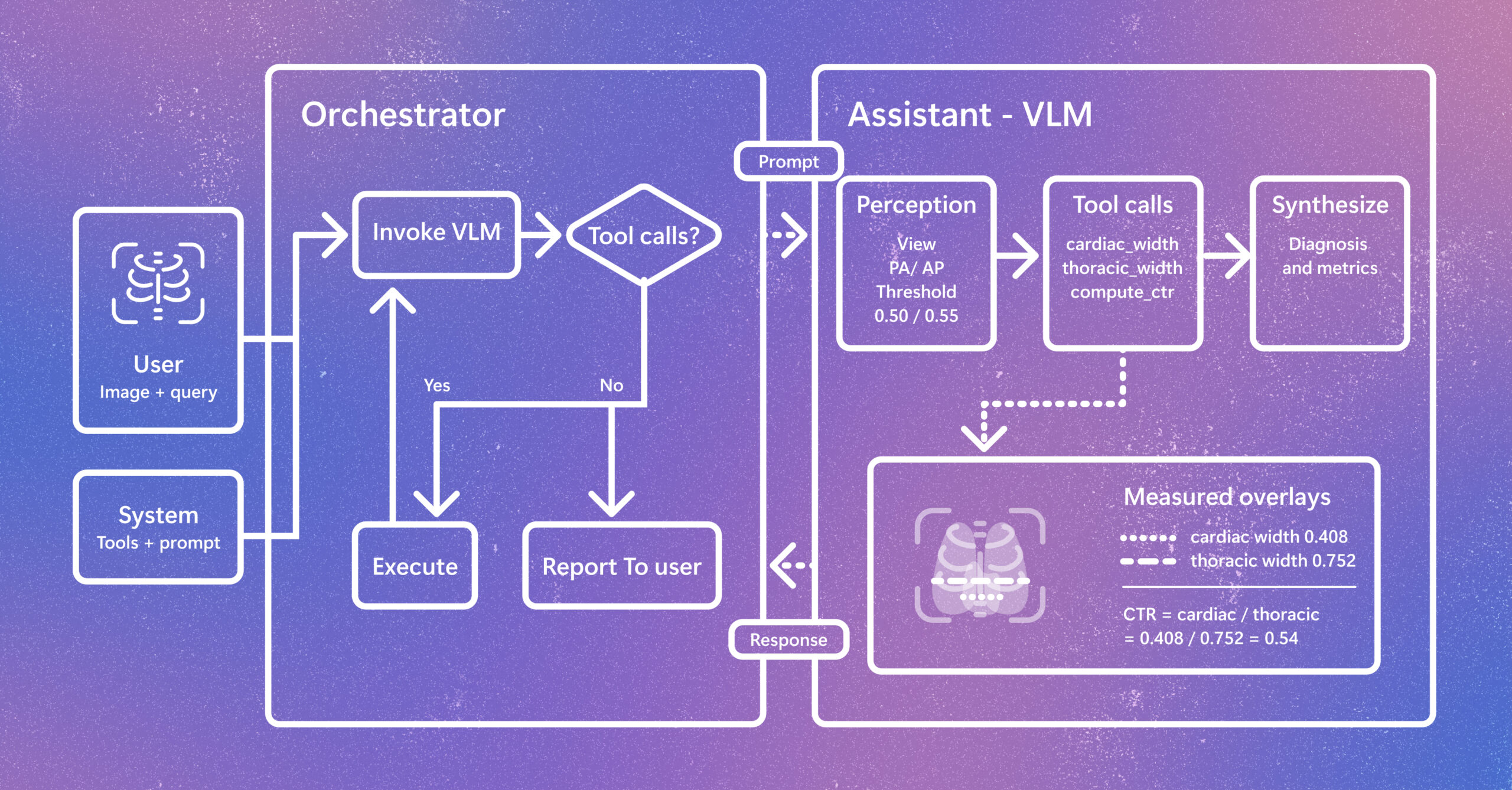
Introducing CARE-X: Towards Clinically Useful Radiology VLMs with Auxiliary Supervision, Reward-Aligned Learning, and Tool-Augmented Measurement

Radiology AI is evolving beyond report generation. CARE-X explores a unified approach that combines flexible reasoning, calibrated predictions, and measurement-based tools for chest X-ray interpretation. The post Introducing CARE-X: Towards Clinically Useful Radiology VLMs with Auxiliary Supervision, Reward-Aligned Learning, and Tool-Augmented Measurement appeared first on Microsoft Research.

We use cookies to run the site and, with your consent, for analytics and to show ads. See our Cookie Policy.