Skip to content
#graph neural networks Review Open access

Cycle-Aware Algorithms for Community Detection and Statistical Network Inference: A Review and Tutorial

Sep 2026 · Algorithms · 0 citations · 38 references
Complex Network Analysis Techniques

Abstract

Community detection is often formulated through edge density, yet many scientifically meaningful groups are characterized by closure, redundancy, and repeated multi-step interaction. This structured review develops an algorithmic and statistical perspective on cycle-aware network analysis, connecting motif and cycle counting, non-backtracking and Bethe–Hessian spectral methods, renewal non-backtracking random walks (RNBRW), Hodge-theoretic representations, and higher-order graph neural networks. We distinguish simple cycles from closed walks, summarize computational trade-offs, and show how fixed-length cycle counts in sparse stochastic block models become power sums of the block-connectivity spectrum, with assortative and disassortative structure producing length-dependent enrichment or depletion. We then separate community detection from statistical validation and develop null-adjusted, selection-aware workflows for cycle evidence. Four explicit algorithms, complexity comparisons, and reproducible simulation code are provided. A paired computational study examines detectability, degree heterogeneity, edge noise, controlled triangle enrichment, runtime, and latent-geometry confounding. Bethe–Hessian improves recovery over the edge baseline in the tested degree-heterogeneous sparse setting, whereas triangle and RNBRW reinforcement do not consistently improve recovery over the edge baseline when paired with spectral clustering in the tested regimes; lower recovery can accompany triangle enrichment even when the degree sequence and block mixing are preserved. The matched geometric benchmark also includes a diagnostic that uses the true simulation labels. It compares the HOSC-selected vector with the most label-aligned vector in a fixed neighborhood of nine eigenvectors and is not deployable. In one tested condition, this analysis traces near-chance HOSC recovery to finite-sample target-eigenvalue selection failure; the result does not imply that community signal is absent from the full spectrum. The review concludes with benchmarking guidance and open problems in null theory, selective inference, overlapping, signed, temporal, and learned network representations.


Read PDF

Similar papers

#computer vision Review Open access Mar 2016

Determinants of overweight or obesity among ever-married adult women in Bangladesh

The findings of the study indicate that a large number of women in Bangladesh are suffering from being overweight or obese, and multiple factors are responsible for this including, older age,being from wealthy households, higher education, being from food-secured households, watching TV at least once a week, and being...

Haribondhu Sarma, N. Saquib, M. Hasan et al. · 75 citations · ⚡5
#data science Review Open access Dec 2017

Trends and inequities in use of maternal health care services in Indonesia, 1986–2012

Purpose Overall health status indicators have improved significantly over the past three decades in Indonesia. However, the country’s maternal mortality ratio remains high with a stark inequality by region. Fewer studies have explored access inequity in maternal health care service over time using multiple inequality m...

Herfina Y. Nababan, M. Hasan, Tiara Marthias et al. · 64 citations · ⚡2
#computer vision Conference Aug 2008

Scrum in a Multiproject Environment: An Ethnographically-Inspired Case Study on the Adoption Challenges

Agile methods continue to gain popularity. In particular, the Scrum method appears to be on the verge of becoming a de-facto standard in the industry, leading the so called Agile movement. While there are success stories and recommendations, there is little scientifically valid evidence of the challenges in the adoptio...

A. Marchenko, P. Abrahamsson · 59 citations · ⚡11
#data science Review Open access Apr 2022

Association between Mother’s Education and Infant and Young Child Feeding Practices in South Asia

Findings demonstrate a strong positive association between mother’s education and IYCF indicators and suggest strengthening national policies to educate women at least to the secondary level in SACs might be a cost-effective intervention for improving IY CF practices.

M. Tariqujjaman, M. Hasan, M. Mahfuz et al. · 45 citations · ⚡4
#computer vision Open access Sep 2012

Making the leap to a software platform strategy: Issues and challenges

A comprehensive taxonomy of the challenges faced when a medium-scale organization decided to adopt software platforms is provided, namely: business challenges, organizational challenges, technical challenges, and people challenges.

Yaser Ghanam, F. Maurer, P. Abrahamsson · 41 citations · ⚡3
#natural language process... Review Open access Sep 2021

Prevalence, knowledge, attitudes and factors associated with exclusive breastfeeding among mothers in Dhaka, Bangladesh: A cross-sectional study

Good knowledge, positive attitude and some sociodemographic factors were significant with exclusive breastfeeding which are needed to improve for promoting exclusive breastfeeding practices and reducing infant mortality and morbidity.

M. Hasan, M. Hassan, M. Khan et al. · 32 citations · ⚡6

Related blog posts

Microsoft Research Blog Jul 13, 2026

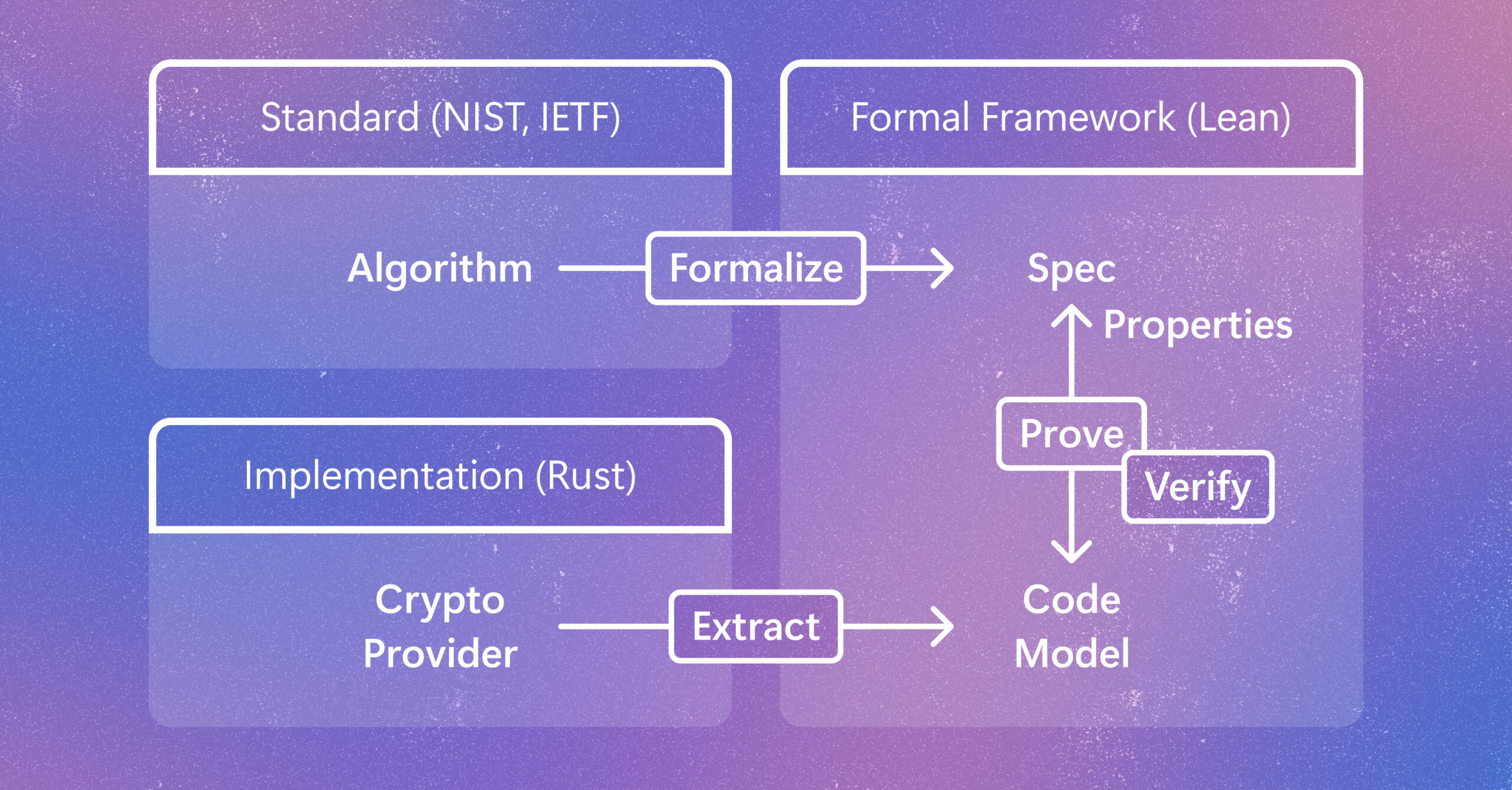
Verifying Rust cryptography in SymCrypt, from standards to code

Cryptographic code supports vital protections in modern computing systems. Learn how a new method helps verify code as developers write it while preserving speed and adaptability as it gets implemented and evolves. The post Verifying Rust cryptography in SymCrypt, from standards to code appeared first on Microsoft Research.

We use cookies to run the site and, with your consent, for analytics and to show ads. See our Cookie Policy.