Dec 2025· arXiv.org· Vol abs/2512.18640· 0 citations· 60 references
Computer Science
TL;DR
This work proposes GPERT, a framework to address the trade-off between accuracy and temporal resolution in event-based 3DGS, by decouple the rendering into two branches: event-by-event geometry (depth) rendering and snapshot-based radiance (intensity) rendering, by using ray-tracing and the image of warped events.
Abstract
Event cameras offer a high temporal resolution over traditional frame-based cameras, which makes them suitable for motion and structure estimation. However, it has been unclear how event-based 3D Gaussian Splatting (3DGS) approaches could leverage fine-grained temporal information of sparse events. This work proposes GPERT, a framework to address the trade-off between accuracy and temporal resolution in event-based 3DGS. Our key idea is to decouple the rendering into two branches: event-by-event geometry (depth) rendering and snapshot-based radiance (intensity) rendering, by using ray-tracing and the image of warped events. The extensive evaluation shows that our method achieves state-of-the-art performance on the real-world datasets and competitive performance on the synthetic dataset. Also, the proposed method works without prior information (e.g., pretrained image reconstruction models) or COLMAP-based initialization, is more flexible in the event selection number, and achieves sharp reconstruction on scene edges with fast training time. We hope that this work deepens our understanding of the sparse nature of events for 3D reconstruction. https://github.com/e3ai/gpert

Event cameras asynchronously detect brightness changes as events rather than capturing full image frames, making them attractive for a wide range of applications. This has created a growing demand for simulation methods that generate realistic event streams directly from 3D scenes. However, accurate simulation remains...
Yuichiro Manabe, Tatsuya Yatagawa, Shigeo Morishima et al.· IEEE Transactions on Visuali...· 0 citations
This paper introduces a spatio-temporal registration framework to increase accuracy of current state-of-the-art event-by-event flow estimation, while also introducing a twofold algorithm acceleration approach and a real-time implementation strategy to mitigate the impact of computation scaling with event rate.
Zhi-Chao Li, Arren J. Glover, Lorenzo Natale et al.· IEEE Transactions on Pattern...· 0 citations
Experiments show that EdMCGS outperforms both RGB-based and event-based baselines, while rendering in real time with far fewer Gaussians than the strongest event-based baseline.
Event cameras hold excellent dynamic properties, showing great potential for monocular depth estimation (MDE). However, existing methods mainly improve performance by optimizing contextual features, but still struggle with the ill-posed and nonlinear nature of direct full-depth regression. In this paper, we propose Hyp...
Dynamic scenes may be captured by a moving camera, multiple video streams, or images taken at different times. These observations reveal complementary aspects of scene geometry and motion, yet bringing them together requires establishing correspondence across viewpoints, capture times, and visibility changes. We introd...
Ilya Fradlin, Christian Schmidt, Jens Piekenbrinck et al.· 0 citations
This work proposes GSPotential, a framework that quantifies view-space supervision imbalance using a Camera Potential Field, and uses the potential field to guide reconstruction from two complementary aspects.
Zeyuan An, Yang Xiao, Zhiying Leng et al.· 0 citations
Related blog posts
MIT News · Artificial Intelligence· news.mit.eduJul 30, 2026
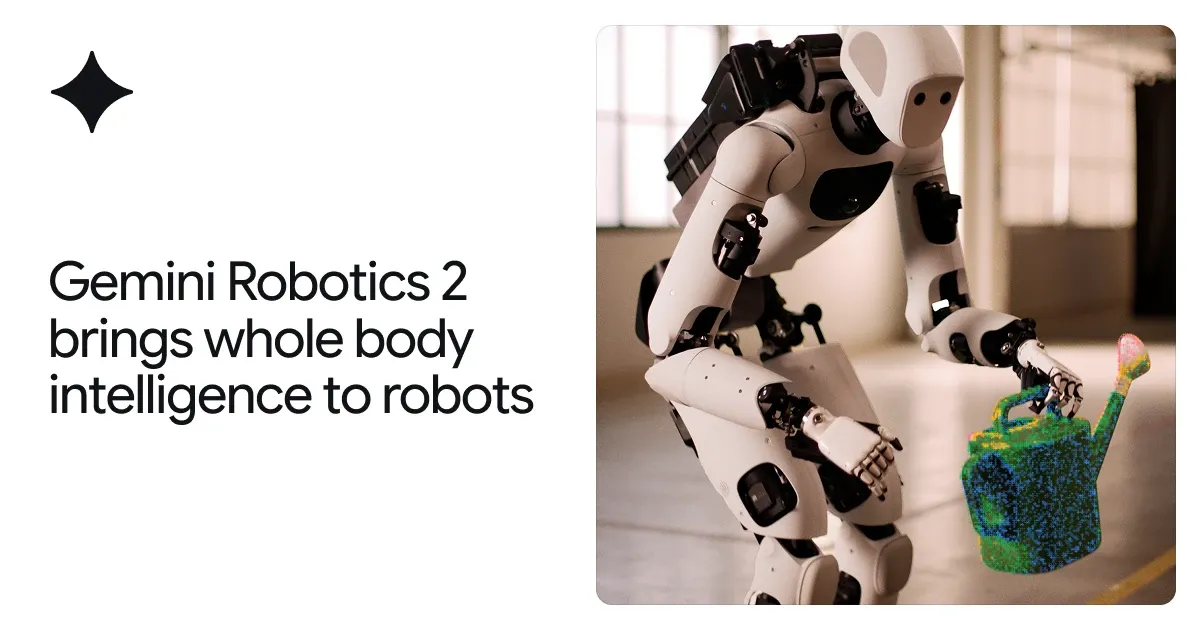
From feet to fingertips — we are teaching robots intelligent whole-body control, fine dexterity, and teamwork to complete a broad range of complex tasks.
Known for his clear and elegant writing style, Bertsekas shaped fields from control and optimization to large-scale computation and artificial intelligence.
We use cookies to run the site and, with your consent, for analytics and to show ads.
See our Cookie Policy.