Skip to content

Query-Conditioned Prototype Adaptation for Cross-Domain Few-Shot Learning: Single-Query Inference, Controlled Comparisons, and Failure Modes

Sep 2026 · 0 citations · 20 references
Computer Science

TL;DR

Overall, WIPT provides a streaming-compatible form of test-time prototype adaptation that can improve difficult low-shot cross-domain decisions without target-time optimization.

Abstract

Cross-domain few-shot learning requires adapting a classifier to a new visual domain from very few labelled examples without target-time parameter updates. We isolate one question: under a fixed global representation, what does joint query-support adaptation contribute to prototype construction? The Within-Instance Prototypical Transformer (WIPT) implements single-query test-time prototype adaptation by jointly transforming one unlabelled query and the labelled support embeddings, then forming query-specific class means. Using a shared frozen ViT-S/16 encoder, miniImageNet source training, and CUB, EuroSAT and ISIC targets, we replicate the key comparisons across five independent training seeds. In 1-shot evaluation, WIPT improves frozen ProtoNet in every run on CUB (+0.21 percentage points) and EuroSAT (+2.07), but decreases ISIC (-0.22). In 5-shot evaluation, ProtoNet remains strongest overall, while WIPT consistently improves a capacity-matched support-only Transformer on ISIC (+0.99). Joint processing of up to five queries yields no reliable accuracy gain; in a head-only 5-shot benchmark, g = 5 reduces analytical attention-token pairs by 73% and peak allocated memory by 29% relative to g = 1, although latency is non-monotonic. Across all target/shot conditions, WIPT changes uncertain ProtoNet decisions far more than confident ones, and rescue/break decomposition accounts for the observed gains and losses. Source-shift and scorer controls further show that the benefit is not universal. Overall, WIPT provides a streaming-compatible form of test-time prototype adaptation that can improve difficult low-shot cross-domain decisions without target-time optimization.

View source

Similar papers

Preprint Sep 2026

Training-Free Spectral Transductive Refinement for Cross-Domain Few-Shot Classification

Few-shot recognition with frozen visual features is especially fragile under domain shift and one-shot supervision, where a single labelled image is an unreliable estimate of its class. We ask how far this fragility can be reduced purely at test time, without retraining the encoder or augmenting the source domain. We p...

F. Rahman, S. Rohan, Mahmound Sayed et al. · 0 citations
Review Open access Sep 2026

Mathematical Optimization and Advanced Algorithms for Few-Shot and Zero-Shot Visual Learning: An Optimization-Centered Review

A unified comparison of attribute-based ZSL, episodic meta-learning, metric and prototype estimators, graph and optimal-transport inference, generative any-shot models, and adaptation of vision–language models is analyzed.

Jie Li, Yu-Bo Sun, Xun Du et al. · 0 citations
#small language model Preprint Sep 2026

Position Aware Layer Queries for Test Time Training in Vision Language Models

Test-Time Training (TTT) adapts models to incoming test samples (e.g. out-of-distribution, (OOD)) when conventional fine-tuning is infeasible. Existing TTT methods for Vision-Language Models (VLMs) create supervision from several augmented views, each requiring forward (and often backward) passes through the entire VLM...

Rajat Modi, P. Pathak, Xin Liang et al. · 0 citations
Oct 2026

GIPACount: Global interaction and prototype-guided aggregation network for exemplar-conditioned few-shot object counting.

Few-shot object counting (FSC) aims to estimate counts for previously unseen (novel) categories given only a few exemplars, leveraging knowledge learned on seen (base) categories for generalization. However, most existing methods rely on unidirectional matching and underuse scene context, limiting the effective use of...

Jing-Hui He, Bo Liu, Fan Cao et al. · 0 citations
Preprint Sep 2026

Test-Time Adaptation with Query-Dependent Residuals for Visual Document Retrieval

Visual document retrieval (VDR) systems depend on page embeddings computed before deployment, which makes adaptation difficult when encoder parameters or corpus re-encoding are unavailable. Rerankers provide useful relevance signals, but conventional reranking applies them only to selected queries and candidate pages....

Ze-Liang Li, Xiao-Fen Xing, K. Guo et al. · 0 citations
#artificial intelligence Preprint Oct 2026

Enhancing Long-Video VLM Embeddings with Query-Aware Streaming Latent Reasoning

Long-video embedding requires capturing sparse query-relevant evidence under a limited visual-token budget. Uniform sampling can miss brief events in videos spanning minutes or hours, whereas encoding more frames in a single context increases memory and computation. We introduce \textbf{Query-Aware Streaming Latent Rea...

Hao-Zhe Chi, Song Jin, Yang Jin et al. · 0 citations

Related blog posts

Microsoft Research Blog Aug 11, 2026

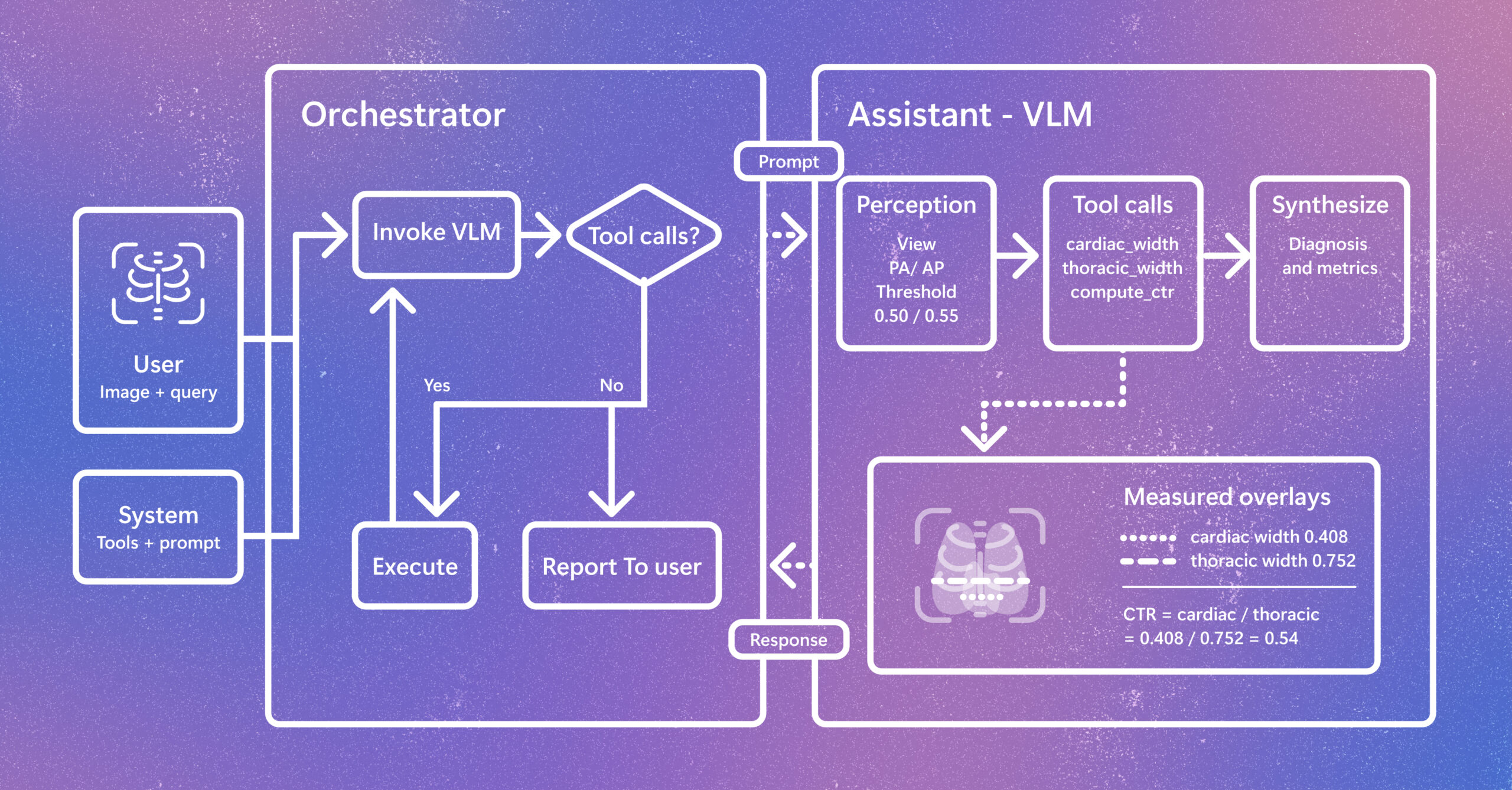
Introducing CARE-X: Towards Clinically Useful Radiology VLMs with Auxiliary Supervision, Reward-Aligned Learning, and Tool-Augmented Measurement

Radiology AI is evolving beyond report generation. CARE-X explores a unified approach that combines flexible reasoning, calibrated predictions, and measurement-based tools for chest X-ray interpretation. The post Introducing CARE-X: Towards Clinically Useful Radiology VLMs with Auxiliary Supervision, Reward-Aligned Learning, and Tool-Augmented Measurement appeared first on Microsoft Research.

We use cookies to run the site and, with your consent, for analytics and to show ads. See our Cookie Policy.