LoRA merging methods increasingly operate on the low-rank structure of task updates, yet how the common subspace is estimated and how coefficients are assigned after recomposition are rarely compared directly. We propose CT-Merging, which estimates common directions from averaged task subspace projectors and assigns a separate residual scale to each task. Projector averaging selects directions supported across task subspaces without weighting them by singular magnitude, while task-specific scaling removes component-wise magnitude variation and preserves scale differences across tasks. On the released KnOTS CLIP adapters, CT-Merging achieves the best average and worst-task normalized accuracy on both backbones, improving over the strongest baseline by up to 2.56 and 6.65 points, respectively. On the DC-Merge adapter benchmark, it achieves the best average normalized accuracy in eight of nine backbone and task-count settings. Ablations show that projector averaging outperforms summed-update SVD and that task-specific scaling improves worst-task accuracy over global isotropic scaling.
Net Utility is introduced, a data free metric that first decomposes every task LoRA by its Singular Value Decomposition (SVD) and scores each of those singular directions by its task utility and its interference with other tasks directions, which shows that net utility based rank allocation outperforms its counterparts...
Avinash Amballa, Yashas Malur Saidutta, Wen-Bo Li et al.· 0 citations
Task-specific LoRA adapters offer a modular way to specialize large language and vision-language models. However, existing adapter composition methods are mostly static and cannot adapt to individual test inputs. To address these issues, we propose \textbf{LiST}, a label-free test-time LoRA fusion framework that conver...
Yi-Hua Shao, Jia Li, Si-Yu Chen et al.· 2 citations
While Low-Rank Adaptation (LoRA) enables efficient task specialization, its learned updates can compromise capabilities beyond the target task. We identify \textbf{adaptation imbalance}: a few singular directions dominate the trained update, leaving its performance sensitive to how gains are allocated. We argue that \t...
Zai-Long Tian, Yan-Zhe Chen, Zhuo-Heng Han et al.· 0 citations
Spectral Energy-proportional Rank Allocation (SERA) is proposed, a simple task-adaptive strategy that allocates ranks according to the singular-value energy structure of each task vector, extending SVD-based model merging from uniform-capacity merging to task-dependent capacity allocation.
Merging finetuned models combines specialized capabilities without joint training or access to the original data. Most methods operate by linear arithmetic in Euclidean weight space, which cannot carry the geometry of the update. Orthogonal Model Merging (OrthoMerge) uses a single orthogonal transform for each weight m...
Xinyi Sui, Zi-Ran Liu, Nam Ling et al.· 1 citation
DART is proposed, a training-free reparameterization method that transports source LoRAs into aligned coordinates through a low-rank distillation bridge and complements response calibration, with adapter-level benefits encompassing both functional preservation and reduced negative transfer.
Shi-Hong Li, Jun-Tao Xu, Cao Jin et al.· 1 citation
Related blog posts
MIT News · Artificial Intelligence· news.mit.eduOct 28, 2026
Professor Paris Smaragdis develops computers with superhuman hearing for applications like speech recognition, music understanding, and environmental monitoring.
Exploring how generative AI could make machine vision more accessible to businesses. The post GenEye in a Box: Making Machine Vision Something You Can Just Ask For appeared first on GPT-Lab.
Microsoft Research Blog· microsoft.comAug 11, 2026
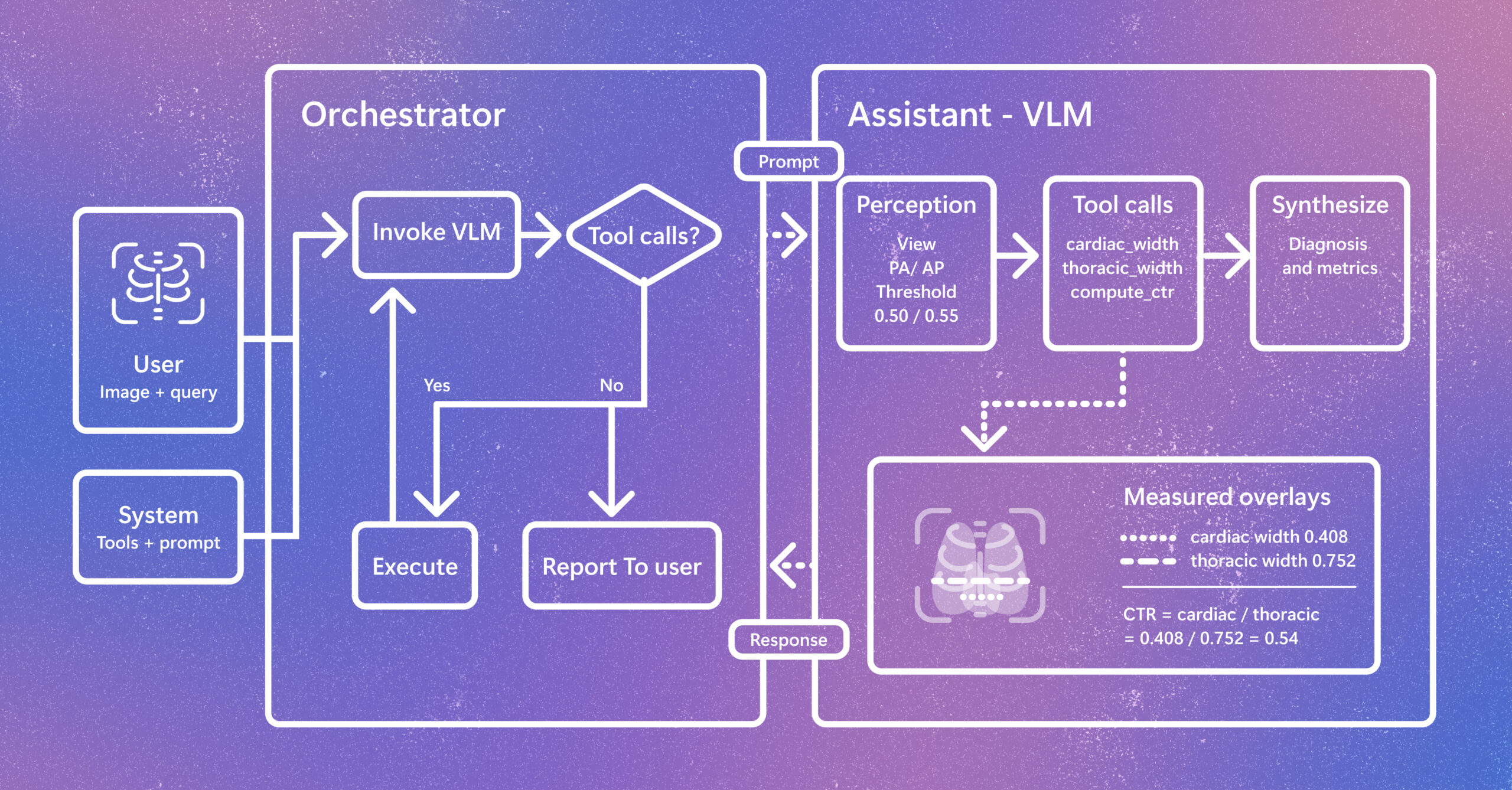
Radiology AI is evolving beyond report generation. CARE-X explores a unified approach that combines flexible reasoning, calibrated predictions, and measurement-based tools for chest X-ray interpretation. The post Introducing CARE-X: Towards Clinically Useful Radiology VLMs with Auxiliary Supervision, Reward-Aligned Learning, and Tool-Augmented Measurement appeared first on Microsoft Research.