Text-guided image editing aims to perform a desired edit while preserving source content unrelated to it. Pretrained rectified-flow models enable training-free editing of real images through modifications to their sampling trajectories. However, responses at locations unrelated to the desired edit can still accumulate along the editing trajectory and become visible in the final result. To overcome this, we propose Constrained Edit Fields (CEF), which assigns each spatial location a continuous edit responsibility that quantifies its relevance to the desired edit. CEF estimates edit responsibility directly from the source image when the relevant content is present. For edits whose target content is absent from the source, CEF first generates an unconstrained proposal to reveal its realized spatial support and then estimates responsibility from that proposal. At each editing step, CEF decomposes the base edit field into prompt-induced and trajectory-induced components, enabling edit responsibility to preserve instruction-relevant updates while suppressing unintended trajectory-induced changes. Evaluated on all 700 PIE-Bench examples, CEF achieves state-of-the-art Structure Distance, background LPIPS, and background MSE with both Stable Diffusion 3.5 Medium and FLUX, while retaining competitive instruction alignment. On Stable Diffusion 3.5 Medium, it reduces these metrics over the previous best results by 10.2%, 21.2%, and 48.0%, respectively.
This publication proposes a definition and a classification of agile software development approaches and analyses ten software development methods that can be characterized as being "agile" against the defined criterion.
P. Abrahamsson, O. Salo, Jussi Ronkainen et al.· arXiv.org· 727 citations· ⚡54
The study shows that agile practices improve both informal and formal communication, but indicates that, in larger development situations involving multiple external stakeholders, a mismatch of adequate communication mechanisms can sometimes even hinder the communication.
M. Pikkarainen, Jukka Haikara, O. Salo et al.· Empirical Software Engineeri...· 401 citations· ⚡48
The results indicate that software engineering work practices are chosen opportunistically, adapted and configured to provide value under the constrains imposed by the startup context.
Nicolò Paternoster, Carmine Giardino, M. Unterkalmsteiner et al.· Information and Software Tec...· 394 citations· ⚡54
The possibility of inferring high-dimensional data inference in a model that consists of a prior and an auxiliary differentiable constraint given some additional information is considered, thereby allowing a range of potential applications in adapting models to new domains and tasks.
Alexandros Graikos, Esmeralda S. Whitammer, N. Jojic et al.· Neural Information Processin...· 316 citations· ⚡15
It is proved that any global minimizer of the trajectory balance objective can define a policy that samples exactly from the target distribution, and empirically demonstrate the benefits of the trajectories balance objective for GFlowNet convergence, diversity of generated samples, and robustness to long action sequenc...
Esmeralda S. Whitammer, Moksh Jain, Emmanuel Bengio et al.· Neural Information Processin...· 302 citations· ⚡60
Related blog posts
Microsoft Research Blog· microsoft.comAug 11, 2026
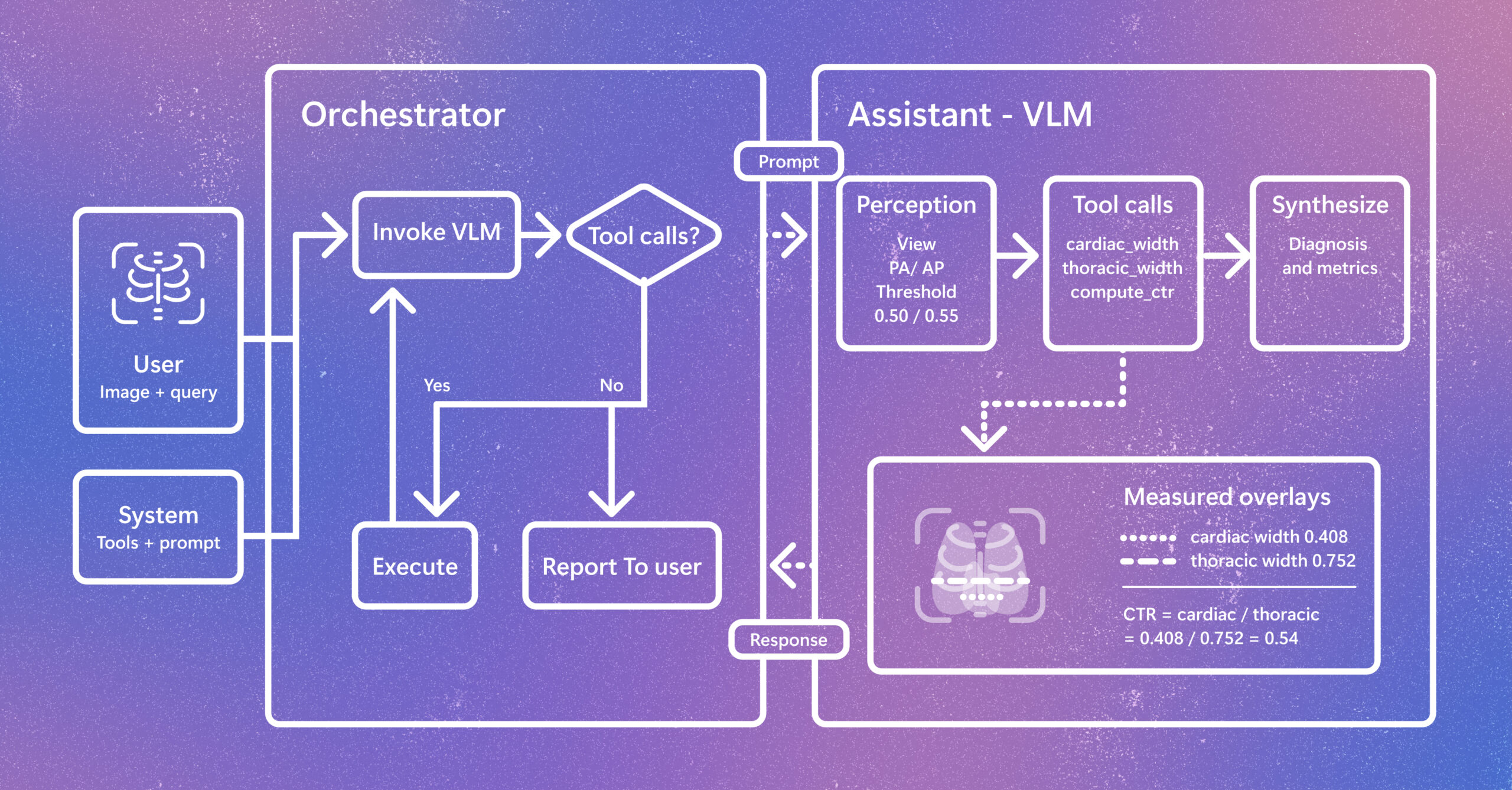
Radiology AI is evolving beyond report generation. CARE-X explores a unified approach that combines flexible reasoning, calibrated predictions, and measurement-based tools for chest X-ray interpretation. The post Introducing CARE-X: Towards Clinically Useful Radiology VLMs with Auxiliary Supervision, Reward-Aligned Learning, and Tool-Augmented Measurement appeared first on Microsoft Research.
