Across three VLMs and twelve benchmarks, this work tracks the answer-relevant information decodable at each decoder layer and measures when it becomes coupled to the final output, and distinguishes the availability of visual information from its influence on prediction.
Abstract
Vision-language models (VLMs) achieve high accuracy on many visual question-answering benchmarks, yet it remains unclear whether this accuracy reflects reliable use of the visual details a question depends on. We examine this tension through the lens of visual ignorance: cases where a model can represent task-relevant visual evidence without using it to determine the answer. Across three VLMs and twelve benchmarks, we track the answer-relevant information decodable at each decoder layer and measure when it becomes coupled to the final output. The visual evidence needed for the correct answer can already be read out from intermediate layers, yet it has little effect on the output until the final layers of the decoder. Causal residual interchange confirms that shifting the answer requires the late states, not the earlier ones. We then evaluate all twelve benchmarks under progressive Gaussian blur and find that substantial fractions of predictions survive the entire degradation sequence while continuing to receive benchmark credit. These results distinguish the availability of visual information from its influence on prediction, and show that standard accuracy can coexist with limited sensitivity to the tested visual detail. They motivate training and evaluation that make answer-relevant visual distinctions necessary to answer correctly.

Vision-language models (VLMs) answer visual questions by combining visual information extraction with downstream problem solving. We investigate a fundamental question: Does an incorrect answer necessarily reflect a failure in visual extraction or problem solving? A model may succeed at both abilities when tested separ...
Zi-Heng Wang, Ming-Xuan Xie, Yi-Lin Liu et al.· 0 citations
Results show that process priors are most useful when aligned with the scene's specific decision boundary, motivating boundary-aware prior selection for process-grounded visual reasoning.
Yu-Yang Dai, Bo-Fei Huang, Hong-Bo Zhang et al.· 1 citation
A small detector is trained to predict the internal development of answer readiness and stop reasoning at that point, connecting the internal development of answer readiness to a practical rule for allocating reasoning computation.
Some questions about an image need commonsense or factual knowledge that its pixels do not contain. Large Language Models (LLMs) can supply this knowledge to Visual Question Answering (VQA) systems, but the depth at which their guidance should enter a vision-language model remains unclear. We prompt the 70-billion-para...
Aneerban Saha, Vijay Kumar, D. SameerMadhav et al.· 0 citations
AdaLoop is presented, a framework for question-conditioned visual recurrence in VLMs that adapts visual computation to the question and reuses the encoder's transformations across multiple iterations, with the pretrained vision weights frozen.
Xinran Nicole Han, Yi-Yang Lu, Katelyn Gan et al.· 0 citations
Vision-language models answer questions about images they were never shown, a failure called mirage. Such an answer can be correct without being justified by the evidence, and the difference matters wherever a model's output is checked by someone who did not see its input. We locate the failure in the training objectiv...
Alfaj Uddin Ahmed, Md. Shawon Miah, Md Arid Hasan et al.· 0 citations
Related blog posts
MIT News · Artificial Intelligence· news.mit.eduOct 28, 2026
Professor Paris Smaragdis develops computers with superhuman hearing for applications like speech recognition, music understanding, and environmental monitoring.
Exploring how generative AI could make machine vision more accessible to businesses. The post GenEye in a Box: Making Machine Vision Something You Can Just Ask For appeared first on GPT-Lab.
Microsoft Research Blog· microsoft.comAug 11, 2026
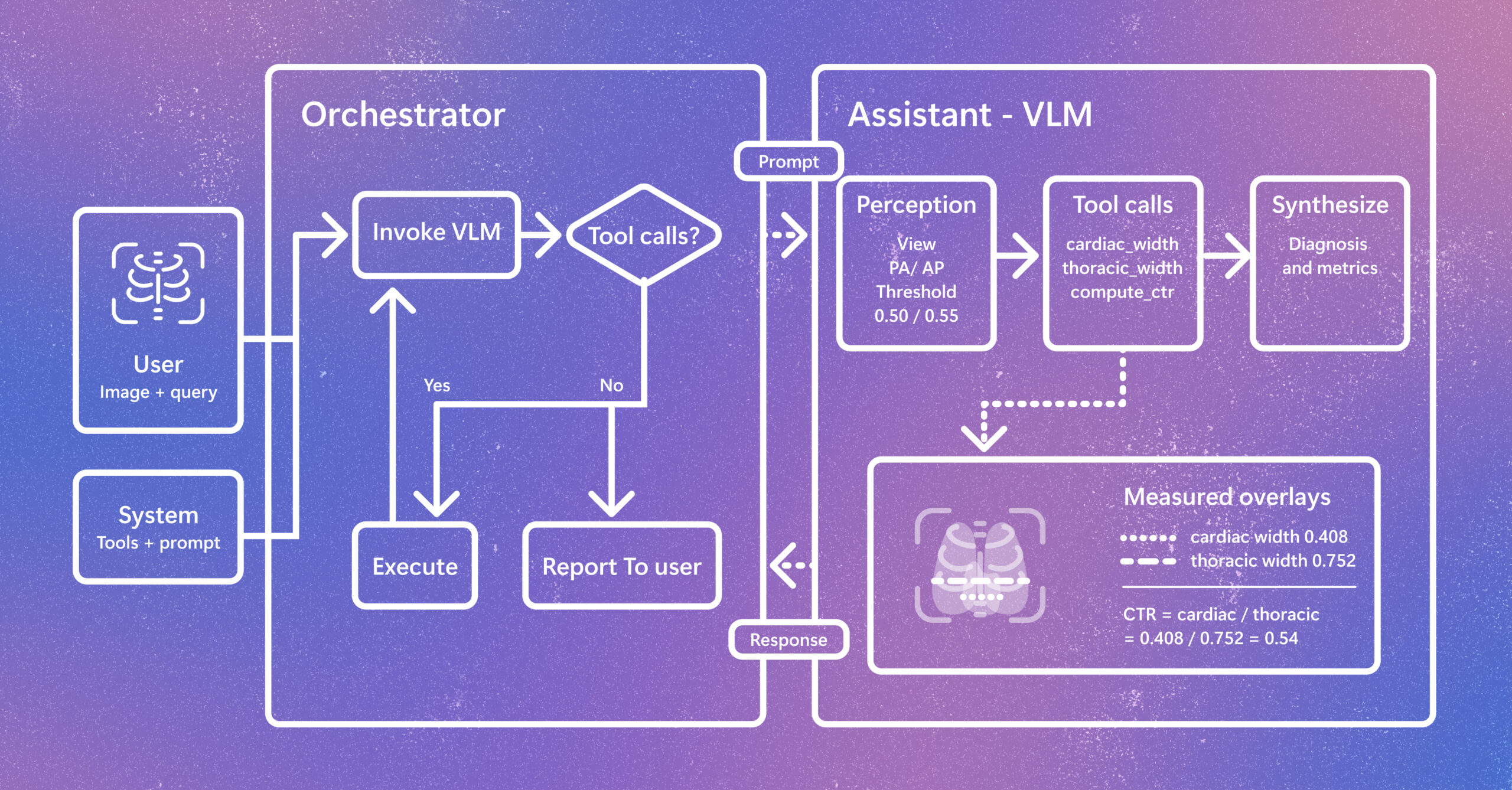
Radiology AI is evolving beyond report generation. CARE-X explores a unified approach that combines flexible reasoning, calibrated predictions, and measurement-based tools for chest X-ray interpretation. The post Introducing CARE-X: Towards Clinically Useful Radiology VLMs with Auxiliary Supervision, Reward-Aligned Learning, and Tool-Augmented Measurement appeared first on Microsoft Research.