Skip to content

Lightweight Relation-Aware Graph Neural Networks for Network Threat Detection in the Social Internet of Things

Sep 2026 · Symmetry · 0 citations · 29 references
Advanced Graph Neural Networks

Abstract

Network threat detection in the Internet of Things must exploit typed relations between devices: a device with unremarkable flow statistics may still be compromised relative to its ownership, co-location, and social ties. Existing graph-based intrusion detectors discard relation type, while lightweight detectors compress tabular rather than graph models. This paper presents Light-SIoT-GAD, a lightweight relation-aware graph detector that treats typed relations as first-class input. The model learns one scalar weight per relation, shares a small basis across relation transforms so that each additional relation type costs only a handful of mixing coefficients rather than a full weight matrix, and combines supervised feature selection, bounded neighbour sampling, and 8-bit post-training quantisation for gateway deployment. A dual-track evaluation isolates typed aggregation on a real 16,216-device SIoT relation graph with injected anomalies and tests attack detection on three labelled NetFlow v2 corpora against classical, deep tabular, and graph baselines, including cross-corpus transfer and ablations. Light-SIoT-GAD matches or exceeds the strongest untyped graph baselines on all three corpora, reaching an AUPRC of 0.9986 with 73,962 parameters, substantially fewer than the unshared R-GCN; on the sparsest corpus a gradient-boosted tabular ensemble still ranks better, which bounds the claim to graphs that carry usable structure. Whether the gain comes from the relation semantics or merely from having per-relation parameters is tested directly: permuting the relation labels leaves the dense corpora unchanged to four decimals and costs 0.0083 AUPRC only on the sparsest one, so the typed advantage is real there and is a capacity effect elsewhere. On the social track, where the anomalies are injected under a stated protocol rather than observed, removing message passing collapses AUPRC from 0.9990 to 0.4869 under that same injection, isolating propagation over the relation graph as the source of the gain; this track measures whether relational structure carries signal, not accuracy against real SIoT attacks. The quantised model occupies 85.4 KB at 14.38 ms per 1000 edges on CPU. The learned relation gates are shown to be identified only up to a per-relation rescaling, and a leave-one-relation-out intervention finds no relation of the SIoT taxonomy to be load-bearing under the injection protocol, so the social track supports the typed parameterisation and not a ranking of the relations.
Read PDF

Similar papers

#computer vision Conference Aug 2008

Scrum in a Multiproject Environment: An Ethnographically-Inspired Case Study on the Adoption Challenges

Agile methods continue to gain popularity. In particular, the Scrum method appears to be on the verge of becoming a de-facto standard in the industry, leading the so called Agile movement. While there are success stories and recommendations, there is little scientifically valid evidence of the challenges in the adoptio...

A. Marchenko, P. Abrahamsson · 59 citations · ⚡11
#computer vision Open access Sep 2012

Making the leap to a software platform strategy: Issues and challenges

A comprehensive taxonomy of the challenges faced when a medium-scale organization decided to adopt software platforms is provided, namely: business challenges, organizational challenges, technical challenges, and people challenges.

Yaser Ghanam, F. Maurer, P. Abrahamsson · 41 citations · ⚡3
#machine learning Open access Mar 2024

Integration of molecular coarse-grained model into geometric representation learning framework for protein-protein complex property prediction

MCGLPPI, a novel geometric representation learning framework that combines graph neural networks (GNNs) with the MARTINI molecular coarse-grained (CG) model to predict overall PPI properties accurately and efficiently, offers an effective and efficient solution for PPI overall property predictions.

Yang Yue, Shu Li, Yihua Cheng et al. · 15 citations

PepPCBench is a Comprehensive Benchmarking Framework for Protein-Peptide Complex Structure Prediction

PepPCBench enables a robust evaluation of PFNN-based methods and supports their continued development for peptide-protein structure prediction, and highlights the influence of peptide length, conformational flexibility, and training set similarity on prediction accuracy.

Si-Long Zhai, Huifeng Zhao, Ji-Ke Wang et al. · 13 citations · ⚡1
#machine learning Open access Sep 2025

Unified and explainable molecular representation learning for imperfectly annotated data from the hypergraph view

OmniMol is presented, a framework using hypergraphs to improve predictions of molecular properties, addressing challenges of imperfect data annotation and enhancing model explainability, and achieves state-of-the-art performance in properties prediction.

Bowen Wang, Junyou Li, Donghao Zhou et al. · 11 citations

Related blog posts

Microsoft Research Blog Jul 13, 2026

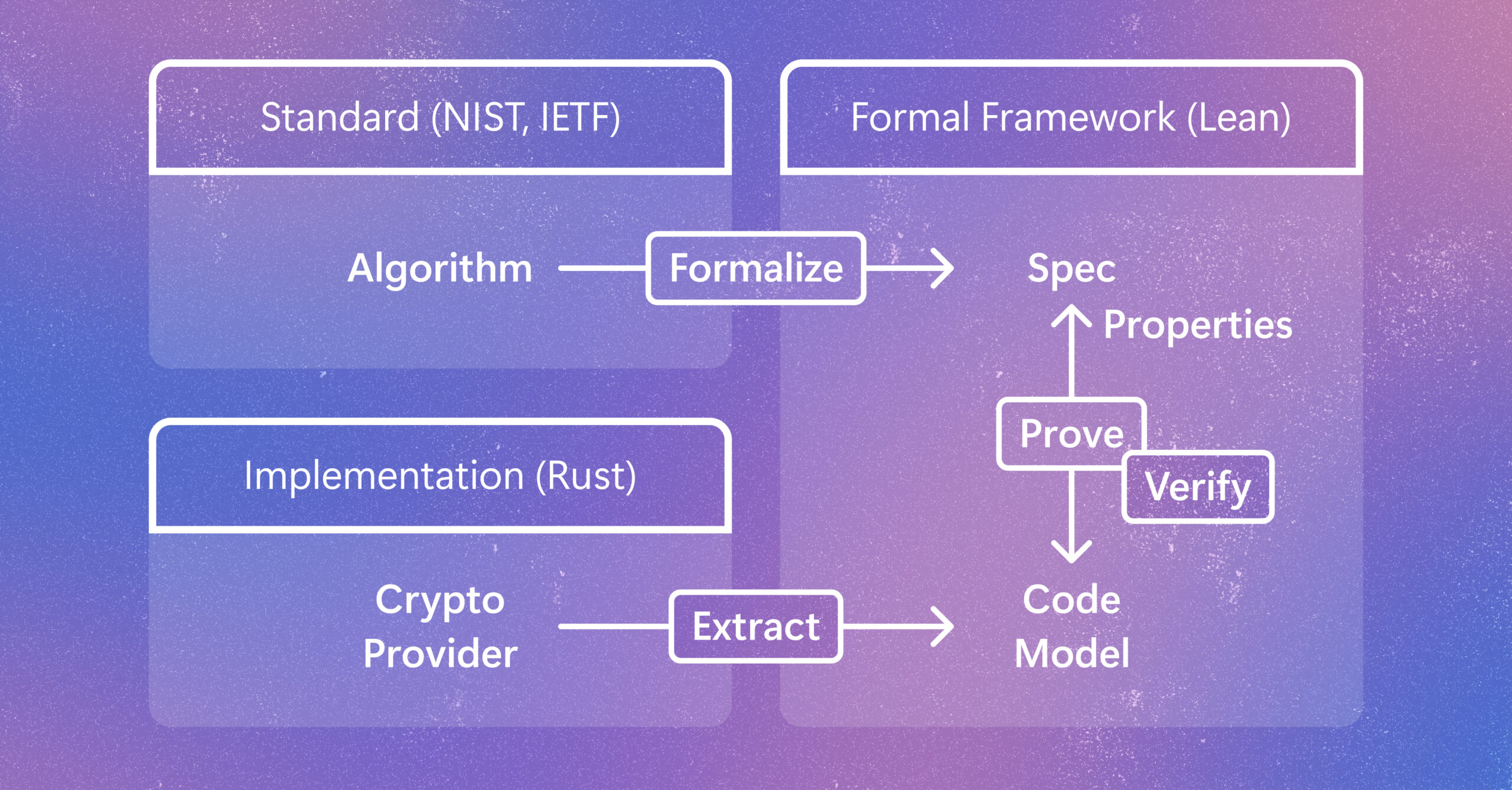
Verifying Rust cryptography in SymCrypt, from standards to code

Cryptographic code supports vital protections in modern computing systems. Learn how a new method helps verify code as developers write it while preserving speed and adaptability as it gets implemented and evolves. The post Verifying Rust cryptography in SymCrypt, from standards to code appeared first on Microsoft Research.

We use cookies to run the site and, with your consent, for analytics and to show ads. See our Cookie Policy.