Vision-Language-Action (VLA) models have recently incorporated world models to provide richer dynamic supervision beyond sparse action labels. However, explicitly predicting future images or videos may include control-irrelevant appearance, while guidance derived from holistic future visual representations and shared global action features may fail to establish timestep-specific correspondence between actions and local visual changes. To address this issue, we propose MotionWeave, a motion-centric future-dynamics framework for action-chunk prediction with two modules: the Action-Induced Motion Grounder (AIMG) and the Horizon Residual Composer (HRC). Specifically, AIMG conditions on action and proprioceptive representations to construct horizon-specific queries that localize interaction regions associated with each future action timestep from current visual tokens. HRC extracts differences between interaction representations at adjacent horizons, encodes them as temporal motion cues, and injects them into action tokens through a gated residual. During training, robot-arm masks rendered from future frames are used to construct KL-based motion-grounding supervision, while inference uses only the current observation. On six MetaWorld tasks, MotionWeave achieves a 75.3% average success rate, an absolute gain of 8.6% over {\pi}0 (66.7%), especially on sustained-interaction tasks. Our code is available at https://github.com/autu-mn/MotionWeave.
This publication proposes a definition and a classification of agile software development approaches and analyses ten software development methods that can be characterized as being "agile" against the defined criterion.
P. Abrahamsson, O. Salo, Jussi Ronkainen et al.· arXiv.org· 727 citations· ⚡54
The study shows that agile practices improve both informal and formal communication, but indicates that, in larger development situations involving multiple external stakeholders, a mismatch of adequate communication mechanisms can sometimes even hinder the communication.
M. Pikkarainen, Jukka Haikara, O. Salo et al.· Empirical Software Engineeri...· 401 citations· ⚡48
The results indicate that software engineering work practices are chosen opportunistically, adapted and configured to provide value under the constrains imposed by the startup context.
Nicolò Paternoster, Carmine Giardino, M. Unterkalmsteiner et al.· Information and Software Tec...· 394 citations· ⚡54
The possibility of inferring high-dimensional data inference in a model that consists of a prior and an auxiliary differentiable constraint given some additional information is considered, thereby allowing a range of potential applications in adapting models to new domains and tasks.
Alexandros Graikos, Esmeralda S. Whitammer, N. Jojic et al.· Neural Information Processin...· 316 citations· ⚡15
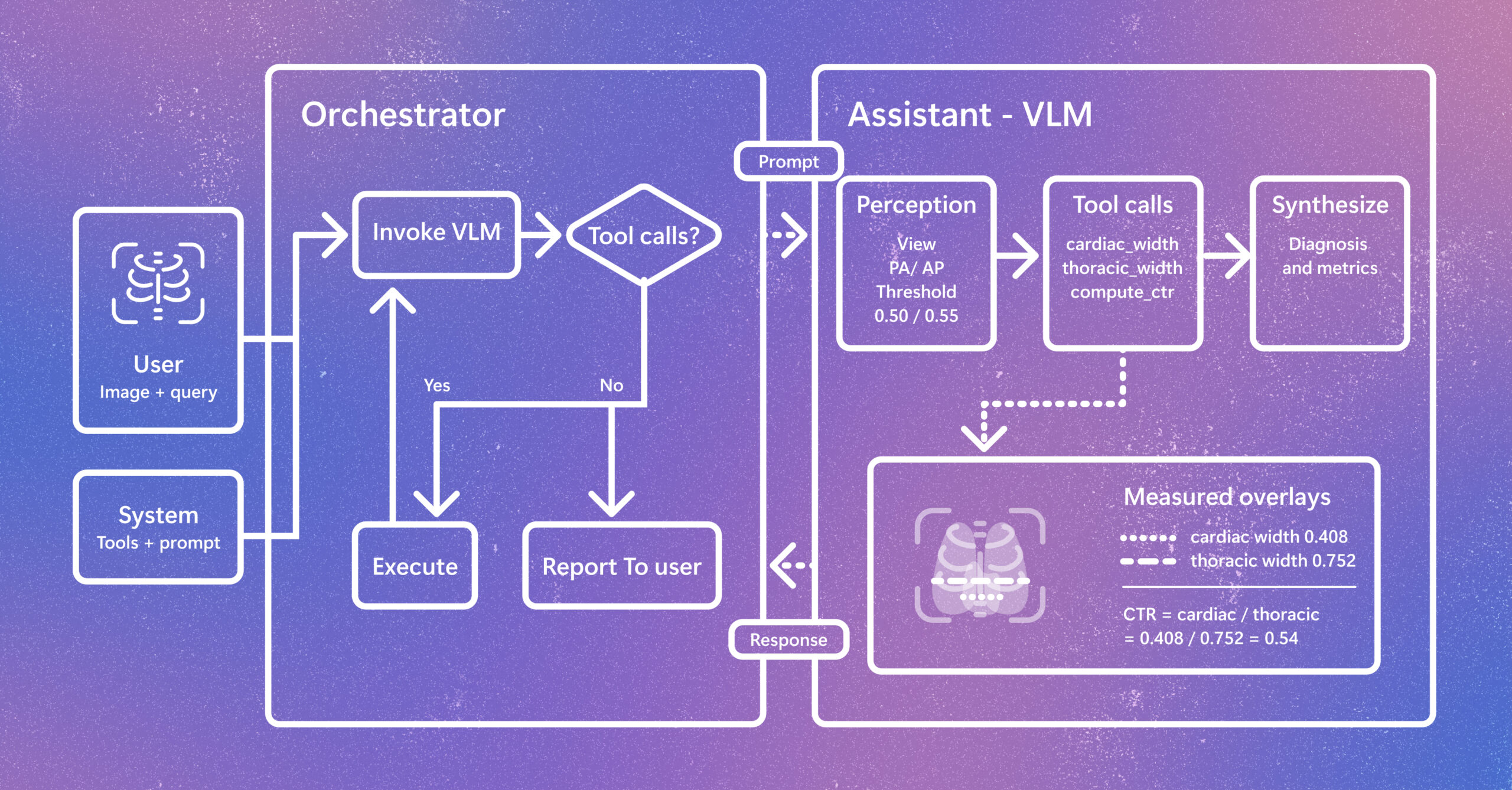
Radiology AI is evolving beyond report generation. CARE-X explores a unified approach that combines flexible reasoning, calibrated predictions, and measurement-based tools for chest X-ray interpretation. The post Introducing CARE-X: Towards Clinically Useful Radiology VLMs with Auxiliary Supervision, Reward-Aligned Learning, and Tool-Augmented Measurement appeared first on Microsoft Research.
