This paper introduces the idea of {\em magnitude potential} -- a quantity based on the theory of metric magnitude -- that reflects how well an arbitrary point is represented by a given set, and finds that this basic quantity can be applied to examine various features in neural generalization.
Abstract
Explaining generalization and training dynamics in neural networks remains a challenge, and various approaches have been developed to study different aspects of these phenomena. In this paper, we introduce the idea of {\em magnitude potential} -- a quantity based on the theory of metric magnitude -- that reflects how well an arbitrary point is represented by a given set. We find that this basic quantity can be applied to examine various features in neural generalization. The ratio between the magnitude potential with respect to a class and with respect to the entire data, computed at the logit layer, is informative of the representation of the point. In experiments, these ratios for individual training points are found to be correlated with the Feldman memorization scores. Magnitude potential ratios aggregated across points detect structural changes in the decision boundaries and provide a geometric indicator of grokking in modular arithmetic. Although the magnitude potential ratio and neural collapse are both closely associated with intra-class and inter-class geometric structure, the magnitude potential ratio remains informative even when neural collapse is explicitly suppressed.

This survey reviews the geometry, learning, and computation of superposed representations, explaining how feature statistics and decoder choice affect the conclusions and compares practical methods for recovering and analyzing features.
A broad class of neural networks trained under the $\ell^2$ loss by gradient descent with weight decay with weight decay is studied, and the convergence of GD to a neighbourhood of the global minimizers of the empirical loss is proved.
Yu-Qing Wang, I. Kevrekidis, Mikhail Belkin· 1 citation
Decoding how the brain computes with variables, such as an object's speed, encoded in populations of neurons is essential for understanding perception, decision-making, and motor control. While experiments consistently reveal correlated firing rates within these populations, the origins of these correlations are still...
A curious phenomenon called mode connectivity, the ability to connect neural networks in the loss surface, defies explanation entirely is elucidates, explains and exploits this special structure in the loss landscape.
A fruitful approach towards understanding generalization in machine learning involves characterizing how models separate generalizable structure from idiosyncratic or even corrupted features of training data. Fisher information has emerged as a diagnostic tool for this separation, leveraging loss geometry to distinguis...
Daniel T. Bernstein, Chase Goddard, L. di Carlo et al.· 0 citations
Understanding the learning-rate (LR) dependence of trained model performance is essential for better optimization of neural networks, but the appropriate size of the LR depends on learning dynamics, architecture, and their hidden biases, and thus our understanding of this complex dependence remains limited. The behavio...
Satoki Ishikawa, Rio Yokota, Ryo Karakida· 0 citations
Research Manager Mike Walker reflects on a career spanning hacker culture, cybersecurity, and AI, sharing lessons about trust, teamwork, leadership, and why solving difficult problems requires curiosity, judgment, agility—and an understanding of the rules. The post Learn the rules: The hacker mindset appeared first on Microsoft Research.
Learn how Google Antigravity and our Cheminformatics Skills accelerate drug discovery workflows, search compounds, and propose novel rigidified macrocycles.
MIT News · Artificial Intelligence· news.mit.eduOct 28, 2026
Professor Paris Smaragdis develops computers with superhuman hearing for applications like speech recognition, music understanding, and environmental monitoring.
MIT News · Artificial Intelligence· news.mit.eduOct 27, 2026
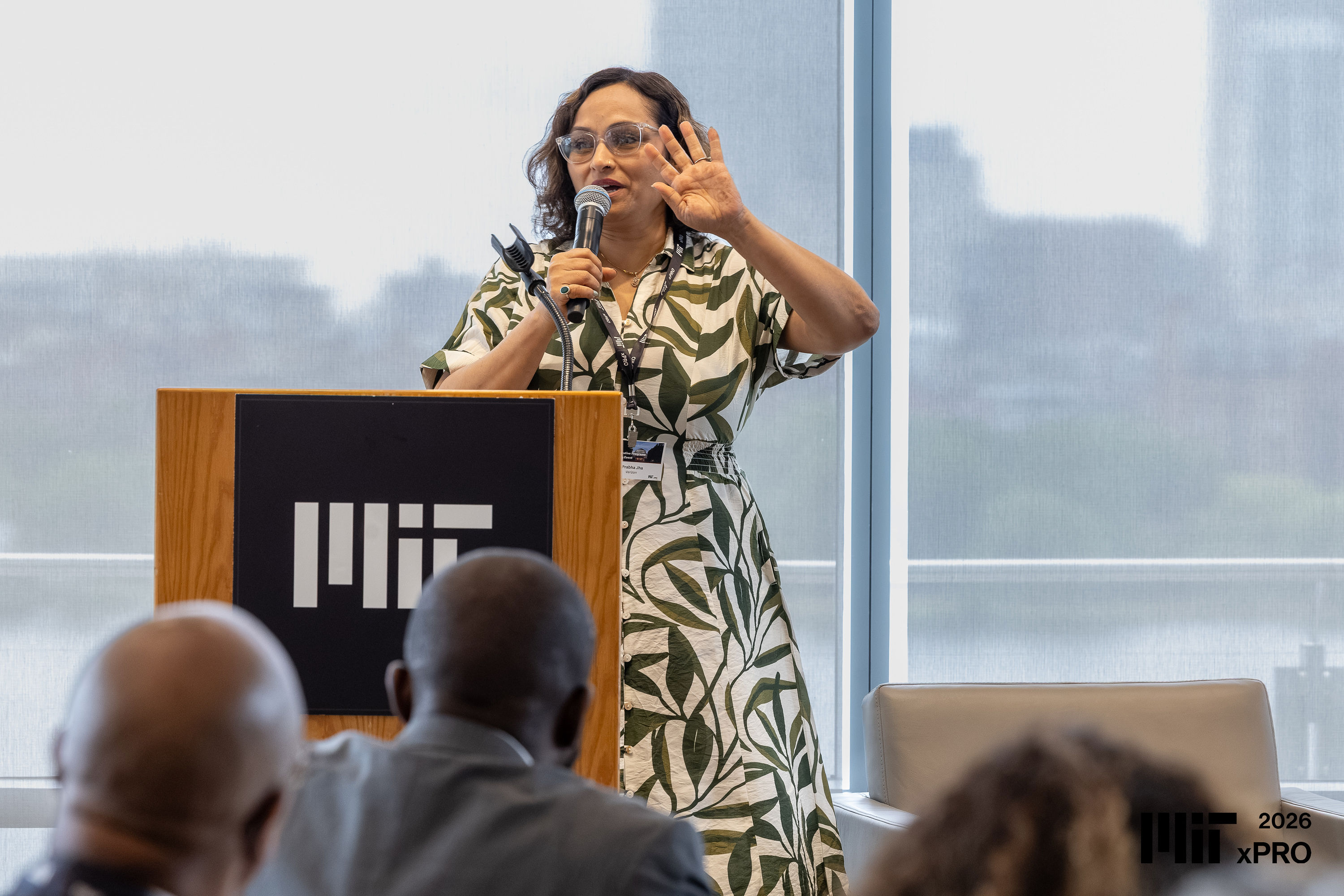
Prabha Jha used her experience with MIT Open Learning’s program for senior executives to develop AI solutions for her employer, Verizon, and to write a book.
We use cookies to run the site and, with your consent, for analytics and to show ads.
See our Cookie Policy.