Federated Continual Multimodal Learning (FedCMM), a framework that embeds continual-learning safeguards into the federated optimization loop at three complementary levels, is proposed, confirming that holistic, modality-aware optimization enables robust evolutive adaptation across heterogeneous networked AI deployments.
Abstract
Federated fine-tuning of Multimodal Large Language Models (MLLMs) across distributed networks enables privacy-sensitive adaptation to evolving data streams, yet a fundamental obstacle prevents robust deployment in dynamic environments: catastrophic forgetting, wherein sequential task updates erase previously acquired knowledge across visual, linguistic, and cross-modal representations. Addressing this challenge is especially critical for autonomous networked AI operating in safety-sensitive domains, such as content moderation, where reliable retention of prior knowledge underpins system integrity. To overcome this, we propose Federated Continual Multimodal Learning (FedCMM), a framework that embeds continual-learning safeguards into the federated optimization loop at three complementary levels. At the parameter level, modality-aware elastic weight consolidation computes separate Fisher information matrices for the vision encoder, language backbone, and cross-modal projector, providing granular, asymmetry-aware protection against modality-specific forgetting. At the data level, each client trains a lightweight local generative replay module to synthesize raw-data-free embedding-level multimodal replay tuples without any raw data sharing. At the aggregation level, Task-similarity-aware gradient aggregation autonomously filters and reweights client updates by gradient cosine similarity, suppressing conflicting directions and stabilizing the global learning trajectory. Extensive experiments on two benchmarks demonstrate that FedCMM consistently outperforms recent baselines on accuracy and backward transfer, confirming that holistic, modality-aware optimization enables robust evolutive adaptation across heterogeneous networked AI deployments.
This work proposes RAVEL-FCL, a generative replay-based framework for federated continual learning that integrates an improved generative model based on Rebooting ACGAN with multi-level feature alignment to ensure consistency and employs Elastic Variational Continual Learning on the server to probabilistically regulari...
Yurui Zhou, Jia Hu, G. Min et al.· ACM Transactions on Autonomo...· 0 citations
FedTaste is proposed, a parameter-efficient framework for topology-aware structural transfer in Multimodal Federated Learning with missing modalities that avoids explicit modality imputation while preserving shared semantic structure across clients.
Haocheng Liang, Jie Zhang, Hideya Ochiai· arXiv.org· 0 citations
FedFST is a spectral-aware framework that mitigates dual spectral forgetting in Federated Graph Continual Learning, and comprises Historical High-Frequency Knowledge Restoration to reconstruct and preserve high-frequency inconsistency knowledge, and Historical Low-Frequency Semantic Transfer to stabilize low-frequency...
Hanyao Guo, Zihan Tan, Wen-Ke Huang et al.· Proceedings of the 32nd ACM...· 0 citations
FedOGL preserves historical decision behavior through replay and task-start distillation, while protecting graph-propagation memory via projection onto a globally shared structure basis via projection onto a globally shared structure basis.
Ze-Kai Chen, Haodong Lu, Shi-Hao Li et al.· arXiv.org· 0 citations
FedADB, a Class Anchor-Driven Dual-Branch FL framework, a dual-branch collaborative training mechanism designed for clients that achieves significant improvements in both accuracy and convergence speed.
Zhenyan Liu, Hua Zhang, Haoran Gao et al.· 0 citations
FedPrism is proposed, a novel framework that shifts alignment granularity from the coarse client level to the precise instance level and devise a Posterior-Guided Performance Distillation mechanism that leverages experts' actual training loss as self-supervision to autonomously refine routing policies without explicit...
Ke Wang, Shao-Jing Fu, Yu-Chuan Luo et al.· Proceedings of the Thirty-Fi...· 0 citations
Exploring how generative AI could make machine vision more accessible to businesses. The post GenEye in a Box: Making Machine Vision Something You Can Just Ask For appeared first on GPT-Lab.
Microsoft Research Blog· microsoft.comAug 11, 2026
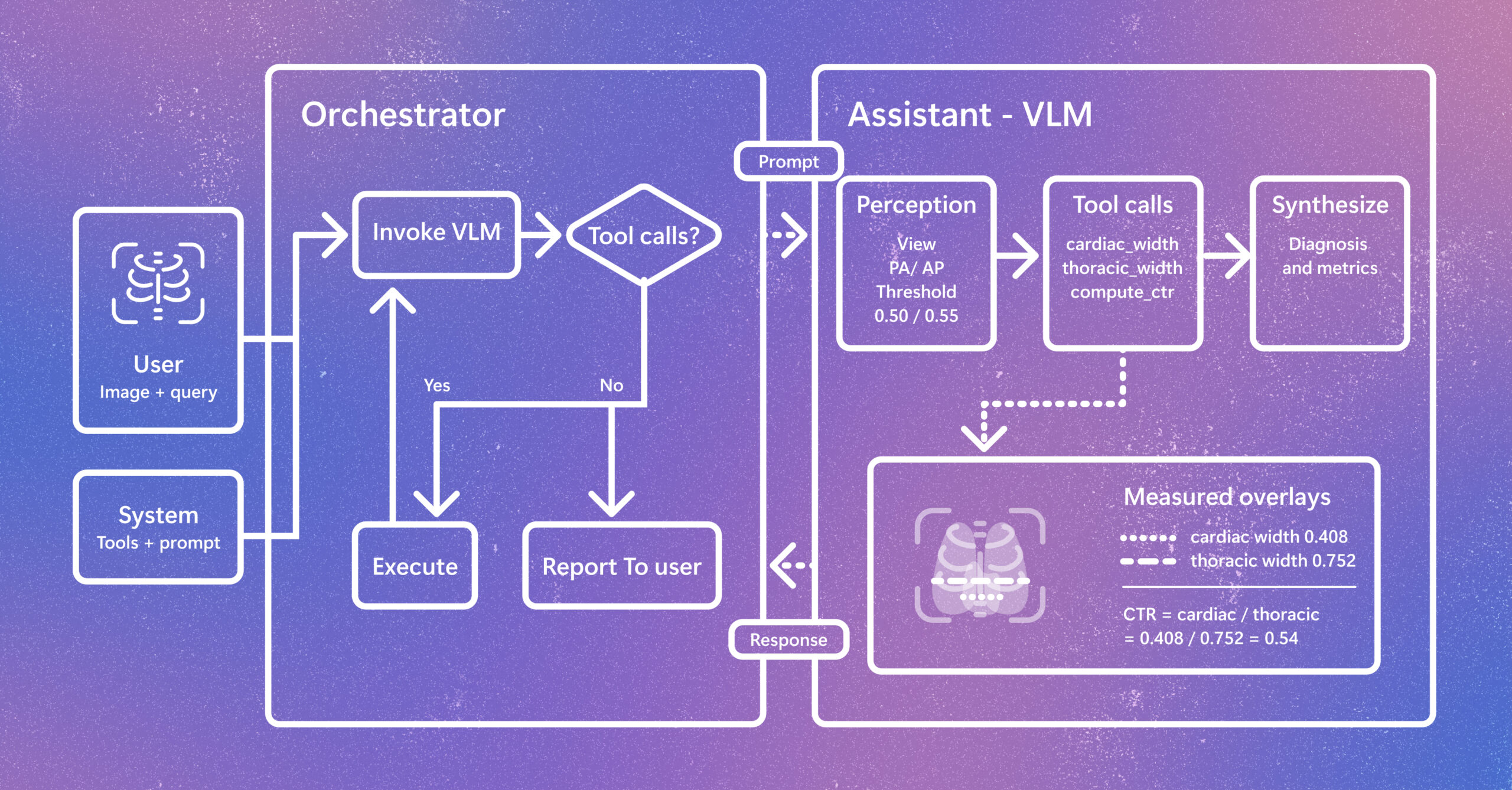
Radiology AI is evolving beyond report generation. CARE-X explores a unified approach that combines flexible reasoning, calibrated predictions, and measurement-based tools for chest X-ray interpretation. The post Introducing CARE-X: Towards Clinically Useful Radiology VLMs with Auxiliary Supervision, Reward-Aligned Learning, and Tool-Augmented Measurement appeared first on Microsoft Research.
