This work proposes Safe Variance-Adaptive Exploration (SVAE), an efficient algorithm that learns candidate safe subgraphs and performs variance-adaptive optimistic planning within them and establishes a lower bound showing that dependence on these instance-specific quantities is unavoidable.
Abstract
We study online learning in episodic tabular constrained Markov decision processes with step-wise safety constraints. In such a setting, the constraints induce a safe subgraph that shapes the variance of cumulative rewards under feasible policies and, consequently, the difficulty of learning. Exploiting this structure, however, requires learning which actions are safe while controlling constraint violations. We propose Safe Variance-Adaptive Exploration (SVAE), an efficient algorithm that learns candidate safe subgraphs and performs variance-adaptive optimistic planning within them. With high probability, SVAE achieves cumulative regret of order $\widetilde{\mathcal{O}}(\sqrt{SAH\min\{\mathbb{V}_\Sigma,K\mathrm{Var}^{\star}\}}+S\sqrt{AH^3\min\{K,\mathcal{C}\}}+S^2AH^2)$ over $K$ episodes, where $H$ is the horizon of a single episode, while $S$ and $A$ are the numbers of states and actions, respectively. Here, $\mathrm{Var}^{\star}$ is the maximum return variance among safe policies, $\mathbb{V}_\Sigma$ is the variance accumulated before the first unsafe action is encountered, and $\mathcal{C}$ captures the statistical complexity of eliminating actions incorrectly considered potentially safe. SVAE additionally attains $\widetilde{\mathcal{O}}(H\sqrt{SAK}+S^2AH^2)$ step-wise constraint violation and a gap-dependent violation bound that is polylogarithmic in $K$. Finally, we establish a lower bound showing that dependence on these instance-specific quantities is unavoidable.

We study episodic adversarial linear constrained Markov decision processes (CMDPs) with unknown transitions, where both the loss and constraint functions may vary adversarially across episodes. The best previous algorithm achieves $\widetilde{\mathcal{O}}(K^{3/4})$ regret and cumulative constraint violation, leaving a...
We study episodic constrained Markov decision processes with adversarial losses under stochastic hard constraints. Specifically, starting from a known strictly feasible policy with margin $d$, we seek to obtain optimal regret while satisfying the expected cost constraints in every episode. In this setting, Stradi et al...
We study infinite-horizon average-reward constrained Markov decision processes (CMDPs) under the weakly communicating assumption. Existing high-probability guarantees for this setting either require computationally inefficient algorithms or have suboptimal dependence on the number of interactions $T$. We propose, to th...
In multi-objective reinforcement learning, preferences may be specified only after data collection, requiring one dataset to support a continuum of reward trade-offs. We study finite discounted Markov decision processes with unknown transitions, $S$ states, $A$ actions, and $m$ known reward functions taking values in $...
We study online learning in two-player uninformed Markov games, where the opponent may follow an arbitrary, unknown policy in each episode and the learner does not observe the opponent's actions. [TWYS21] showed that achieving sublinear external regret requires an exponential dependence on the episode length $H$. Motiv...
Jun-Yan Liu, Hai-Peng Luo, Lillian J. Ratliff et al.· 0 citations
We study episodic adversarial MDPs with unknown dynamics and full-information rewards and achieve regret with leading term $\widetilde O(\sqrt{H^3SAK})$. Here $H$ is the horizon, $S$ the total number of states across decision layers, $A$ the number of actions, and $K$ the number of episodes. This improves the two incom...
Machine-learning networks can learn without detailed instructions from a designer. Those that do may offer insight into how the brain reorganizes itself during learning.
MIT News · Artificial Intelligence· news.mit.eduSep 29, 2026
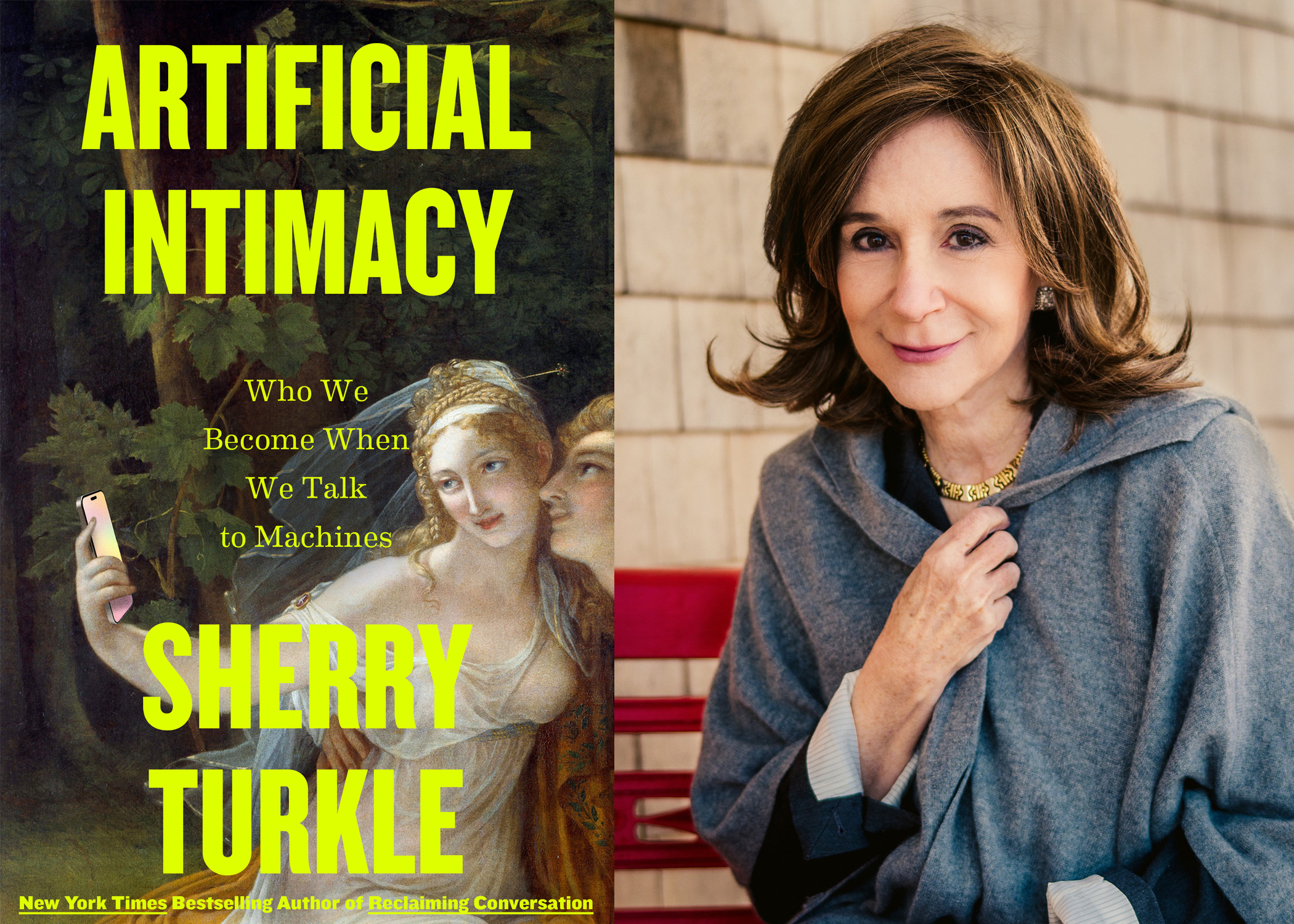
Professor Sherry Turkle’s new book, “Artificial Intimacy,” offers a withering critique of chatbots and the antisocial dynamics she believes they encourage.